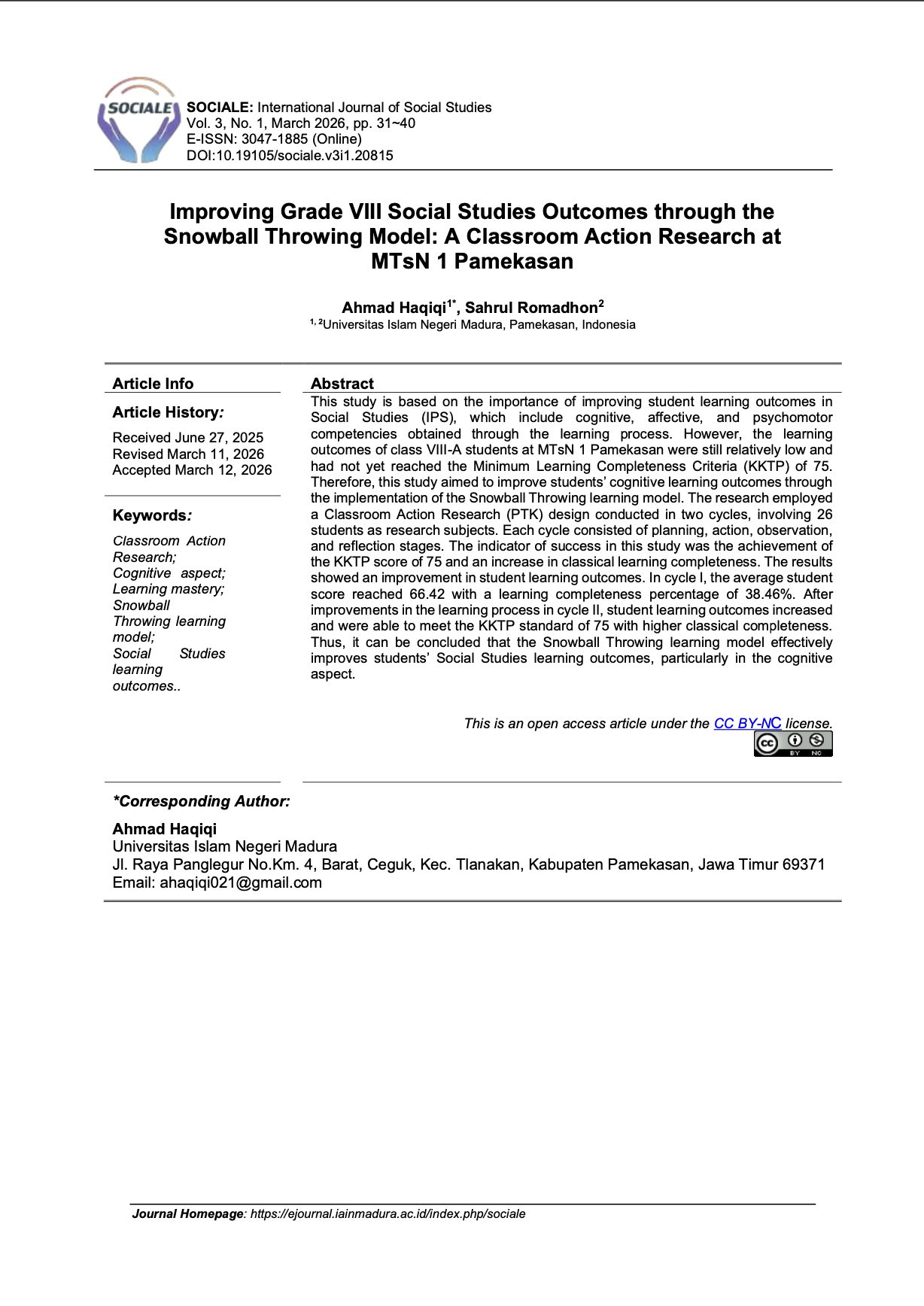
The Application of Snowball Throwing Learning Model to Improve Learning Outcomes in Social Studies Subjects for Class VIII-A
The Application of Snowball Throwing Learning Model to Improve Learning Outcomes in Social Studies Subjects for Class VIII-A

 Abstract views: 140
 PDF downloads: 121
Keywords:
Snowball Throwing model, Social Studies learning, Learning OutcomesAbstract
Learning outcomes are certain competencies or abilities achieved by students after participating in the teaching and learning process and include cognitive, affective, and psychomotor skills. Learning outcomes are related to changes in knowledge, understanding, attitudes and behavior in a person due to the learning they do. Changes caused by growth are not included in learning outcomes. This study aims to improve learning outcomes in Social Studies subjects in class VIII-A at MTsN 1 Pamekasan. The study used the Classroom Action Research (CAR) method with two cycles. The subjects of the study were 26 students. cycle 1 with an average value of 66.42 and a learning completion value of 38.46%, this shows good development when compared to before. it can be concluded that the objectives that the researcher had hoped to have achieved, namely to improve student learning outcomes in Social Studies subjects in the cognitive aspect using the snowball throwing learning model
Downloads
References
D. Shavkidinova, F. Suyunova, ir J. Kholdarova, „Pedagogi lingkungan pembelajaran yang terorganisir sendiri (SOLEs) sebagai saluran menuju keterampilan metakognitif peserta didik dan pemahaman konseptual tentang “S†dalam STEM: Studi di Afrika Selatan“, Curr. Res. J. Pedagog., t. 04, nr. 01, p. 27–34, 2023.
P. Attahakul, „Education’s Role in Creating a Sustainable and Equitable Society“, J. Asian Lang. Teach. Learn., t. 6, nr. 1, p. 81–93, 2025.
S. Althoff, K. Linde, J. Mason, N. Nagel, ir K. O’Reilly, „Learning Objectives: Posting & Communicating Daily Learning Objectives to Increase Student Achievement and Motivation.“, Online Submiss., nr. May, 2007.
A. A. Sewagegn, „Learning objective and assessment linkage: Its contribution to meaningful student learning“, Univers. J. Educ. Res., t. 8, nr. 11, p. 5044–5052, 2020, doi: 10.13189/ujer.2020.081104.
W. Naro, M. Mirnawati, S. Suarni, ir S. M. Gani, „How Aspects of Characteristic-Based Learner Development: Cognitive, Affective, and Psychomotor Aspects“, Didakt. J. Kependidikan, t. 12, nr. 1, p. 1–14, 2023, doi: 10.58230/27454312.171.
L. O. Wilson, „The Three Domains of Learning: Cognitive,Affective, and Psychomotor/Kinesthetic“, AIAA 57th Int. Astronaut. Congr. IAC 2006, t. 8, p. 5266–5275, 2006.
R. Lile ir C. Bran, „The Assessment of Learning Outcomes“, Procedia - Soc. Behav. Sci., t. 163, p. 125–131, 2014, doi: 10.1016/j.sbspro.2014.12.297.
J. W. Lin, M. H. Yen, J. C. Liang, M. H. Chiu, ir C. J. Guo, „Examining the factors that influence students’ science learning processes and their learning outcomes: 30 years of conceptual change research“, Eurasia J. Math. Sci. Technol. Educ., t. 12, nr. 9, p. 2617–2646, 2016, doi: 10.12973/eurasia.2016.000600a.
K. Bolinger ir W. Warren, „Methods Practiced in Social Studies Instruction: a review of Public School Teacher’s Strategies“, Int. J. Soc. Educ. Off. J. Indiana Counc. Soc. Stud., t. 22, nr. 1, p. 68–84, 2007.
D. Meziobi, E. Oyeoku, ir B. Ezegbe, „The Challenges of Social Studies Educators for Effective Teacher Preparation and Implementation of the Universal Basic Education Programme in Nigerian Junior Secondary Schools.“, Online Submiss., t. 11, p. 947–955, 2012.
S. De Freitas, G. Rebolledo-Mendez, F. Liarokapis, G. Magoulas, ir A. Poulovassilis, „Learning as immersive experiences: Using the four-dimensional framework for designing and evaluating immersive learning experiences in a virtual world“, Br. J. Educ. Technol., t. 41, nr. 1, p. 69–85, 2010, doi: 10.1111/j.1467-8535.2009.01024.x.
Kathleen Cotton, „SCHOOL IMPROVEMENT RESEARCH SERIES Expectations and Student Outcomes“, nr. November, 1989.
J. Mctighe ir K. O ’connor, „Seven Practices for Effective Learning // Jay McTighe and Ken O’Connor“, t. 63, nr. 3, p. 10–17, 2005.
D. Amorin-Woods, „The COVID-19 Pandemic: An Evolving Story. Professional and Personal Insights using Self and Culture as Agents of Calm and Healing after a Year of Co-habitation with Imminent Threat“, Aust. New Zeal. J. Fam. Ther., t. 42, nr. 1, p. 30–43, 2021, doi: 10.1002/anzf.1442.
R. M. Amorim, „Transforming passive listeners into active speakers: A study with portuguese undergraduates in ,English for the social sciences‘“, English Lang. Teach., t. 6, nr. 4, p. 110–119, 2013, doi: 10.5539/elt.v6n4p110.
V. D. . Miller ir M. S. Poole, „Organizational communication theory and research“, p. 641, 2024, Žiūrėta: 2024 m. spalio 23 d. [Interaktyvus]. Available at: https://www.oreilly.com/library/view/organizational-communication-theory/9783110718607/
C. J. Miller, J. McNear, ir M. J. Metz, „A comparison of traditional and engaging lecture methods in a large, professional-level course“, Am. J. Physiol. - Adv. Physiol. Educ., t. 37, nr. 4, p. 347–355, 2013, doi: 10.1152/advan.00050.2013.
T. Kabanga’ ir J. Jesika, „Optimization IPAS Learning Outcomes through the Snowball Throwing Model Based on Animated Media among Elementary School Students“, AL-ISHLAH J. Pendidik., t. 17, nr. 4, p. 7218–7226, 2025, doi: 10.35445/alishlah.v17i4.7323.
S. Irawahyuni, P. Pujiastuti, ir A. S. Nugraheni, „The Effect of Snowball Throwing Cooperative Learning Model on Student Learning Outcomes“, AL-ISHLAH J. Pendidik., t. 13, nr. 3, p. 1995–2002, 2021, doi: 10.35445/alishlah.v13i3.696.
L. Rini Idriastuti, „Application of Cooperative Learning Learning Snowball Throwing Model to Improve The Results of History Learning For Learners“, Eduvest - J. Univers. Stud., t. 1, nr. 6, p. 484–497, 2021, doi: 10.59188/eduvest.v1i6.92.
L. Muhria, „Using Cooperative Lerning Model- Snowball Throw To Improve Students English Learning Outcomes“, ELT Echo J. English Lang. Teach. Foreign Lang. Context, t. 6, nr. 2, p. 224–234, 2021, doi: 10.24235/eltecho.v6i2.9226.
M. Syamsuddin, „History Of Madura : Sejarah, Budaya, dan Ajaran Luhur Masyarakat Madura“. ŽiÅ«rÄ—ta: 2026 m. sausio 17 d. [Interaktyvus]. Available at: https://books.google.co.id/books?hl=en&lr=&id=bUHBEAAAQBAJ&oi=fnd&pg=PA3&dq=Sastra+Madura+merupakan+bagian+integral+dari+khazanah+sastra+Nusantara+yang+tumbuh+dan+berkembang+dalam+kehidupan+masyarakat+Madura+secara+turun-temurun.+Keberadaan+sastra+Madura+tidak+hanya+berfungsi+sebagai+sarana+hiburan,+tetapi+juga+sebagai+media+pewarisan+nilai-nilai+budaya,+religiusitas,+norma+sosial,+serta+pandangan+hidup+masyarakat+Madura.+Hal+ini+sejalan+dengan+pandangan+Hutomo+yang+menegaskan+bahwa+sastra+daerah,+khususnya+sastra+lisan,+merupakan+“mutiara+yang+terlupakanâ€+namun+memiliki+fungsi+penting+dalam+membentuk+identitas+budaya+masyarakat&ots=supsr5M1Hl&sig=_7WywrdiPPSWwK0lY8_IJ9CPS4U&redir_esc=y#v=onepage&q&f=false
A. Yusron, J. Irawati, Teguh Setiawan Wibowo, Husen, ir Sudadi, „The Impact of Classroom Action Research (CAR) and Innovation on Teacher Professionalism: an Intervention of Competence“, J. Inform. Ekon. Bisnis, t. 5, p. 563–570, 2023, doi: 10.37034/infeb.v5i2.594.
K. A. O. Connor, H. C. Greene, ir P. J. Anderson, „Ed494955“, 2006.
T. A. Prasetya ir C. T. Harjanto, „Tri Adi Prasetya, Chrisna Tri Harjanto 60 | VANOS“, VANOS J. Mech. Eng. Educ., t. 59, nr. 1, p. 59–66, 2020, [Interaktyvus]. Available at: http://jurnal.untirta.ac.id/index.php/vanos
S. Pozdeeva ir N. Plotnikova, „Forms of Organizing Collective Educational Activity at Primary School“, Procedia - Soc. Behav. Sci., t. 214, nr. June, p. 51–58, 2015, doi: 10.1016/j.sbspro.2015.11.592.
N. Kunlasomboon, S. Wongwanich, ir S. Suwanmonkha, „Research and Development of Classroom Action Research Process to Enhance School Learning“, Procedia - Soc. Behav. Sci., t. 171, p. 1315–1324, 2015, doi: 10.1016/j.sbspro.2015.01.248.
M. I. Assyauqi, „Model Pengembangan Borg and Gall“, Inst. Agama Islam Negeriegeri, nr. December, p. 2–8, 2020, [Interaktyvus]. Available at: https://www.taufiq.net/2019/09/model-penelitian-pengembangan-borg-and.html
K. Soe, M. Aung, ir S. Tepsuriwong, „Lesson openings : How teachers begin lessons in an English class“, Online Proc. Int. Conf. DRAL 3/19th ESEA 2017, nr. DRAL 3, p. 252–263, 2017, [Interaktyvus]. Available at: ola.kmutt.ac.th/dral2017/proceedings/5-6Additional/252-263_Lesson Openings_Khin Soe Myint Aung and Saowaluck Tepsuriwong.pdf
R. Jannah ir P. Gusti Yanti, „Pembelajaran Bahasa Indonesia Bagi Penutur Asing Menggunakan Metode Darmawisata“, Imajeri J. Pendidik. Bhs. dan Sastra Indones., t. 2, nr. 2, p. 182–189, 2020, doi: 10.22236/imajeri.v2i2.5096.