OKARA: Jurnal Bahasa dan Sastra has a zero-tolerance policy for plagiarism and unethical behavior in publishing. Authors must guarantee that their paper is of the highest standard, that attributions and citations are accurate, and that the paper is original in its entirety. The journal uses plagiarism detection on each submitted manuscript. The journal uses plagiarism-checking tools to measure similarity, with a maximum similarity of 25%, and the author will be informed of the results. All papers with any plagiarism detections will be immediately rejected.
Plagiarism may happen when an author takes ideas, information, or words either in the form of direct or indirect quotations from another source without proper credit to the source. Even when it occurs unintentionally, plagiarism is still a serious academic violation and unacceptable in international academic publications.
When the author learns specific information (a name, date, place, statistical number, or other detailed information) from a specific source, a citation is required.
If the author takes an idea from another author, he/she should cite the author's name clearly. In cases where the author develops the idea further, the author may cite one or more quotations from the original sources and then develop their own ideas in a subsequent sentence.
OKARA: Jurnal Bahasa dan Sastra takes academic integrity very seriously, and the editors reserve the right to withdraw acceptance from a paper found to violate any of the plagiarism standards above.

sidebar2
indexing
Indexed by:


_(1).png)
.png)
.png)
1.png)
.png)
template
.png) Message us on WhatsApp |
 |
.png) |
_-_Copy_-_Copy.png)  |
|
|
about
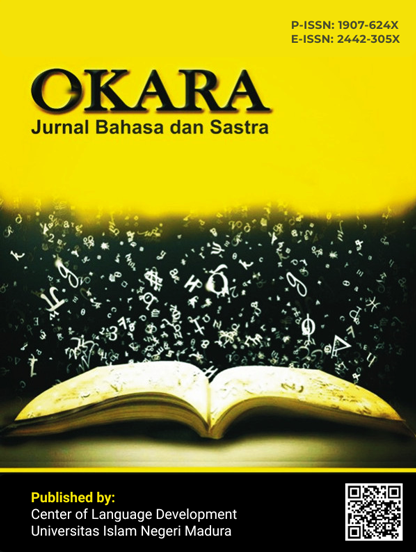
OKARA:
Jurnal Bahasa dan Sastra
Frequency: 2 issues per year
May and November
E ISSN: 2442-624X
Print ISSN: 1907-624X
OKARA: Jurnal Bahasa dan Sastra
Center of Language Development
Center of Language Development
Universitas Islam Negeri Madura - © 2026
Powered by Open Journal System 3.3.0.22

This work is licensed under a
Creative Commons Attribution-NonCommercial 4.0 International License
Creative Commons Attribution-NonCommercial 4.0 International License