Students Perceptions of the Influence of Anti-Violence Value Internalization on Prosocial Behavior in Social Studies Learning

 Abstract views: 149
 PDF downloads: 158
Keywords:
Anti-violence values, Internalization, Prosocial Behavior, Social Studies LearningAbstract
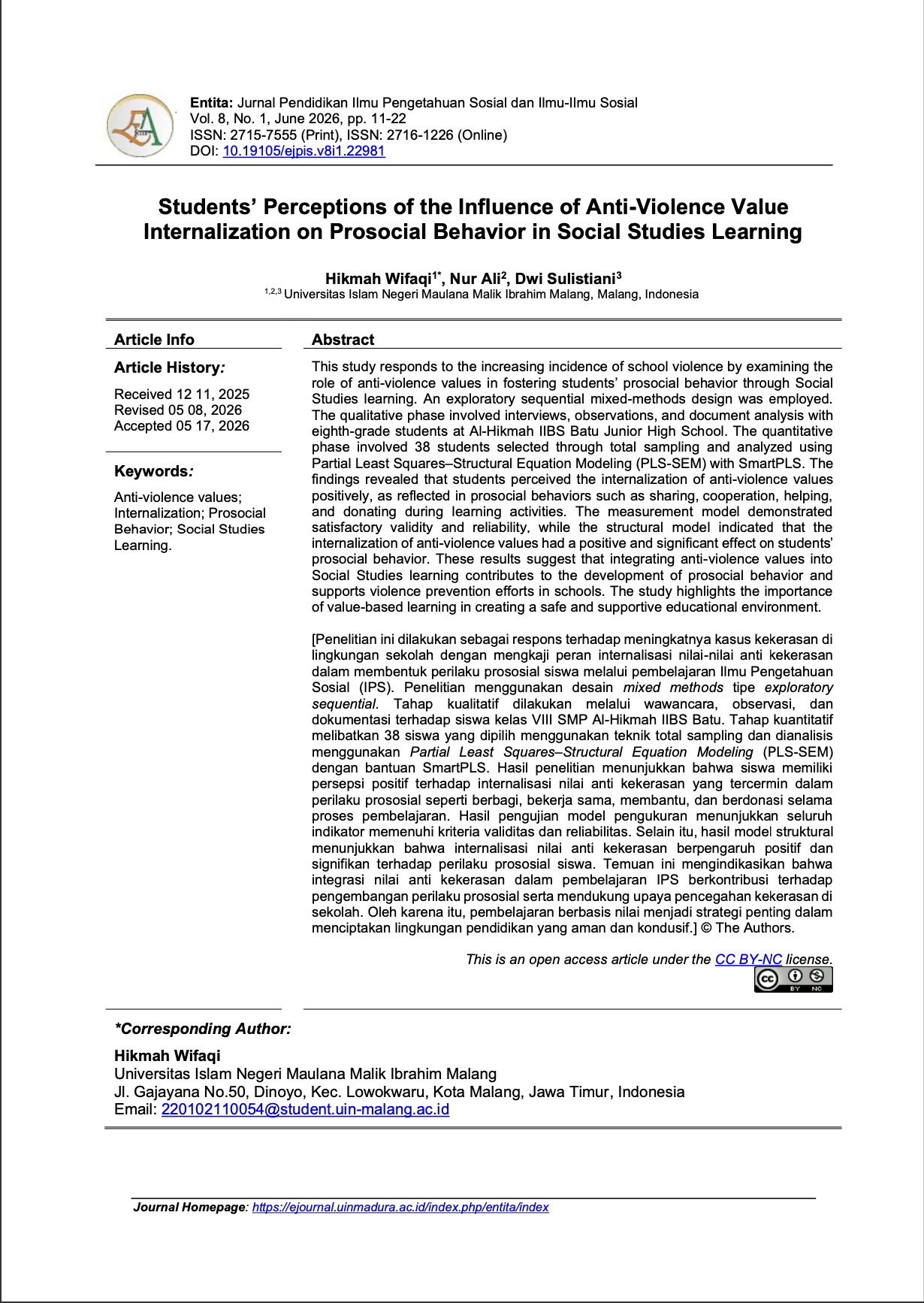
This study responds to the increasing incidence of school violence by examining the role of anti-violence values in fostering students’ prosocial behavior through Social Studies learning. An exploratory sequential mixed-methods design was employed. The qualitative phase involved interviews, observations, and document analysis with eighth-grade students at Al-Hikmah IIBS Batu Junior High School. The quantitative phase involved 38 students selected through total sampling and analyzed using Partial Least Squares–Structural Equation Modeling (PLS-SEM) with SmartPLS. The findings revealed that students perceived the internalization of anti-violence values positively, as reflected in prosocial behaviors such as sharing, cooperation, helping, and donating during learning activities. The measurement model demonstrated satisfactory validity and reliability, while the structural model indicated that the internalization of anti-violence values had a positive and significant effect on students’ prosocial behavior. These results suggest that integrating anti-violence values into Social Studies learning contributes to the development of prosocial behavior and supports violence prevention efforts in schools. The study highlights the importance of value-based learning in creating a safe and supportive educational environment.
Downloads
References
I. Uleng and A. Aderus, “Islam Ditinjau Dari Berbagai Aspek: Penggambaran Islam Yang Sebenarnya, Islam Sebagai Agama, Dan Islam Sebagai Tafsir Keagamaan,†J. Andi Djemma, vol. 8, no. 1, pp. 1–10, 2025, doi: https://doi.org/10.35914/jad.v8i1.
D. Himmawan, A. Muthi’ah, and S. Ramahdani, “Interaction between Humans as an Implementation of Hablumminannas in Realizing Tolerance Between Communities of the Same Religion and Other Religions,†Annu. J. Hum. Law, vol. 1, no. 2, pp. 68–77, 2025, doi: https://doi.org/10.63738/annujum.v1i2.10.
Syafi’i and L. Ramadhan, “Moderasi Beragama dalam Mewujudkan Islam Rahmatan Lil Alamin,†AL-AFKAR J. Islam. Stud., vol. 7, no. 3, pp. 1015–1026, 2024, doi: 10.31943/afkarjournal.v7i4.1706.Religious.
KPAI, “KPAI: Kekerasan terhadap anak di satuan pendidikan fenomena gunung es.†Accessed: Nov. 08, 2025. [Online]. Available: https://www.antaranews.com/berita/4085268/kpai-kekerasan-terhadap-anak-di-satuan-pendidikan-fenomena-gunung-es?utm_source=chatgpt.com
F. Kurniawati, A. Suprijono, and K. G. Setyawan, “Konstruksi Sosial Guru IPS Terhadap Pencegahan Tindakan Perilaku Bullying Dalam Pembelajaran Di SMP Surabaya,†vol. 5, no. 1, pp. 235–245, 2025, [Online]. Available: https://ejournal.unesa.ac.id/index.php/PENIPS/article/view/66314
A. Ginanjar, “Kontribusi pembelajaran IPS terhadap perilaku prososial,†J. Pendidik. DASAR SETIA BUDHI, vol. 1, no. 2, pp. 99–108, 2018, [Online]. Available: https://jurnal.usbr.ac.id/jpds/article/download/76/50
M. F. Tartila and L. A.-A. Aulia, “Kecerdasan Interpersonal dan Perilaku Prososial,†J. Psikol. J. Ilm. Fak. Psikol., vol. 8, pp. 53–66, 2021, [Online]. Available: https://pdfs.semanticscholar.org/5c0e/3cf583297add76fe0e5515804d8d2327334e.pdf
D. Clarke, P. Larroulet, D. Pailañir, and D. Quintana, “Schools as a Safety-net: The Impact of School Closures and Reopenings on Rates of Reporting of Violence Against Children,†2022, [Online]. Available: http://arxiv.org/abs/2206.14612
F. H. Nasution, Risnita, M. S. Jailani, and R. Junaidi, “Kombinasi (Mixed-Methods) Dalam Praktis Penelitian Ilmiah,†J. Genta Mulia, vol. 15, no. 2, pp. 251–256, 2024, [Online]. Available: https://ejournal.uncm.ac.id/index.php/gm/article/view/1145
Saparudin and K. Arizona, Metode Penelitian Campuran, 1st ed. Jakarta: PRENADA, 2022. [Online]. Available: https://repository.uinmataram.ac.id/3088/3/metpen campuran.pdf
Y. Novitasari and M. Fauziddin, “Analisis Literasi Digital Tenaga Pendidik pada Pendidikan Anak Usia Dini,†J. Obs. J. Pendidik. Anak Usia Dini, vol. 6, no. 4, pp. 3570–3577, 2022, doi: 10.31004/obsesi.v6i4.2333.
M. B. Miles, A. M. Hubernman, and J. Saldana, Qualitative Data Analysis: A Methods Sourcebook, Third Edit. United States of America: SAGE Publications, Inc., 2014. [Online]. Available: https://jurnal.peneliti.net/index.php/JIWP/article/view/7892
Suparmi and S. Sumijati, “Pelatihan Empati dan Perilaku Prososial pada Anak Usia Sekolah Dasar ( Empathy Training and Prosocial Behavior of School-Aged Children ),†PSIKODIMENSIA Kaji. Ilm. Psikol., vol. 20, no. 1, pp. 46–58, 2021, doi: 10.24167/psidim.v20i1.2879.
M. Lathifah and M. H. Khoiri, “Jenis-Jenis Perilaku Prososial Dan Faktor Yang Mempengaruhinya Pada Siswa SMP di Kota Surabaya,†Pros. Semin. Lokakarya Nas. Bimbing. dan Konseling, pp. 35–41, 2024, doi: https://doi.org/10.1234/pdabkin.v4i2.190.
M. Asrori and C. Effendy, “Developing Students ’ Prosocial Behavior Through Collaborative Teamwork Teaching,†Adv. Soc. Sci. Res. J., vol. 8, no. 7, 2021, doi: https://doi.org/10.14738/assrj.87.10602.
N. Chen, J. Zhang, and Z. Wang, “Effects of middle-aged and elderly people’s self-efficacy on health promotion behaviors: Mediating effects of sports participation,†Front. Psychol., vol. 13, no. January, pp. 1–12, 2023, doi: 10.3389/fpsyg.2022.889063.
S. Kisliuk and K. S. Wei, “Social Sciences & Humanities Open Social capital as a resource for prosocial donation behavior ? Quantitative evidence on the dark side of strategic networking,†Soc. Sci. Humanit. Open J., vol. 8, no. May, 2023, doi: 10.1016/j.ssaho.2023.100573.
I. Nonitasari, “Prosocial Behavior of Elementary School Students and Factors That Affect Them,†Pedagog. J. Islam. Elem. Schoo, vol. 3, no. 2, pp. 15–24, 2020, doi: https://doi.org/10.24256/pijies.v3i2.1661.
C. Graf, B. Suanet, P. Wiepking, and E. M. Merz, “Social Norms Offer Explanation for Inconsistent Effects of Incentives on Prosocial Behavior,†J. Econ. Behav. Organ., vol. 211, pp. 429–441, 2023, doi: 10.1016/j.jebo.2023.05.003.
D. Syafitri and Taufik, “Hubungan Kecerdasan Emosional Dengan Perilaku Prososial Siswa,†DE_JOURNAL (Dharmas Educ. Journal), vol. 5, no. 2, pp. 1204–1212, 2024, doi: https://doi.org/10.56667/dejournal.v5i2.1634.
H. Setiabudhi, Suwono, Y. A. Setiawan, and S. Karim, Analisis Data Kuantitatif dengan Smart PLS 4. Balikpapan: Borneo Novelty Publishing, 2025.
S. Yarsasi, I. Tahyudin, and T. Hariguna, “Analisis Validitas dan Reliabilitas Kuesioner dengan Metode Partial Least Squares Structural Equation Modeling pada Aplikasi SMARTPLS Analysis of Validity and Reliability of Questionnaires Using Partial Least Squares Structural Equation Modeling Method on,†J. Pendidik. dan Teknol. Indones., vol. 5, no. 7, pp. 1905–1913, 2025, doi: https://doi.org/10.52436/1.jpti.885.
E. Yamamura, Y. Tsutsui, and F. Ohtake, “The effect of primary school education on preventive behaviours during COVID-19 in Japan,†sustainability, vol. 15, no. 11, pp. 376–382, 2023, doi: 10.3390/su15118655.
S. A. Prihatina, Sukarno, and Triyanto, “Internalizing The Social Care Value Of Elementary School Students Through Character Education,†Qalamuna - J. Pendidikan, Sos. dan Agama, vol. 1, no. 2, pp. 509–524, 2022, doi: 10.37680/qalamuna.v14i2.3417.
T. Heryadi and A. Nursobah, “Internalisasi Nilai-Nilai Pendidikan Karakter Di Sekolah Pada Peserta Didik Jurusan Tbsm Melalui Keteladanan Dan Pembiasaan Guru Pai,†Khazanah Pendidik. Islam, vol. 3, no. 2, pp. 63–81, 2021, doi: 10.15575/kp.v3i2.
Downloads
Published
How to Cite
Issue
Section
License
Copyright (c) 2026 Hikmah Wifaqi, Nur Ali, Dwi Sulistiani

This work is licensed under a Creative Commons Attribution-NonCommercial 4.0 International License.
License
Copyright (c) 2025 Authors
This is an open access article under the CC BY-NC license.