Strengthening the literacy and numeracy culture among Madurese language teachers through the Pakem Maddhu community empowerment program

 Abstract views: 147
 PDF downloads: 128
Keywords:
community empowerment, literacy culture, local culture, Madurese language teachers, participatory action researchAbstract
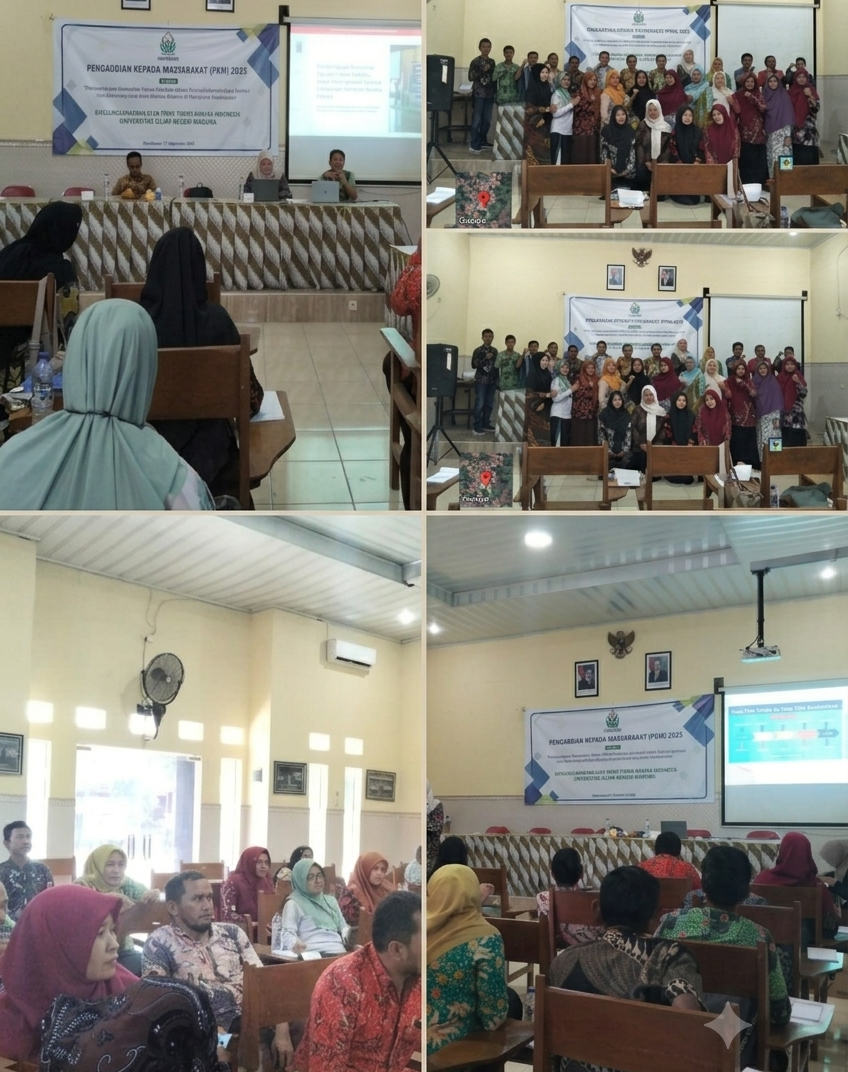
Madurese language education faces two major challenges: declining intergenerational language transmission and limited integration of literacy and numeracy into classroom practice. A preliminary needs assessment in three partner schools in Pamekasan Regency identified low teacher competency, limited contextual teaching resources, weak student engagement, and minimal utilization of local cultural assets in learning. To address these challenges, this community engagement program adopted a Participatory Action Research (PAR) approach involving 20 Madurese language teachers, school leaders, researchers, and the Pakem Maddhu community. The program was conducted through four interactive cycles: (1) participatory problem identification and asset mapping; (2) collaborative planning and capacity building; (3) classroom implementation with mentoring and observation; and (4) reflective evaluation to improve teaching practices and learning resources. Local cultural assets, including paribasan, pantun, tembang macapat, and Madurese batik motifs, were integrated into literacy- and numeracy-based learning activities. Program evaluation, using competency tests, questionnaires, classroom observations, and reflective discussions, demonstrated substantial improvements in teacher competency (52.0 to 78.3; p < .001), increased teacher confidence in using digital learning media (85%), and higher student interest in Madurese language learning (38.6% to 72.4%; p = .004). Beyond improving instructional competence, the program strengthened collaboration among teachers, schools, and the local community, resulting in contextual teaching modules, lesson plans, digital learning resources, and a sustainable professional learning network. The program contributes a replicable, community-based empowerment model that integrates Participatory Action Research, local cultural assets, literacy and numeracy integration, and teacher professional development for regional language education.
Downloads
References
Alatas, M. A., Purnomo, A., Putikadyanto, A., & Nur, A. (2025). Transformasi edu literasi melalui novel anak: Integrasi SDGs dan pembentukan pola pikir sistemik dalam pendidikan guru. Entita: Jurnal Pendidikan Ilmu Pengetahuan Sosial dan Ilmu-Ilmu Sosial, 813. https://doi.org/10.19105/ejpis.v1i.19118
Anderson-Butcher, D., Bates, S., Lawson, H. A., Childs, T. M., & Iachini, A. L. (2022). The community collaboration model for school improvement: A scoping review. Education Sciences, 12(12), 918. https://doi.org/10.3390/educsci12120918
Cockerham, D. (2024). Participatory action research: Building understanding, dialogue, and positive actions in a changing digital environment. Educational Technology Research and Development, 72, 2763–2791. https://doi.org/10.1007/s11423-023-10294-1
Effendy, M. H., Hadi, S., Azizah, S., Alatas, M. A., & Dzhelilov, A. A. (2026). Cultural Identity Stereotypes of Madurese Women in Traditional Expressions. 12, 104–118.
Falloon, G. (2020). From digital literacy to digital competence: The teacher digital competency (TDC) framework. Educational Technology Research and Development, 68(5), 2449–2472. https://doi.org/10.1007/s11423-020-09767-4
Geiger, V., Forgasz, H., Gal, I., Hagena, M., & Venkatasubramanian, N. (2023). Numeracy across the curriculum: Research-based strategies for enhancing teaching and learning. In B. Atweh et al. (Eds.), Numeracy and mathematics education: Perspectives and practices (pp. 39–67). Springer. https://doi.org/10.1007/978-981-99-5786-2_3
Glynn, S. M., & Winter, L. K. (2004). Contextual teaching and learning of science in elementary schools. Journal of Elementary Science Education, 16(2), 51–63. https://doi.org/10.1007/BF02693477
Gonçalves, L. L., Parker, M., Luguetti, C., & Carbinatto, M. (2022). The facilitator’s role in supporting physical education teachers’ empowerment in a professional learning community. Sport, Education and Society, 27(3), 272–285. https://doi.org/10.1080/13573322.2020.1825371
Hake, R. R. (1998). Interactive-engagement versus traditional methods: A six-thousand-student survey of mechanics test data for introductory physics courses. American Journal of Physics, 66(1), 64–74. https://doi.org/10.1119/1.18809
Knowles, M. S., Holton, E. F., III, & Swanson, R. A. (2015). The adult learner: The definitive classic in adult education and human resource development (8th ed.). Routledge. https://doi.org/10.4324/9781315816951
Ladson-Billings, G. (2021). Culturally relevant pedagogy: Asking a different question. Teachers College Press.
Miles, M. B., Huberman, A. M., & Saldaña, J. (2014). Qualitative data analysis: A methods sourcebook (3rd ed.). Sage.
Nasir, M., & Sutiah, S. (2025). Strengthening communities of practice through the Bintang innovation program: Literacy and numeracy tutoring based on culturally responsive digital literacy media and platforms. Transformasi: Jurnal Pengabdian Masyarakat, 21(1), 1–18. https://doi.org/10.20414/transformasi.v21i1.14077
Ningrum, D. P., Laksono, K., & Mintowati, M. (2022). Developing numeracy module based on local culture in Indonesia. Jurnal Elemen, 9(1), 243–260. https://doi.org/10.29408/jel.v9i1.6883
OECD. (2023). PISA 2022 results (Volume I): The state of learning and equity in education. OECD Publishing. https://doi.org/10.1787/53f23881-en
Perkins, D. D., & Zimmerman, M. A. (1995). Empowerment theory, research, and application. American Journal of Community Psychology, 23(5), 569–579. https://doi.org/10.1007/BF02506982
Rachmadtullah, R., Prasetyo, T., Humaira, M. A., Sari, D. A., Samsudin, A., Nurtanto, M., ZamZam, R., Rofiah, N. H., Minsih, M., Rasmitadila, R., & Ou, Y. (2025). Professional development for Indonesian elementary school teachers: Increased competency and sustainable teacher development programs. F1000Research, 13, 1474. https://doi.org/10.12688/f1000research.156946.3
Ramdani, E. (2021). Model pembelajaran kontekstual berbasis kearifan lokal sebagai penguatan pendidikan karakter [Contextual learning model based on local wisdom as strengthening character education]. JUPIIS: Jurnal Pendidikan Ilmu-Ilmu Sosial, 10(1), 1–10. https://doi.org/10.24114/jupiis.v10i1.8264
Revina, S., Pramana, R. P., Bjork, C., & Suryadarma, D. (2023). Replacing the old with the new: Long-term issues of teacher professional development reforms in Indonesia. Asian Education and Development Studies, 12(4/5), 262–274. https://doi.org/10.1108/AEDS-12-2022-0148
Romadhon, S., Alatas, M. A., & Diningrum, S. D. (2025). Pelatihan pembuatan media pembelajaran sastra Madura dengan Artificial Intelligence (AI) pada guru Madrasah Ibtidaiyah di Kabupaten Pamekasan. PERDIKAN (Journal of Community Engagement), 7(1), 27–39. https://doi.org/https://doi.org/10.19105/pjce.v7i1.18401
Sunzuma, G., & Umbara, U. (2025). Ethnomathematics-based technology in Indonesia: A systematic review. Asian Journal for Mathematics Education, 4(1), 129–153. https://doi.org/10.1177/27527263241305812
Wibowo, A. P., & Wahyudi, A. B. (2022). Revitalisasi bahasa daerah sebagai media pendidikan di era digital [Revitalization of regional languages as educational media in the digital era]. Jurnal Pendidikan dan Kebudayaan, 7(2), 145–162. https://doi.org/10.24832/jpnk.v7i2.2904
Zimmerman, M. A. (1995). Psychological empowerment: Issues and illustrations. American Journal of Community Psychology, 23(5), 581–599. https://doi.org/10.1007/BF02506983
Downloads
Published
Issue
Section
License
Copyright (c) 2026 PERDIKAN (Journal of Community Engagement)

This work is licensed under a Creative Commons Attribution-NonCommercial 4.0 International License.
In order for PERDIKAN to publish and disseminate research articles, we need publishing rights. This is determined by a publishing agreement between the author and PERDIKAN. This agreement deals with the transfer or license of the copyright to PERDIKAN and authors retain significant rights to use and share their own published articles. For both subscription and open access articles, published in proprietary titles, PERDIKAN is granted the following rights:
- The right to provide the article in all forms and media so the article can be used on the latest technology even after publication.
- The authority to enforce the rights in the article, on behalf of an author, against third parties, for example in the case of plagiarism or copyright infringement.
Copyright aims to protect the specific way the article has been written to describe an experiment and the results. PERDIKAN is committed to its authors to protect and defend their work and their reputation and takes allegations of infringement, plagiarism, ethic disputes and fraud very seriously.
If an author becomes aware of a possible plagiarism, fraud or infringement we recommend contacting their PERDIKAN publishing contact who can then liaise with our in-house legal department. Note that certain open access user licenses may permit
1.png)