Strengthening local aquaculture management in a group of Vannamei shrimp farmers through an MQTT-based early warning system for water quality monitoring

 Abstract views: 258
 PDF downloads: 169
Keywords:
Early Warning System, Internet of Things, MQTT, Vannamei Shrimp Farming, water quality monitoringAbstract
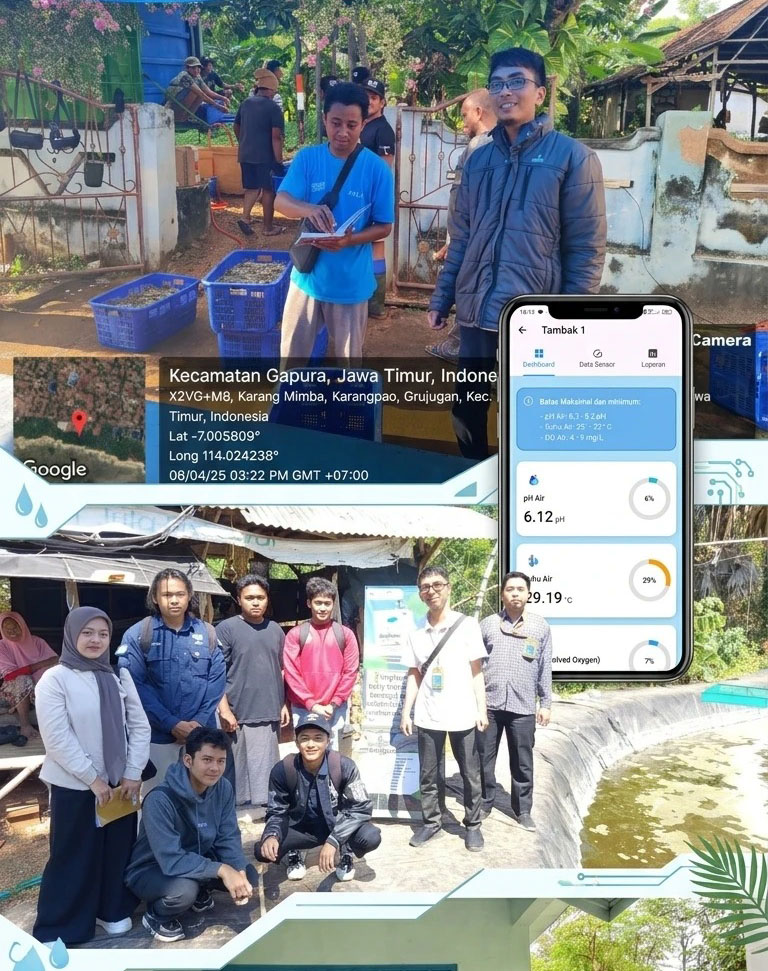
Vannamei shrimp farming is an important source of livelihood and local food production for coastal communities, yet its productivity is highly sensitive to rapid fluctuations in pond water quality. In many small-scale and group-based ponds, monitoring is still conducted manually and intermittently, leading to delayed corrective actions and avoidable production losses. This community engagement program aimed to strengthen local aquaculture management in the Jaring Emas Vannamei shrimp farmer group in Sumenep Regency, Indonesia, through the implementation of an Internet of Things (IoT)-based Early Warning System (EWS) for real-time water quality monitoring. The program was carried out using a participatory and practice-based approach that actively involved the partner group throughout the process, from problem identification and solution design to system installation, practical training, and ongoing assistance. The intervention introduced three ESP32-based IoT nodes equipped with pH, temperature, and dissolved oxygen (DO) sensors, supported by an MQTT communication server and integrated web and mobile applications that provided real-time dashboards, early warning alerts, and more systematic records for feeding and harvesting activities. The evaluation examined system operability, continuity of monitoring, and changes in partners’ operational practices. The findings showed that the system operated continuously and enabled real-time monitoring through both web and mobile access. The partners were increasingly able to interpret data trends, understand alerts, and use this information to take corrective actions, such as adjusting aeration when DO levels declined. Operational record-keeping also became more systematic, while harvest data indicated improved outcomes after system adoption: yields increased from approximately 830–880 kg per pond with grade B quality to approximately 1,190–1,220 kg per pond with grade A quality. Overall, the program strengthened not only technical monitoring capacity but also more preventive, responsive, and data-informed pond management practices at the community level. Future programs should strengthen post-deployment mentoring and develop simple recommendations based on historical data to support sustained adoption and broader impact.
Downloads
References
Adila Novianti, F., Nursetiawan, I., Sobari, M., & Risnawati, R. (2024). Pemberdayaan kelompok tani dalam pemanfaatan teknologi tepat guna untuk meningkatkan produktivitas pertanian di Desa Sukajadi Kecamatan Sadananya. Manfaat: Jurnal Pengabdian pada Masyarakat Indonesia, 1(3), 52–59. https://doi.org/10.62951/manfaat.v1i3.83.
Ahmed, F., Bijoy, M. H. I., Hemal, H. R., & Noori, S. R. H. (2024). Smart aquaculture analytics: Enhancing shrimp farming in Bangladesh through real-time IoT monitoring and predictive machine learning analysis. Heliyon, 10(17), e37330. https://doi.org/10.1016/j.heliyon.2024.e37330
Albab, M. A. U., Sabdaningsih, A., & Prakoso, K. (2025). Pengaruh kualitas air terhadap laju pertumbuhan udang vaname (Penaeus vannamei Boone, 1931). Management of Aquatic Resources Journal (MAQUARES), 12(1), 53–63. https://doi.org/10.14710/MARJ.V12I1.48589
Amirkhanov, B., Amirkhanova, G., Kunelbayev, M., Adilzhanova, S., & Tokhtassyn, M. (2025). Evaluating HTTP, MQTT over TCP and MQTT over WEBSOCKET for digital twin applications: A comparative analysis on latency, stability, and integration. International Journal of Innovative Research and Scientific Studies, 8(1), 679–694. https://doi.org/10.53894/IJIRSS.V8I1.4414
Cho, Y., & Noh, S. Do. (2024). Design and implementation of digital twin factory synchronized in real-time using MQTT. Machines 2024, Vol. 12, Page 759, 12(11), 759. https://doi.org/10.3390/MACHINES12110759
D’ortona, C., Tarchi, D., & Raffaelli, C. (2022). Open-source MQTT-based end-to-end IoT system for smart city scenarios. Future Internet 2022, Vol. 14, Page 57, 14(2), 57. https://doi.org/10.3390/FI14020057
Dwi, D., Wati, F., Murwaningsih, T., & Sukmawati, F. (2024). Inovasi pembelajaran berbasis video tutorial: Optimalisasi keterampilan administrasi Pemberdayaan Kesejahteraan Keluarga (PKK). JIIP - Jurnal Ilmiah Ilmu Pendidikan, 7(2), 1301–1307. https://doi.org/10.54371/JIIP.V7I2.3350
Habil Cahaya Gusti, M., Rifaldi, M., Oktaviani, S., Hidayat, J., Firdaus, F., Bragi Muslim, A., Setiawan, E., Wardoyo, S., & Vokasional Teknik Elektro, P. (2025). Diseminasi teknologi tepat guna berbasis lingkungan untuk mitigasi hama burung dan ketahanan pertanian di Desa Pakuluran, Kabupaten Pandeglang / dissemination of eco-friendly appropriate technology for bird pest mitigation and agricultural resilience in Pakuluran Village, Pandeglang, Indonesia. Darma Diksani: Jurnal Pengabdian Ilmu Pendidikan, Sosial, dan Humaniora, 5(1), 229–239. https://doi.org/10.29303/DARMADIKSANI.V5I1.7296
Hari, N. H., & Darmawan, I. (2023). Sistem pengontrol suhu pada kandang brooding dengan logika fuzzy menggunakan Arduino Uno berbasis mobile. JURNAL RESPONSIF, 5(1), 43–51. https://ejurnal.ars.ac.id/index.php/jti
Herrera, V. A. S., de Araújo, H. P., Penteado, C. G., Gazziro, M., & Carmo, J. P. (2025). Low-cost embedded system applications for smart cities. Big Data and Cognitive Computing 2025, Vol. 9, Page 19, 9(2), 19. https://doi.org/10.3390/BDCC9020019
Mohd Jais, N. A., Abdullah, A. F., Mohd Kassim, M. S., Abd Karim, M. M., M, A., & Muhadi, N. ‘Atirah. (2024). Improved accuracy in IoT-Based water quality monitoring for aquaculture tanks using low-cost sensors: Asian seabass fish farming. Heliyon, 10(8), e29022. https://doi.org/10.1016/j.heliyon.2024.e29022
Ningsih, D. S. (2024). Pengembangan program pemberdayaan masyarakat berbasis teknologi di Desa Wukirsari Cangkringan Sleman. MUJAHADA: Jurnal Pengabdian Masyarakat, 2(2), 56–73. https://doi.org/10.54396/MJD.V2I2.1655
Nurlaili, N., Suryati, S., Murtadhahadi, M., & Nasri, N. (2025). Perancangan sistem kontrol kualitas air pada budidaya udang vaname dengan menggunakan aktuator untuk regulasi air dan aerasi udara. Prosiding Seminar Nasional Politeknik Negeri Lhokseumawe, 8(1), 113–121. https://e-jurnal.pnl.ac.id/semnaspnl/article/view/6757
Pinandhita, F., & Susanto, D. A. (2025). PKM pelatihan how to start business in digital era bagi pelaku bisnis di Madiun. Indonesian Journal of Empowerment, Service, and Training, 1(2), 168–179. https://ijest.id/index.php/ijest/article/view/26
Putri, D. R. D., & Tjenreng, M. B. Z. (2025). Strategi inovatif dalam pelayanan publik: Mengintegrasikan teknologi untuk responsivitas yang lebih baik. Jurnal PKM Manajemen Bisnis, 5(1), 354–364. https://doi.org/10.37481/PKMB.V5I1.1315
Putro, G. S., Arfiany, A., & Yasni, Y. (2024). Analisis dampak sosial dari implementasi program pengabdian berbasis teknologi di pedesaan. ABDI DAYA: Jurnal Pengabdian dan Pemberdayaan Masyarakat, 2(1), 1–13. https://doi.org/10.52421/ABDIDAYA.V2I1.555
Rachmatsyah, T. H. (2025). Pemberdayaan masyarakat berbasis teknologi untuk optimalisasi UMKM sebagai pilar utama ekonomi Indonesia. ABDI MOESTOPO: Jurnal Pengabdian pada Masyarakat, 8(1), 164–173. https://doi.org/10.32509/ABDIMOESTOPO.V8I1.4733
Rachmatullah, S., Hari, N. H., Matsaini, M., & Rachman, A. F. (2023). Sistem informasi manajemen pakan dan monitoring kualitas air tambak pada budidaya udang vaname berbasis web. ILKOMNIKA, 5(1), 84–95. https://doi.org/10.28926/ILKOMNIKA.V5I1.541
Satra, R., Hadi, M. S., Sujito, Febryan, Fattah, M. H., & Busaeri, S. R. (2024). IoAT: Internet of aquaculture things for monitoring water temperature in tiger shrimp ponds with DS18B20 sensors and WeMos D1 R2. Journal of Robotics and Control (JRC), 5(1), 62–71. https://doi.org/10.18196/JRC.V5I1.18470
Selvester Thadeus, M., Susantiningsih, T., Simanjuntak, K., Yuliyanti, R., & Citrawati, M. (2023). Pelatihan cuci tangan pakai sabun (CTPS) untuk pencegahan dan pengendalian infeksi diare dan typhoid anak di Desa Pangkalan Jati, Cinere, Depok. SEGARA: Jurnal Pengabdian Kepada Masyarakat, 1(1), 20–27. https://doi.org/10.33533/SEGARA.V1I1.6102
Shete, R. P., Bongale, A. M., & Dharrao, D. (2024). IoT-enabled effective real-time water quality monitoring method for aquaculture. MethodsX, 13, 102906. https://doi.org/10.1016/J.MEX.2024.102906
Sonjaya, Y., Noy, I. R., Sutisna, E., Ermawati, Y., & Khotimah, K. (2025). Evaluasi dampak pengabdian masyarakat berbasis kearifan lokal. Celebes Journal of Community Services, 4(2), 266–284. https://doi.org/10.37531/CELEB.V4I2.2930
Supriyono, S., & Bahruddin, U. (2024). Pengembangan smart village melalui digitalisasi dan pemberdayaan masyarakat Kota Batu menggunakan metode participatory action research. Prosiding Seminar Nasional Teknologi dan Sistem Informasi, 4(1), 504–516. https://doi.org/10.33005/SITASI.V4I1.890
Yulian, J., Adi, S. A., & Rachmi, I. S. (2022). Pendekatan partisipatif dalam program Bahari Sembilang Mandiri sebagai upaya peningkatan inisiatif lokal. Jurnal Locus Penelitian dan Pengabdian, 1(10), 496–504. https://doi.org/10.58344/LOCUS.V1I7.168
Downloads
Published
Issue
Section
License
Copyright (c) 2026 PERDIKAN (Journal of Community Engagement)

This work is licensed under a Creative Commons Attribution-NonCommercial 4.0 International License.
In order for PERDIKAN to publish and disseminate research articles, we need publishing rights. This is determined by a publishing agreement between the author and PERDIKAN. This agreement deals with the transfer or license of the copyright to PERDIKAN and authors retain significant rights to use and share their own published articles. For both subscription and open access articles, published in proprietary titles, PERDIKAN is granted the following rights:
- The right to provide the article in all forms and media so the article can be used on the latest technology even after publication.
- The authority to enforce the rights in the article, on behalf of an author, against third parties, for example in the case of plagiarism or copyright infringement.
Copyright aims to protect the specific way the article has been written to describe an experiment and the results. PERDIKAN is committed to its authors to protect and defend their work and their reputation and takes allegations of infringement, plagiarism, ethic disputes and fraud very seriously.
If an author becomes aware of a possible plagiarism, fraud or infringement we recommend contacting their PERDIKAN publishing contact who can then liaise with our in-house legal department. Note that certain open access user licenses may permit
1.png)