Strengthening household financial resilience through financial management training for women tobacco warehouse workers in Blumbungan Village, Pamekasan Regency

 Abstract views: 126
 PDF downloads: 134
Keywords:
financial literacy, female workers, household financial management, women empowermentAbstract
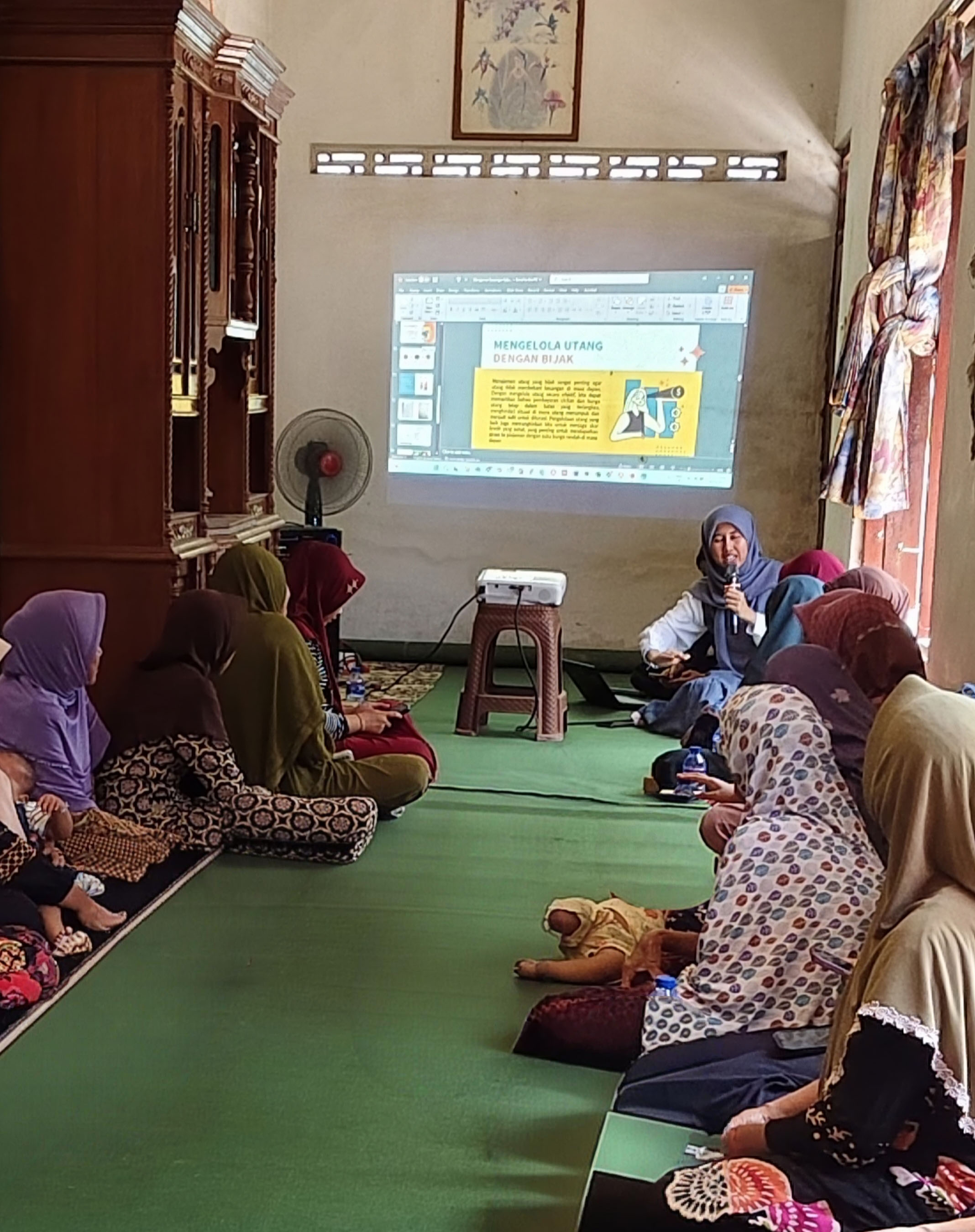
The level of financial literacy among rural communities, particularly women working in the informal sector, remains relatively low, affecting household economic resilience. This condition is also observed in Blumbungan Village, Larangan District, Pamekasan Regency, where most women work in tobacco warehouses and play dual roles as additional breadwinners and household financial managers. This community service program aims to improve financial literacy and household financial management skills through participatory-based training. The activity employed the Participatory Action Research (PAR) method over one month, involving 23 female tobacco warehouse workers. The stages included a needs assessment, delivery of financial literacy materials, budgeting simulations, and practice in expense evaluation using the 50–30–20 allocation concept. Data were collected through observation, interviews, and documentation, and analyzed descriptively. The results revealed that before the training, most participants lacked a financial recording system and tended to spend their income spontaneously on daily needs. After the training, participants showed significant improvement in understanding proportional income allocation, recording expenditures, and saving regularly. They also became aware of the importance of budgeting evaluation and the need for financial independence in old age without relying on their children. This program not only enhanced participants' technical and financial management skills but also strengthened women's economic empowerment and household financial resilience in rural areas. The program recommends follow-up activities such as periodic mentoring and the establishment of village-based financial literacy learning groups to ensure the sustainability of proper financial management practices.
Downloads
References
Aini, N., Rachmawati, E., & Sari, D. (2021). Pelatihan literasi keuangan untuk meningkatkan kesejahteraan keluarga di desa agraris. Jurnal Abdimas Nusantara, 4(2), 101–110. https://doi.org/10.31537/jan.v4i2.1234
Aribawa, D. (2016). Pengaruh literasi keuangan terhadap kinerja dan keberlangsungan UMKM di Jawa Tengah. Jurnal Siasat Bisnis, 20(1), 1–13. https://doi.org/10.20885/jsb.vol20.iss1.art1
Bank Indonesia, (2021). Panduan Literasi Keuangan bagi Rumah Tangga. Departemen Pengembangan UMKM Bank Indonesia. https://www.bi.go.id/id/publikasi/lain/literasi-keuangan/default.aspx
Huston, S. J. (2010). Measuring Financial Literacy. Journal of Consumer Affairs, 44(2), 296–316. https://doi.org/10.1111/j.1745-6606.2010.01170.x
Lusardi, A., & Mitchell, O. S. (2014). The economic importance of financial literacy: Theory and evidence. Journal of Economic Literature, 52(1), 5–44. https://doi.org/10.1257/jel.52.1.5
OJK, (2022). Survei Nasional Literasi dan Inklusi Keuangan 2022. OJK. https://www.ojk.go.id/id/berita-dan-kegiatan/publikasi/Pages/Survei-Nasional-Literasi-dan-Inklusi-Keuangan-2022.aspx
OJK, (2025). Yuk pahami peran wanita dalam keuangan keluarga. buanafinance.co.id. https://sikapiuangmu.ojk.go.id/FrontEnd/CMS/Home
Pratiwi, I. G. A. M. A. M. A., Suarbawa, I. W., & Kusmawan, I. M. H. (2025). Peran literasi keuangan bagi ibu rumah tangga dalam meningkatkan kesejahteraan keluarga. Jis Siwirabuda, 3(1), 73–80. https://doi.org/10.58878/jissiwirabuda.v3i1.378
Rahmah, S., & Yuliana, D. (2023). The influence of financial literacy on women’s financial behavior in rural East Java. Asian Journal of Economics and Education, 7(2), 122–133. https://doi.org/10.47509/AJEE.2023.v07i02.005
Sari, R., Kusuma, N., & Lestari, P. (2022). Financial literacy and household economic resilience in rural areas. Jurnal Ekonomi dan Pembangunan Indonesia, 23(3), 210–220. https://doi.org/10.21002/jepi.v23i3.1194
Setiawan, A., & Utami, W. (2020). Women empowerment through financial literacy in informal sectors. Jurnal Ilmu Sosial dan Humaniora, 9(4), 355–366. https://doi.org/10.23887/jish-undiksha.v9i4.28999
Warren, E., & Tyagi, A. (2020). All your worth: The ultimate lifetime money plan. Free Press. https://books.google.com/books/about/All_Your_Worth.html?id=4H1KDwAAQBAJ
Widyastuti, R., Hidayati, S., & Rahman, D. (2023). Financial literacy training to improve household financial management. Jurnal Pengabdian Masyarakat Indonesia, 8(1), 42–50. https://doi.org/10.12345/jpmi.v8i1.2023
Women, U. N. (2022). Financial literacy as a pathway to women’s economic empowerment. United Nations. https://www.unwomen.org/en/digital-library/publications/2022/financial-literacy-empowerment
Wulandari, R., & Nugraheni, D. (2021). Family financial education and its impact on youth financial independence. Journal of Family Studies Indonesia, 7(1), 35–46. https://doi.org/10.24036/jfsi.v7i1.5432
Zimmerman, M. A. (2000). Empowerment Theory. In J. Rappaport & E. Seidman (Eds.), Handbook of Community Psychology (pp. 43–63). Springer US. https://doi.org/10.1007/978-1-4615-4193-6_2
Downloads
Published
Issue
Section
License
Copyright (c) 2026 PERDIKAN (Journal of Community Engagement)

This work is licensed under a Creative Commons Attribution-NonCommercial 4.0 International License.
In order for PERDIKAN to publish and disseminate research articles, we need publishing rights. This is determined by a publishing agreement between the author and PERDIKAN. This agreement deals with the transfer or license of the copyright to PERDIKAN and authors retain significant rights to use and share their own published articles. For both subscription and open access articles, published in proprietary titles, PERDIKAN is granted the following rights:
- The right to provide the article in all forms and media so the article can be used on the latest technology even after publication.
- The authority to enforce the rights in the article, on behalf of an author, against third parties, for example in the case of plagiarism or copyright infringement.
Copyright aims to protect the specific way the article has been written to describe an experiment and the results. PERDIKAN is committed to its authors to protect and defend their work and their reputation and takes allegations of infringement, plagiarism, ethic disputes and fraud very seriously.
If an author becomes aware of a possible plagiarism, fraud or infringement we recommend contacting their PERDIKAN publishing contact who can then liaise with our in-house legal department. Note that certain open access user licenses may permit
1.png)