Integrating Social Capital and Ethnopedagogy in Social Studies: Fostering Cultural Identity and Community Resilience in Indonesia

 Abstract views: 198
 PDF downloads: 181
Keywords:
Social Capital, Ethnopedagogy, Social Studies, Cultural Identity, Civic EngagementAbstract
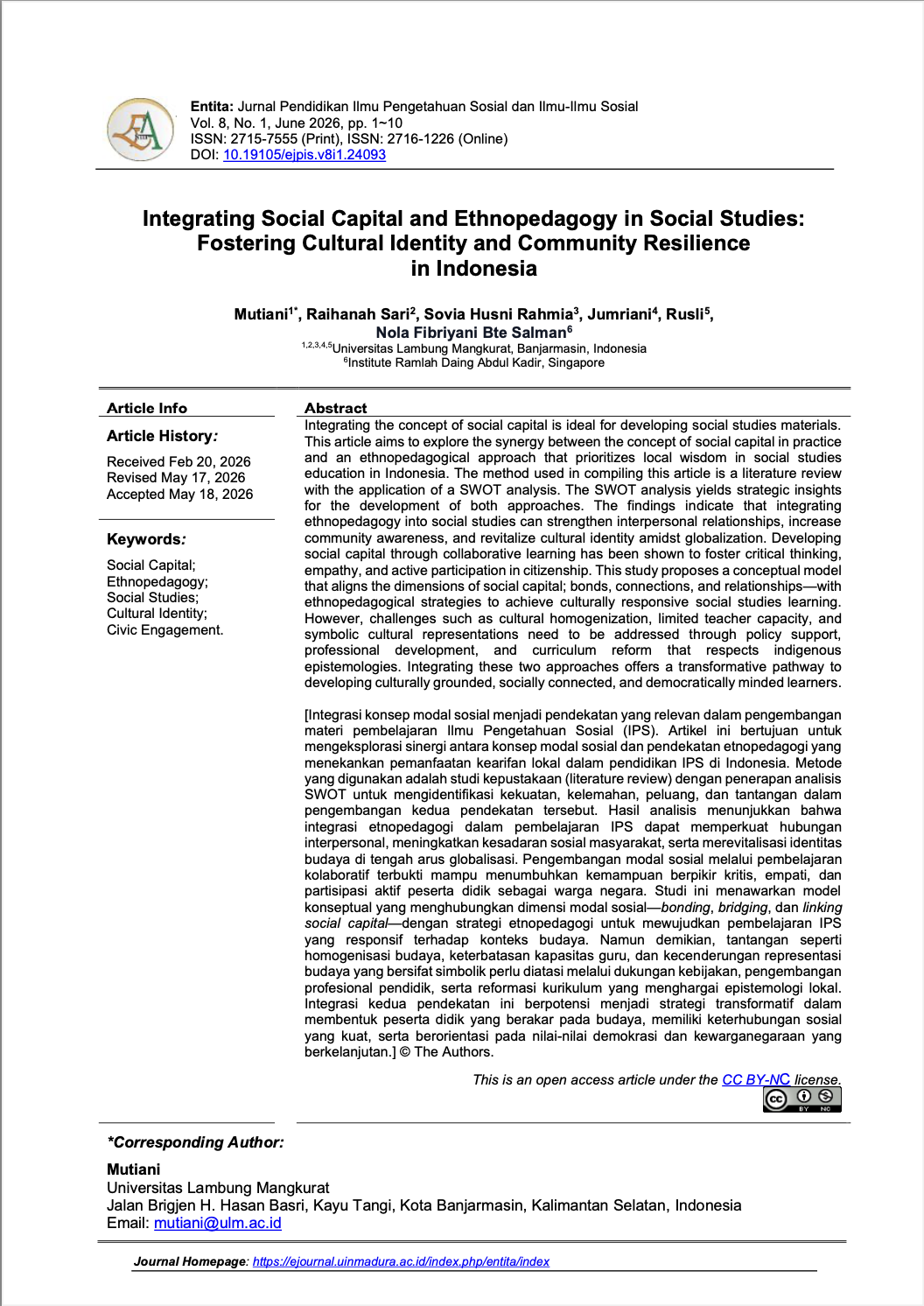
Integrating the concept of social capital is ideal for developing social studies materials. This article aims to explore the synergy between the concept of social capital in practice and an ethnopedagogical approach that prioritizes local wisdom in social studies education in Indonesia. The method used in compiling this article is a literature review with the application of a SWOT analysis. The SWOT analysis yields strategic insights for the development of both approaches. The findings indicate that integrating ethnopedagogy into social studies can strengthen interpersonal relationships, increase community awareness, and revitalize cultural identity amidst globalization. Developing social capital through collaborative learning has been shown to foster critical thinking, empathy, and active participation in citizenship. This study proposes a conceptual model that aligns the dimensions of social capital; bonds, connections, and relationships—with ethnopedagogical strategies to achieve culturally responsive social studies learning. However, challenges such as cultural homogenization, limited teacher capacity, and symbolic cultural representations need to be addressed through policy support, professional development, and curriculum reform that respects indigenous epistemologies. Integrating these two approaches offers a transformative pathway to developing culturally grounded, socially connected, and democratically minded learners.
Downloads
References
S. Tian, S. Ning, H. Li, L. Chen, H. Zhu, and G. Gao, “Relationships among social capital, community identity and perceived safety resilience under public emergencies: Evidence from
Shanghai,†Nov. 26, 2024. doi: 10.21203/rs.3.rs-5315273/v1.
H. Sofyan, E. Anggereini, and J. Saadiah, “Development of E-Modules Based on Local Wisdom
in Central Learning Model at Kindergartens in Jambi City,†EUROPEAN J ED RES, vol. volume– 8–2019, no. volume8-issue4.html, pp. 1137–1143, Oct. 2019, doi: 10.12973/eu-jer.8.4.1139.
M. A. S. Hammada and S. Sampean, “Modal Kultural Masyarakat di Daerah Rawan Bencana di Indonesia: Kajian Berdasarkan Karakteristik Wilayah,†HUMANIKA, vol. 31, no. 2, pp. 158–171, Dec. 2024, doi:10.14710/humanika.v31i2.67933.
I. Moeis, J. Indrawadi, Z. H. Prasojo, F. Fatmariza, and R. Febriani, “A VYGOTSKIAN PERSPECTIVE ON MULTICULTURAL EDUCATION: A SOCIAL- BASED LEARNING PROCESS IN THE MINANGKABAU COMMUNITY, WEST SUMATRA, INDONESIA,†paradigma, vol. 14, no. 3, pp. 479–494, Dec. 2024, doi: 10.17510/paradigma.v14i3.1507.
S. Tian, S. Ning, H. Li, L. Chen, H. Zhu, and G. Gao, “Relationships among social capital, community identity and perceived safety resilience under public emergencies: Evidence from Shanghai,†Nov. 26, 2024. doi: 10.21203/rs.3.rs-5315273/v1.
S. Sutomo, A. Musnandar, D. U. D. M. Alzitawi, and S. Sutrisno, “Religious-Sociocultural Networks and Social Capital Enhancement in Pesantren,†Jurn. Pend. Islam, vol. 10, no. 1, pp. 137–148, Jun. 2024, doi: 10.15575/jpi.v10i1.19997.
D. T. B. An Le and J. Hockey, “Critical thinking in the higher education classroom: knowledge, power, control and identities,†British Journal of Sociology of Education, vol. 43, no. 1, pp. 140– 158, Jan. 2022, doi: 10.1080/01425692.2021.2003182.
J. Han and S.-H. Kim, “Effectivity analysis of approaches to creativity education for engineering students,†in Proceedings of 2013 IEEE International Conference on Teaching, Assessment and Learning for Engineering (TALE), Bali, Indonesia: IEEE, Aug. 2013, pp. 295–300. doi: 10.1109/TALE.2013.6654449.
A. W. Y. Ng and C.-Y. Lee, “Assessment of Creative Thinking of Hong Kong Undergraduate Students Using the Torrance Tests of Creative Thinking,†in 5th International Conference on Higher Education Advances (HEAd’19), Universitat Politècnica València, Jun. 2019. doi: 10.4995/HEAD19.2019.9051.
R. Warren Flint, W. McCarter, and T. Bonniwell, “Interdisciplinary education in sustainability: links in secondary and higher education: The Northampton Legacy Program,†International Journal of Sustainability in Higher Education, vol. 1, no. 2, pp. 191–202, Aug. 2000, doi: 10.1108/1467630010328261.
Ferdinand Salomo Leuwo, Asep Asep, and Dewilna Helmi, “Recommendations for Case Learning Based of Local Wisdom Integrated with The Exo Olo Task Learning Model in Implementing The Merdeka Curriculum at Senior High School in Ambon City,†IJER, vol. 1, no. 2, pp. 11–27, Jun. 2024, doi: 10.62951/ijer.v1i2.22.
P. I. Azizah, “The impact of the campus teaching program on social sciences education students Universitas Negeri Yogyakarta: An interpretative phenomenological analysis,†Jurnal Ilmiah WUNY, vol. 6, no. 2, pp. 14–26, Oct. 2024, doi: 10.21831/jwuny.v6i2.64957.
Muji Budi Lestari et al., “Communicative Practices and Cultural Challenges in Kurikulum Merdeka: The District Teachers’ Voice,†esiculture, pp. 138–150, Oct. 2024, doi: 10.70082/esiculture.vi.1849.
- Hidayat, “The Current Conditions of Social Institutions in the Environmental Changes and Modern FishingAn Analysis on the Local Institutions of Fisherman Communities of Two Ecological Types in the East Coast of North Sumatra,†in Proceedings of the 1st UPI International Conference on Sociology Education (UPI ICSE 2015), Bandung, Indonesia: Atlantis Press, 2016. doi: 10.2991/icse-15.2016.104.
E. M. Q. Morales, D. Lepofsky, and F. Berkes, “Ethnobiology and Fisheries: Learning from the past for the Present,†Journal of Ethnobiology, vol. 37, no. 3, pp. 369–379, Oct. 2017, doi: 10.2993/0278-0771-37.3.369.
D. Bridges, Philosophy in Educational Research. Cham: Springer International Publishing, 2017.
doi: 10.1007/978-3-319-49212-4.
P. Hager, A. Gonczi, and J. Athanasou, “General Issues about Assessment of Competence,†Assessment & Evaluation in Higher Education, vol. 19, no. 1, pp. 3–16, Jan. 1994, doi:10.1080/0260293940190101.
A. J. Gallard MartÃnez, “Argumentation and indigenous knowledge: socio-historical influences in
contextualizing an argumentation model in South African schools,†Cult Stud of Sci Educ, vol. 6, no. 3, pp. 719–723, Sep. 2011, doi: 10.1007/s11422-011-9358-y.
K. Koeppen, J. Hartig, E. Klieme, and D. Leutner, “Current Issues in Competence Modeling and Assessment,†Zeitschrift für Psychologie / Journal of Psychology, vol. 216, no. 2, pp. 61–73, Jan. 2008, doi: 10.1027/0044-3409.216.2.61.
M. J. Hofer and J. Harris, “Tech Integration in Social Studies,†vol. 37, pp. 22–25, 2009.
L. Jackson, “Starting Points in Critical Language Pedagogy,†ELT Journal, vol. 77, no. 2, pp. 277–279, May 2023, doi: 10.1093/elt/ccad015.
O. Zlatkinâ€Troitschanskaia and H. A. Pant, “Measurement Advances and Challenges in Competency Assessment in Higher Education,†J Educational Measurement, vol. 53, no. 3, pp. 253–264, Aug. 2016, doi: 10.1111/jedm.12118.
S. J. Thornton, “Teaching social studies that matter: curriculum for active learning,†Choice Reviews Online, vol. 43, no. 01, pp. 43-0466-43–0466, Sep. 2005, doi: 10.5860/CHOICE.43-0466.
A. R. Crowe and T. Dinkelman, “Self-Study and Social Studies: Framing the Conversation,†in Advancing Social Studies Education through Self-Study Methodology, vol. 10, A. R. Crowe, Ed., in Self Study of Teaching and Teacher Education Practices, vol. 10. , Dordrecht: Springer Netherlands, 2010, pp. 1–19. doi: 10.1007/978-90-481-3943-9_1.
S. Vakil, “A Critical Pedagogy Approach for Engaging Urban Youth in Mobile App Development in an After-School Program,†Equity & Excellence in Education, vol. 47, no. 1, pp. 31–45, Jan. 2014, doi: 10.1080/10665684.2014.866869.
J. Byford and W. Russell, “The New Social Studies: A Historical Examination of Curriculum Reform,†Social Studies Research and Practice, vol. 2, no. 1, pp. 38–48, Mar. 2007, doi: 10.1108/SSRP-01-2007-B0003.
T. Qathrinada, I. U. Huda, and R. Amrulloh, “The Influence of Cultural Values and Individual Seller Behavior on Tourists’ Interest in Visiting the Lok Baintan Floating Market,†Eduvest - Journal of Universal Studies, vol. 4, no. 8, pp. 7243–7256, Aug. 2024, doi: 10.59188/eduvest.v4i8.1774.
W. Y. A. Chan, S. Hirsch, and H. Tiflati, “The Relevancy of Religious Literacy in Social Studies Curricula: Quebec’s CCQ as a Case Study,†Religions, vol. 15, no. 9, p. 1046, Aug. 2024, doi: 10.3390/rel15091046.
S. Giudici and S. G. Selvam, “Integration of Social Critical Consciousness in Missionary Methodology for Social Transformation,†Transformation: An International Journal of Holistic Mission Studies, vol. 40, no. 1, pp. 34–48, Jan. 2023, doi: 10.1177/02653788221131903.
Downloads
Published
How to Cite
Issue
Section
License
License
Copyright (c) 2025 Authors
This is an open access article under the CC BY-NC license.