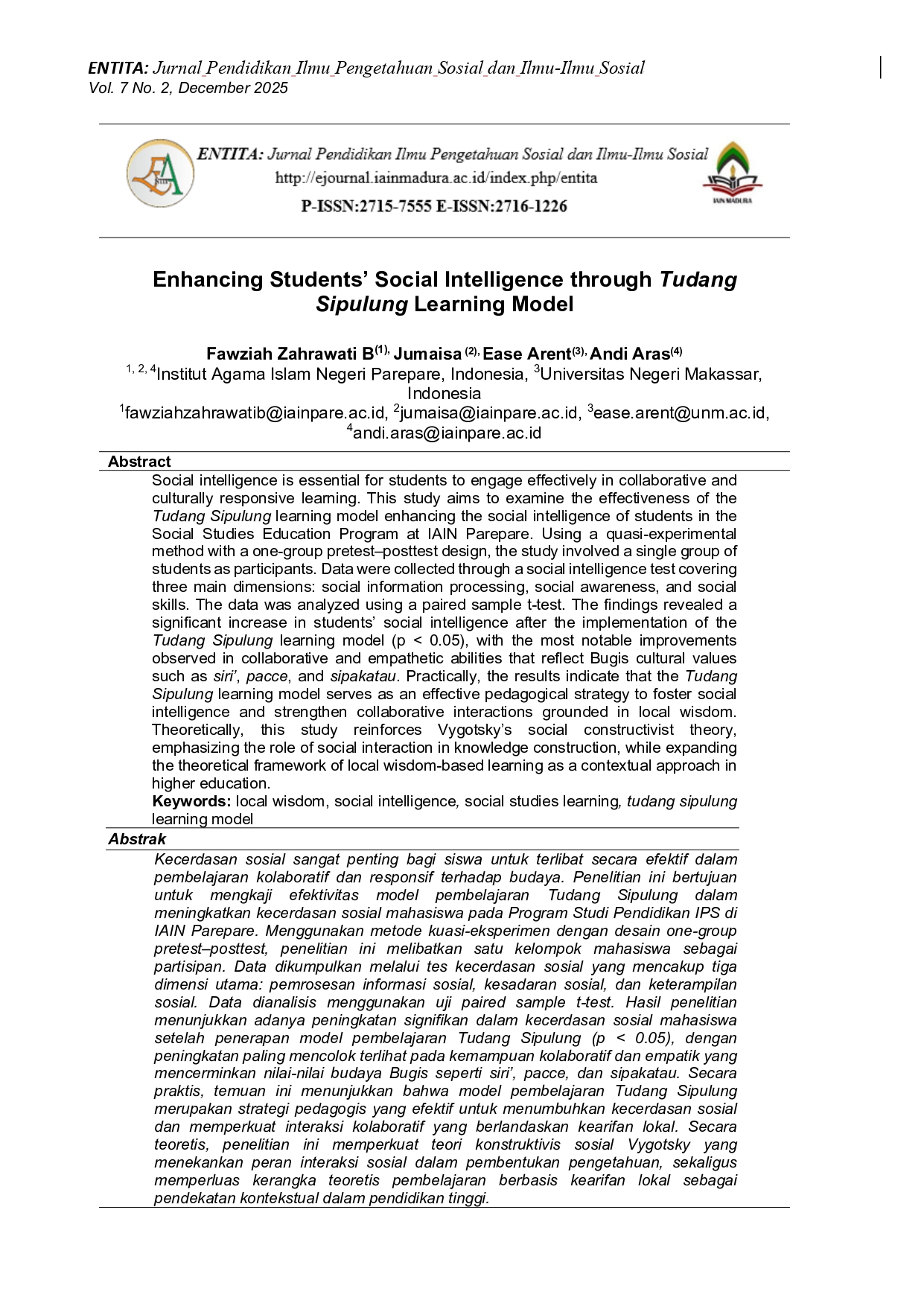
Enhancing Students’ Social Intelligence through Tudang Sipulung Learning Model

 Abstract views: 466
 PDF downloads: 456
Keywords:
local wisdom, social intelligence, social studies learning, tudang sipulung learning modelAbstract
Social intelligence is essential for students to engage effectively in collaborative and culturally responsive learning. This study aims to examine the effectiveness of the Tudang Sipulung learning model enhancing the social intelligence of students in the Social Studies Education Program at IAIN Parepare. Using a quasi-experimental method with a one-group pretest–posttest design, the study involved a single group of students as participants. Data were collected through a social intelligence test covering three main dimensions: social information processing, social awareness, and social skills. The data was analyzed using a paired sample t-test. The findings revealed a significant increase in students’ social intelligence after the implementation of the Tudang Sipulung learning model (p < 0.05), with the most notable improvements observed in collaborative and empathetic abilities that reflect Bugis cultural values such as siri’, pacce, and sipakatau. Practically, the results indicate that the Tudang Sipulung learning model serves as an effective pedagogical strategy to foster social intelligence and strengthen collaborative interactions grounded in local wisdom. Theoretically, this study reinforces Vygotsky’s social constructivist theory, emphasizing the role of social interaction in knowledge construction, while expanding the theoretical framework of local wisdom-based learning as a contextual approach in higher education.
Downloads
References
Adela, D., Suastra, I. W., & Lasmawan, I. W. (2023). Enculturation of bugis sidenreng rappang local wisdom through ethnopedagogy of traditional games. International Journal of Elementary Education, 7(3), 428–436. https://doi.org/10.23887/ijee.v7i3.60689
Al-Ansi, A. M. (2022). Reinforcement of student-centered learning through social e-learning and e-assessment. SN Social Sciences, 2(9), 194. https://doi.org/10.1007/s43545-022-00502-9
Bakar, A. A., Mahanal, S., Gofur, A., & Ibrohim, I. (2024). The development of PACCE learning model based on the Bugis local wisdom to promote student social awareness. Research and Development in Education (RaDEn), 4(1), 361–373. https://doi.org/10.22219/raden.v4i1.33056
Faustino, G. M. A., Gabasa, Ma. L. G., & Jesus, Dr. L. De. (2025). Systematic literature review on skill mismatch: Bridging the gap through educational leadership and industry collaboration. International Journal of Research and Innovation in Social Science, IX(V), 5151–5169. https://doi.org/10.47772/IJRISS.2025.905000400
Ferdiansyah, H., Degeng, I. N. S., Kuswandi, D., & Praherdhiono, H. (2025a). Integrating the tudang sipulung culture into the flipped classroom strategy for conceptual understanding and problem solving in science subjects. Educational Process International Journal, 18(1). https://doi.org/10.22521/edupij.2025.18.438
Ferdiansyah, H., Degeng, I. N. S., Kuswandi, D., & Praherdhiono, H. (2025b). Integrating the tudang sipulung culture into the flipped classroom strategy for conceptual understanding and problem solving in science subjects. Educational Process International Journal, 18(1). https://doi.org/10.22521/edupij.2025.18.438
Goleman, D. (1998). Working with emotional intelligence. Bantam Books.
Goleman, D. (2006). Social Intelligence: The New Science of Human Relationships. Bantam Books.
Gu (顾慧), H., Yao (姚继军), J., Zhou (周龙军), L., C. K. Cheung, A., & C. Abrami, P. (2021). A quasi-experimental study of a web-based english literacy tool for grade 3 students in China. ECNU Review of Education, 4(1), 84–107. https://doi.org/10.1177/2096531120972709
Hadi Sulistyanto, T., Ghina, A., Hanny, H., Dewi, A., Eva, A., & Ela, N. (2025a). Organizational involvement in higher education as a predictor of students’ soft skills. Synergy: Journal of Collaborative Sciences, 1(1), 100–114. https://doi.org/10.69836/synergy.v1i1.94
Hadi Sulistyanto, T., Ghina, A., Hanny, H., Dewi, A., Eva, A., & Ela, N. (2025b). Organizational Involvement in Higher Education as a Predictor of Students’ Soft Skills. Synergy: Journal of Collaborative Sciences, 1(1), 100–114. https://doi.org/10.69836/synergy.v1i1.94
Hargreaves, A., & Fullan, M. (2012). Professional capital: Transforming teaching in every school. Teachers College Press.
Herman, Herlina, Hasan, M., & Ahmar, A. S. (2025). Integrating social learning and experiential learning theories: a novel augmented reality approach to enhancing social skills in early childhood education. Cogent Education, 12(1). https://doi.org/10.1080/2331186X.2025.2556889
Hidayah, Y., Su Fen, C., Suryaningsih, A., & Mazid, S. (2022). Promoting student participation skills through student organizations. Jurnal Civics: Media Kajian Kewarganegaraan, 19(2), 213–223. https://doi.org/10.21831/jc.v19i2.53422
Kaur, R. (2022). An analytical study of social intelligence. Scholars’ Journal, 94–107. https://doi.org/10.3126/scholars.v5i1.55788
Khaeruddin, Umasih, U., & Ibrahim, N. (2020). Nilai kearifan lokal bugis sebagai sumber belajar sejarah lokal pada masyarakat bugis di kabupaten bone. Jurnal Pendidikan Sejarah, 9(2), 110–125. https://doi.org/10.21009/JPS.092.02
KOÇ, K., & TURAN, M. B. (2018). The impact of cultural intelligence on aocial akills among university students. Journal of Education and Learning, 7(6), 241. https://doi.org/10.5539/jel.v7n6p241
Lambert, L. M. (2025). Social empathy in public deliberation. Public Understanding of Science. https://doi.org/10.1177/09636625251350573
Martawijaya, M. A., Sujiono, E. H., Halim, A. D., Siew Wei, T., Mahir, M., Palloan, P., & Zharvan, V. (2025). The impact of physics co-curricular activities based on makassar local wisdom on improving the pancasila student profile and learning satisfaction. Jurnal Pendidikan IPA Indonesia, 14(1). https://doi.org/10.15294/jpii.v14i1.13178
Muchtar, F. Y., Bundu, P., & Anshari, . (2024). The effectiveness of the tudang sipulung integrated project-based learning model to improve the character of mutual cooperation at the elementary school level. Asian Journal of Education and Social Studies, 50(5), 163–169. https://doi.org/10.9734/ajess/2024/v50i51350
Nuh, M. S. (2016). Tudang sipulung: A conflict resolution wisdom of Bugis-Makassar Community. Hasanuddin Law Review, 1(2), 241. https://doi.org/10.20956/halrev.v1n2.308
Nurseng, A. N., Sanusi, S., Firman, & Mirnawati. (2023). Pengembangan model pembelajaran role playing terintegrasi budaya tudang sipulung di sekolah dasar. Jurnal Sinestesia, 13(1), 213–224. https://sinestesia.pustaka.my.id/journal/article/view/304
O’Donnell, C., O’Brien, B., Markey, K., McCarthy, J., Flaten, C., Mueller, C., Leinen, E., Martin, K., & Graham, M. M. (2022). Transatlantic collaborations: Baccalaureate nursing students’ experiences of participating in a semester-long study abroad program. Nursing Education Perspectives, 43(6), 357–362. https://doi.org/10.1097/01.NEP.0000000000001000
Pollak, I., Stiehl, K. A. M., Birchwood, J., Schrank, B., Zechner, K. A., Wiesner, C., & Woodcock, K. A. (2024). Promoting Peer Connectedness Through Social-Emotional Learning: Evaluating the Intervention Effect Mechanisms and Implementation Factors of a Social-Emotional Learning Programme for 9 to 12-Year-Olds. Journal of Youth and Adolescence, 53(1), 89–116. https://doi.org/10.1007/s10964-023-01871-x
Prabowo, M. A., Meutia, Mulyasari, W., & Yulianto, A. S. (2023). Bugis cultural value construction in strengthening management control system (pp. 44–53). https://doi.org/10.2991/978-2-38476-112-8_6
Riggio, R. E. (2010). Before emotional intelligence: Research on nonverbal, emotional, and social competences. Industrial and Organizational Psychology, 3(2), 178–182. https://doi.org/10.1111/j.1754-9434.2010.01221.x
Ristiana, E., Amin, M., Zubaidah, S., & Al Muhdar, M. H. I. (2017). Improving problem-solving ability through culture-based learning model of Tudang Sipulung. IOSR Journal of Pharmacy and Biological Sciences, 12(03), 11–14. https://doi.org/10.9790/3008-1203031114
Rudi, R., & LN, S. Y. (2019). Tudang sipulung: Integrating south sulawesi local wisdom into learning practice in teacher learning community. Proceedings of the 3rd Asian Education Symposium (AES 2018). https://doi.org/10.2991/aes-18.2019.21
Rudi, R., & Yusuf LN, S. (2019). Tudang sipulung: Integrating South Sulawesi local wisdom into learning practice in teacher learning community. Advances in Social Science, Education and Humanities Research, 253, 88–91. http://file.upi.edu/Direktori/FPBS/JUR._PEND._BAHASA
Rusli, R., Azis, C. C., Asdar, A., Rahman, A., & Hastuty, H. (2022a). Cooperative learning model based on Tudang Sipulung with ethnomathematics Approach. EduLine: Journal of Education and Learning Innovation, 2(3), 366–379. https://doi.org/10.35877/454RI.eduline1266
Rusli, R., Azis, C. C., Asdar, A., Rahman, A., & Hastuty, H. (2022b). Cooperative learning model based on tudang sipulung with ethnomathematics approach. EduLine: Journal of Education and Learning Innovation, 2(3), 366–379. https://doi.org/10.35877/454RI.eduline1266
Rusli, R., Azis, C. C., Asdar, A., Rahman, A., & Hastuty, H. (2022c). Cooperative learning model based on tudang sipulung with thnomathematics approach. EduLine: Journal of Education and Learning Innovation, 2(3), 366–379. https://doi.org/10.35877/454ri.eduline1266
Schuster, L., & Glavas, C. (2017). Exploring the dimensions of electronic work integrated learning (eWIL). Educational Research Review, 21, 55–66. https://doi.org/10.1016/j.edurev.2017.04.001
Sidin, I., Rivai, F., & Bulu, R. M. (2020). The role of Bugis cultural value to leader-member exchange and organizational citizenship behavior of Bugis nurses in Makassar. EnfermerÃa ClÃnica, 30, 217–220. https://doi.org/10.1016/j.enfcli.2020.06.049
Van Ryzin, M. J., & Roseth, C. J. (2022). The Longitudinal Relationship Between Peer Relations and Empathy and Their Joint Contribution to Reducing Bullying in Middle School: Findings From a Randomized Trial of Cooperative Learning. Journal of Prevention and Health Promotion, 3(2), 147–165. https://doi.org/10.1177/26320770221094032
Vázquez-RodrÃguez, A., Quiroga-Carrillo, A., GarcÃa-Ãlvarez, J., & Sáez-GambÃn, D. (2025). Soft skills and the corporate social dimension: the perspective of university graduate employers. Educational Research for Policy and Practice. https://doi.org/10.1007/s10671-025-09395-w
Vygotsky, L. S. (1978). Mind in Society: The Development of Higher Psychological Processes. Harvard University Press.
Yoel, S. R., Akiri, E., & Dori, Y. J. (2023). Fostering graduate students’ interpersonal communication skills via online group interactions. Journal of Science Education and Technology, 32(6), 931–950. https://doi.org/10.1007/s10956-022-09998-5
Zahrawati B, F., & Jumaisa. (2025). Pengembangan model pembelajaran IPS kreatif berbasis tradisi tudang sipulung untuk meningkatkan inteligensi sosial mahasiswa Prodi Tadris IPS IAIN Parepare. Institut Agama Islam Negeri Parepare.
Downloads
Published
How to Cite
Issue
Section
License
License
Copyright (c) 2025 Authors
This is an open access article under the CC BY-NC license.