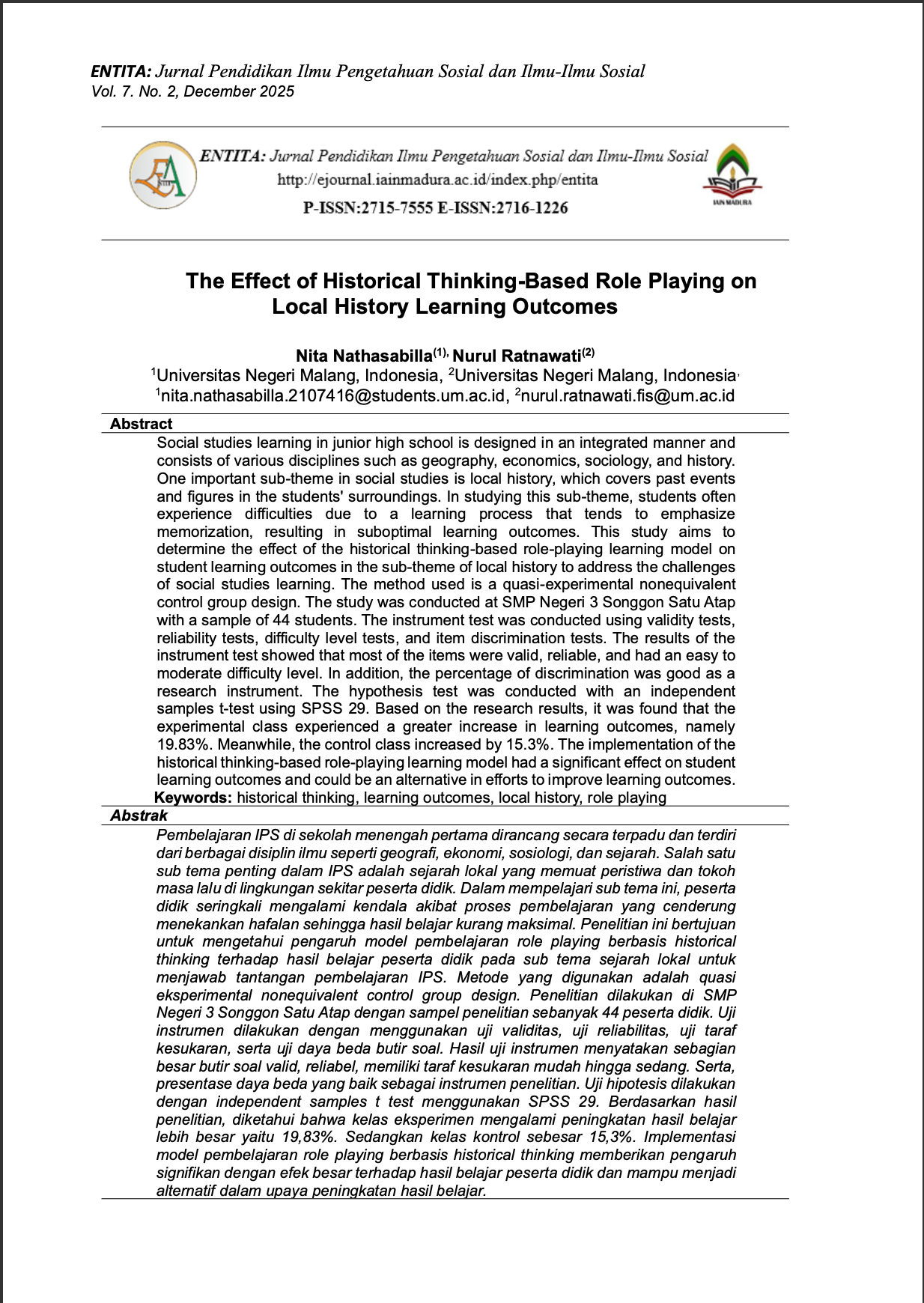
The Effect of Historical Thinking-Based Role Playing on Local History Learning Outcomes

 Abstract views: 431
 PDF downloads: 294
Keywords:
historical thinking, learning outcomes, local history, role playingAbstract
Social studies learning in junior high school is designed in an integrated manner and consists of various disciplines such as geography, economics, sociology, and history. One important sub-theme in social studies is local history, which covers past events and figures in the students' surroundings. In studying this sub-theme, students often experience difficulties due to a learning process that tends to emphasize memorization, resulting in suboptimal learning outcomes. This study aims to determine the effect of the historical thinking-based role-playing learning model on student learning outcomes in the sub-theme of local history to address the challenges of social studies learning. The method used is a quasi-experimental nonequivalent control group design. The study was conducted at SMP Negeri 3 Songgon Satu Atap with a sample of 44 students. The instrument test was conducted using validity tests, reliability tests, difficulty level tests, and item discrimination tests. The results of the instrument test showed that most of the items were valid, reliable, and had an easy to moderate difficulty level. In addition, the percentage of discrimination was good as a research instrument. The hypothesis test was conducted with an independent samples t-test using SPSS 29. Based on the research results, it was found that the experimental class experienced a greater increase in learning outcomes, namely 19.83%. Meanwhile, the control class increased by 15.3%. The implementation of the historical thinking-based role-playing learning model had a significant effect on student learning outcomes and could be an alternative in efforts to improve learning outcomes.
Downloads
References
Abraham, I., & Supriyanti, Y. (2022). Desain Kuasi Eksperimen Dalam Pendidikan: Literature Review. Jurnal Ilmiah Mandala Education (JIME), 08(03), 2476–2482.
Afandi, M. (2023). Pembelajaran Sejarah Thinking Like a Historian: Critical Reading, Mind-Map, dan Creative Writing. Jurnal Praksis Dan Dedikasi (JPDS), 6(1), 58–64.
Arifah, D., Nur, K., & Amaliah. (2025). Strategi Efektif Membimbing Diskusi Kelompok Kecil Untuk Meningkatkan Kolaborasi Siswa. Harmoni Pendidikan: Jurnal Ilmu Pendidikan, 2(1), 213–220.
Arikunto, S. (2009). Dasar-Dasar Evaluasi Pendidikan (Edisi Revisi). Bumi Aksara.
Azizah, A., & Salam, R. (2023). Pengaruh Penerapan Metode Role Playing Terhadap Hasil Belajar IPS Peserta Didik Kelas IX. Sosiolium: Jurnal Pembelajaran IPS, 5(2), 113–124.
Azizah, N. (2022). Penerapan Metode Role Playing Untuk Meningkatkan Keterampilan Berbicara dan Motivasi Belajar Siswa dalam Menguasai Congratulations Expressions. 04.
Basri, I., & Hastuti, H. (2020). Bagaimana Sejarah Seharusnya Diajarkan? (Sebuah Kajian Pemikiran Pembelajaran Sejarah). Jurnal Kronologi, 2(4), 140–148.
Chand, S. P. (2023). Constructivism in Education: Exploring the Contributions of Piaget, Vygotsky, and Bruner. International Journal of Science and Research (IJSR), 12(7), 274–278.
Cohen, J. (1977). Statistic Power Analysis for the Behavior Science. Academic Press, INC.
Fairuzabadi, M., Wardoyo, C. P., & Puji Handayani Putri. (2022). Aplikasi Digital History Sebagai Sumber Belajar Untuk Meningkatkan Kompetensi Sejarah Perjuangan Bangsa di SMP Kelas IX. Jurnal Dinamika Informatika, 11(02), 64.
Harefa, E., Afendi, A. R., Karuru, P., & Sulaeman. (2024). Teori Belajar dan Pembelajaran. PT.Sonpedia Publishing Indonesia.
Hasminindar. (2023). Meningkatkan Hasil Belajar IPS Melalui Teknik Role Play Histori Siswa Kelas IX SMP Negeri 1 Baru. Edu Cendika: Jurnal Ilmiah Pendidikan, 03(Nomor 1). https://doi.org/10.47709/educendikia.v3i01.2547
Hastjarjo, T. D. (2019). Rancangan Eksperimen Kuasi. Jurnal UGM, Buletin Psikologi, 27(02), 187–203.
Hastuti, H., Basri, I., & Zafri. (2021). Meramu Materi Pembelajaran Berlandaskan Analisis Historical Thinking. DIAKRONIKA, 21. https://doi.org/DOI: 10.24036/diakronika/vol21-iss1/181
Hudaidah. (2024). Historical Thinking, Keterampilan Berpikir Utama bagi Mahasiswa Sejarah. PESHUM: Jurnal Pendidikan, Sosial Dan Humaniora, 3(877–888).
Humairoh, F. (2023). Metode Pembelajaran: Mengoptimalkan Pembelajaran Melalui Diskusi Kelompok: Strategi dan Manfaatnya. https://doi.org/10.31949/educatio.v6i1.286
Ibda, F. (2015). Perkembangan Kognitif: Teori Jean Piaget. INTELEKTUALITA, 03(01).
Indriyanti, N., Kusuma, M. A., & Miftahullafiyah, I. (2025). Analisis Statistik Uji t Sampel Independen untuk Perbandingan Dua Kelompok Bebas. Jurnal Pengembangan Pendidikan, 9(6), 9–15.
Karima, Kaulan, M., & Ramadhani, R. (2018). Permasalahan Pembelajaran IPS dan Strategi Jitu Pemecahanya. ITTIHAD, 02(01), 45.
Khairunnas, A. R. (2024). Penerapan Pendekatan Student-Centered Learning Untuk Meningkatkan Keterlibatan Peserta Didik yang Pasif Dalam Pembelajaran. Jurnal Pemikiran Dan Pengembangan Pembelajaran, 6(3), 137–140.
Kim, H. Y. (2019). Statistical Notes for Clinical Researcher: The Independent t-test. Restorative Dentistry & Endodonticts, 44(1).
Kumalasari, N. (2021). Implementasi Desain Pembelajaran Bermain Peran Dalam Meningkatkan Hasil Belajar Sejarah Kebudayaan Islam di MTS Badrussalam Surabaya. Attaqwa: Jurnal Ilmu Pendidikan Islam, 17(1), 75–83.
Kurniawan, B., Purnomo, A., & Ratnawati, N. (2021). Model pembelajaran pola sidang pengadilan: Suatu kerangka teoretis. Jurnal Integrasi Dan Harmoni Inovatif Ilmu-Ilmu Sosial, 1(10), 1108–1112.
Lathifah, A. S., Hardaningtyas, K., Pratama, Z. A., & Moewardi, I. (2024). Penerapan Teori Belajar Konstruktivisme dalam Meningkatkan Keaktifan dan Hasil Belajar Siswa. Diajar: Jurnal Pendidikan Dan Pembelajaran, 3(1), 36–42.
Masgumelar, N. K., & Mustafa, P. S. (2021). Teori Belajar Kontruktivisme dan Implikasinya dalam Pendidikan dan Pembelajaran. GHAITSA: Islamic Education Jurnal, 2(1).
Masitoh, & Laksmi, D. (2009). Strategi Pembelajaran. Direktorat Jenderal Pendidikan Islam Departemen Agama.
Maulana, W. (2021). Tinjauan Mengenai Historical Thinking Skills dan Karakteristik Peserta Dididk Pada Jenjang Menengah Atas. Indonesian Journa lOf Education And Humanity, 01(02), 69–78.
Muwarni, S. (2001). Statistika Terapan (Teknik Analisis Data). Universitas Negeri Malang.
Nurjanah, W. (2020). Historical Thinking and Critical Thinking Skills. Jurnal.Uns.Ac.Id, 23(01), 92–104.
Nurkhofifah, & Ardin. (2023). Pengaruh Gaya Belajar Terhadap Hasil Belajar Peserta Didik Pada Mata Pelajatan IPS Kelas VIII di SMP Wibawa Bangsa Jatimekar Kota Bekasi. Serambi Akademica: Jurnal Pendidikan, Sains, Dan Humaniora, 11(8), 1052–1059.
Nurlina, Nurfadilah, & Bahri, A. (2021). Teori Belajar dan Pembelajaran. LPP Unismuh.
Oktaviani, M. A., & Notobroto, H. B. (2014). Perbandingan Tingkat Konsistensi Normalitas Distribusi Metode Kolmogorov-Smirnov, Liliefors,Shapiro-Wilk, dan Skewness-Kurtosis. Jurnal Biometrika Dan Kependudukan, 3(2), 127–135.
Putri, D. A., & Wahyuni, S. (2021). The Effect of Kinesthetic Learning Styles and Role-Playing Methods on Students’ Learning Outcomes in Social Studies. Journal of Education and Learning, 15(2), 234–241.
Putro, S. D., Adi, K. R., & Ratnawati, N. (2021). Pengembangan Media Evaluasi Pembelajaran IPS “MAPS†dengan Game Web Browser Based Learning untuk Siswa SMP. JPIPS: Jurnal Pendidikan Ilmu Pengetahuan Sosial, 8(1), 25–42.
Rahman, A., & Wijayanti, R. (2022). Penerapan Uji Homogenitas untuk Menentukan Kesetaraan Varians Antar Kelompok. Jurnal Metodologi Penelitian, 9(2), 75–85.
Ratnawati, N., Sukamto, & Ruja. (2019). The Quality of Learning Tools With Constructivist Approaches on the Juvennile Delinquency Theme. In International Conference On Social Studies, Globalisation And Technology (ICSSGT), 238–247.
Saksono, H., Khoiri, A., Surani, D., & Rando, A. R. (2023). Teori Belajar Dalam Pembelajaran. Yayasan Cendikia Mulia Mandiri.
Sari, A. P., Hasanah, S., & Nursalam, M. (2024). Uji Normalitas dan Homogenitas dalam Analisis Statistik. Jurnal Pendidikan Tambusai, 8(3), 51335.
Sayono, J. (2015). Pembelajaran Sejarah di Sekolah: Dari Pragmatis ke Idealis. Jurnal Sejarah Dan Budaya, 07(01).
Shaftel, G., & Shaftel, F. R. (1967). Role-Playing for Social Values: Decision-Making in the Social Studies (01 ed.). Prentice-Hall,Inc.
Solichin, M. (2017). Analisis Daya Beda Soal, Taraf Kesukaran, Validitas Butir Tes, Interpretasi Hasil Tes dan Validitas Ramalan Dalam Evaluasi Pendidikan. Dirasat: Jurnal Manajemen Pendidikan Islam, 2(2), 192–213.
Sugiyono. (2015). Metode Penelitian Kuantitatif, Kualitatif, dan R&D (22nd ed.). Alfabeta.
Supit, D., Melianti, & Meiske. (2023). Gaya Belajar Visual, Auditori, Kinestetik terhadap Hasil Belajar Siswa. Jurnal on Education, 5(3), 6994–7003.
Ursula, A. S. C., Pertiwi, A. P., Arsyah, R. N., & Audina, M. (2023). Penerapan Metode PBL Dengan Bantuan Role Playing Untuk Meningkatkan Motivasi Belajar IPS di SD. Journal of Innovation Research and Knowledge, 03(05), 1149–1160.
Wahyudi, D., Idris, J., & Abidin, Z. (2023). Tren dan Isu Penelitian Uji-t dan Chi Kuadrat dalam Bidang Pendidikan. Journal of Mathematic Education, 4(2), 182–196.
Widodo, W., Wardana, M. P., & Desmila, W. (2025). The Role of Social Studies Learning in Building Student’s Social Awareness. Journal of Pedagogical Content Knowledge, 1(4), 156–162.
Yusmery, A. (2023). Peningkatan Hasil Belajar IPS Sejarah melalui Penerapan Model Pembelajaran Inkuiri dengan Mind Map pada Siswa Kelas VII-4 SMP Negeri 1 Soppeng Riaja Kabupaten Barru. Jurnal Edukasi Saintifik, 3(1), 13–27.
Yusnaldi, E. (2019). Potret Baru Pembelajaran IPS. Perdana Publishing.
Yusnawati. (2016). Meningkatkan Hasil Belajar Siswa Melalui Model Pembelajaran Kooperatif Tipe STAD Dalam Pembelajaran IPS Sejarah. Suara Guru: Jurnal Pendidikan Sosial, Sains, Dan Humaniora, 2(2).
Zhafirah, N., Sugiharto, R., Aji, M., & Susanto, R. (2022). Analisis Proses Pembelajaran Menggunakan Diskusi Kelompok Kecil Terhadap Hasil Belajar Siswa. Prosiding Seminar Nasional Ilmu Pendidikan Dan Multidisiplin V, 5(1), 26–28.
Zulkarnain, S., & Santoso, M. (2023). Uji Homogenitas dalam Analisis Varians: Penggunaan Uji Levene dan Barlett. Jurnal Statistika Dan Metode Analisis, 18(4), 150–162.
Downloads
Published
How to Cite
Issue
Section
License
License
Copyright (c) 2025 Authors
This is an open access article under the CC BY-NC license.