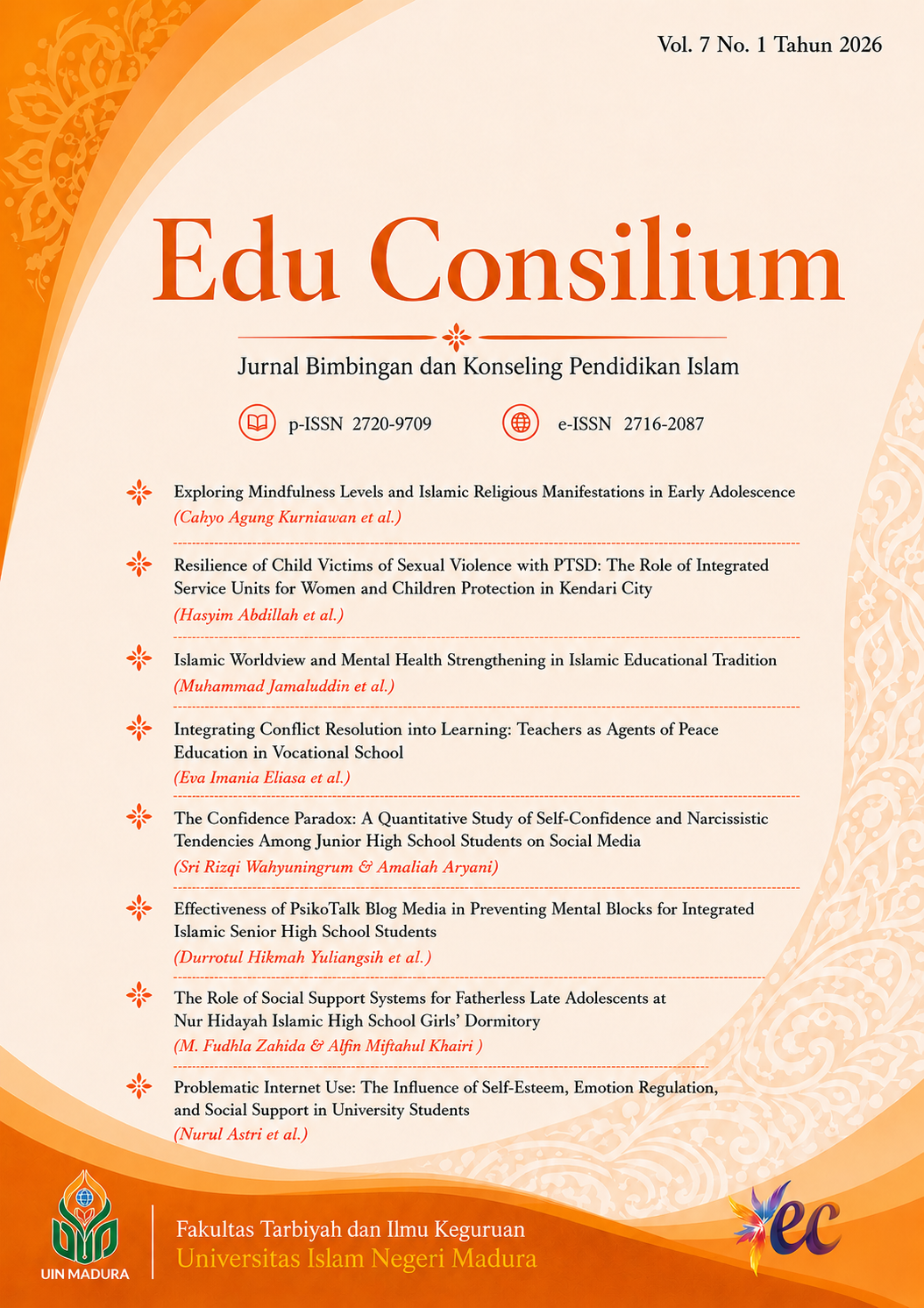
Problematic Internet Use: The Influence of Self-Esteem, Emotion Regulation, and Social Support in University Students

 Abstract views: 706
 PDF downloads: 649
Keywords:
Problematic internet use, self-esteem, emotion regulation, social supportAbstract
Problematic internet use has increasingly become a concern alongside the rapid advancement of digital technology. This study aims to examine the influence of self-esteem, emotion regulation, and social support as independent variables on problematic internet use. A quantitative approach was employed involving 254 university students in the Greater Jakarta area selected through non-probability sampling. Data were collected using the Generalized Problematic Internet Use Scale 2 by Caplan (2010), Self-Liking/Self-Competence Scale by Tafarodi & Swann (2001), Emotion Regulation Questionnaire by Gross & John (2003), and Multidimensional Scale of Perceived Social Support by Zimet et al. (1988). The results show that self-esteem, emotion regulation, and social support simultaneously have a significant effect on problematic internet use, contributing 36,9%. At the dimensional level, self-liking negatively predicts problematic internet use, while self-competence and expressive suppression show significant positive effects. Cognitive reappraisal and all dimensions of social support do not show significant effects. These findings highlight the importance of internal psychological factors, such as self-esteem and emotion regulation, in explaining problematic internet use.
Downloads
References
Adiningrum, W., Wibowo, M. E., & Purwanto, E. (2022). The effects of adolescent-parent attachment, emotion regulation, and self-esteem on problematic internet use (PIU) among adolescents. Jurnal Bimbingan Konseling, 11(3), 253–260. https://doi.org/https://doi.org/10.15294/jubk.v12i2.65685
Agatha, I. A. (2023). 59,1 persen mahasiswa kecanduan internet. www.kompas.com
Alsyabilla, S. V. (2022). Peran perceived stress dan dukungan sosial terhadap problematic internet use pada mahasiswa [Universitas Gadjah Mada]. https://etd.repository.ugm.ac.id/penelitian/detail/211255
Anika, S. O., & Kurniawan, R. (2024). Hubungan antara regulasi emosi dengan problematic internet use pada siswa SMA. Al-DYAS, 3(1), 421–436. https://doi.org/https://doi.org/10.58578/aldyas.v3i1.2709
APJII. (2024). Survei internet APJII 2024. https://survei.apjii.or.id
Asrese, K., & Muche, H. (2020). Online activities as risk factors for problematic internet use among students in Bahir Dar University, North West Ethiopia: A hierarchical regression model. PLoS ONE, 15, 1–16. https://doi.org/10.1371/journal.pone.0238804
Azzahra, F., & Sumaryanti, I. U. (2021). Hubungan regulasi emosi dengan problematic internet use pada mahasiswa pengguna social media. https://doi.org/10.29313/.V0I0.28420
Büyükşahin Çevik, G., & Yıldız, M. A. (2017). The roles of perceived social support, coping, and loneliness in predicting internet addiction in adolescents. Journal of Education and Practice, 8(12), 64–73. www.iiste.org
Caplan, S. E. (2010). Theory and measurement of generalized problematic internet use: A two-step approach. Computers in Human Behavior, 26(5), 1089–1097. https://doi.org/10.1016/j.chb.2010.03.012
Caplan, S., Williams, D., & Yee, N. (2009). Problematic Internet use and psychosocial well-being among MMO players. Computers in Human Behavior, 25(6), 1312–1319. https://doi.org/10.1016/j.chb.2009.06.006
Faghani, N., Akbari, M., Hasani, J., & Marino, C. (2020). An emotional and cognitive model of problematic internet use among college students: The full mediating role of cognitive factors. Addictive Behaviors, 105, 106252. https://doi.org/10.1016/j.addbeh.2019.106252
Gao, Y. X., Wang, J. Y., & Dong, G. H. (2022). The prevalence and possible risk factors of internet gaming disorder among adolescents and young adults: Systematic reviews and meta-analyses. Journal of Psychiatric Research, 154, 35–43. https://doi.org/10.1016/j.jpsychires.2022.06.049
Gross, J. J., & John, O. P. (2003). Individual differences in two emotion regulation processes: Implications for affect, relationships, and well-being. Journal of Personality and Social Psychology, 85(2), 348–362. https://doi.org/10.1037/0022-3514.85.2.348
Gupta, D., & Izgi, F. D. (2024). Psychological impact of social networking sites on Indian adolescents. Edu Consilium : Jurnal Bimbingan Dan Konseling Pendidikan Islam, 5(2), 13–23. https://doi.org/10.19105/ec.v5I2.12643
Hayani, S., Dahlia, D., Khairani, M., & Amna, Z. (2022). Kecanduan internet dan prokrastinasi akademik pada mahasiswa. Seurune : Jurnal Psikologi Unsyiah, 5(2), 177–208. https://doi.org/10.24815/s-jpu.v5i2.27441
Karaer, Y., & Akdemir, D. (2019). Parenting styles, perceived social support and emotion regulation in adolescents with internet addiction. Comprehensive Psychiatry, 92, 22–27. https://doi.org/10.1016/j.comppsych.2019.03.003
Liu, J., Xu, Z., Zhu, L., Xu, R., & Jiang, Z. (2022). Mobile phone addiction is associated with impaired cognitive reappraisal and expressive suppression of negative emotion. Frontiers in Psychiatry, 13, 988314. https://doi.org/10.3389/fpsyt.2022.988314/bibtex
Mentari, U. W., Kholidin, F. I., & Sujadi, E. (2024). Mirror of the self: Exploring the influence of self-esteem and narcissism on social media addiction in college student. Edu Consilium : Jurnal Bimbingan Dan Konseling Pendidikan Islam, 5(2), 1–12. https://doi.org/10.19105/ec.v5I2.12501
Mills, D. J., Milyavskaya, M., Mettler, J., & Heath, N. L. (2018). Exploring the pull and push underlying problem video game use: A self-determination theory approach. Personality and Individual Differences, 135, 176–181. https://doi.org/10.1016/j.paid.2018.07.007
Mutiah, D., Bintang, R. S., Putri, V. A., & Zainuddin, N. I. (2024). Self-control dan internet addiction pada mahasiswa: Pendekatan structural equation modeling. Persona: Jurnal Psikologi Indonesia, 13(1), 173–186. https://doi.org/10.30996/persona.v13i1.10645
Octaviani, A. N., & Qodariah, S. (2022). Hubungan dukungan sosial dengan problematic internet use pada mahasiswa pengguna media sosial. Bandung Conference Series: Psychology Science, 2(2), 342–347. https://doi.org/https://doi.org/10.29313/bcsps.v2I3.3035
Odaci, H., & Çelik, Ç. B. (2016). Does internet dependence affect young people’s psycho-social status? Intrafamilial and social relations, impulse control, coping ability and body image. Computers in Human Behavior, 57, 343–347. https://doi.org/10.1016/j.chb.2015.12.057
Rahmadina, P., Afriyeni, N., & Sarry, S. (2018). Hubungan regulasi emosi dengan problematic internet use pada mahasiswa pengguna media sosial di universitas andalas. Jurnal RAP (Riset Aktual Psikologi Universitas Padang), 9(1), 70–81. https://doi.org/https;//doi.org/10.24036/rapun.v9i1.10381
Rahman, A., Hidayati, I., Wahyuni, R., Kurniawan, R., & Putri, R. N. (2024). Problematic internet use at junior and high school in Padang, Indonesia: The interplay of self-esteem and social acceptance. Participatory Educational Research, 11(5), 244–257. https://doi.org/10.17275/per.24.73.11.5
Rahmawati, D., Mahanani, F., & Rahayu, S. (2021). Self-esteem and problematic internet use during the Covid-19 pandemic. Does it matter. Ieomsociety.Org. https://ieomsociety.org/singapore2021/papers/659.pdf
Rendra, R. Y., & Mardianto, M. (2024). Kontribusi social support terhadap problematic internet use pada mahasiswa Universitas Negeri Padang. AHKAM, 3(4), 681–692. https://doi.org/10.58578/ahkam.v3i4.4032
Ryan, R. M., & Deci, E. L. (2017). Self-determination theory: Basic pyschological needs in motivation, development, and wellness. Guilford Press.
Shi, J., Chen, Z., & Tian, M. (2011). Internet self-efficacy, the need for cognition, and sensation seeking as predictors of problematic use of the internet. Cyberpsychology, Behavior, and Social Networking, 14(4), 231–234. https://doi.org/10.1089/cyber.2009.0462
Tafarodi, R. W., & Swann, W. B. (2001). Two-dimensional self-esteem: theory and measurement. Personality and Individual Differences, 31(5), 653–673. https://doi.org/10.1016/s0191-8869(00)00169-0
van Dijk, R., van der Valk, I. E., Vossen, H. G. M., Branje, S., & Deković, M. (2021). Problematic internet use in adolescents from divorced families: The role of family factors and adolescents’ self-esteem. International Journal of Environmental Research and Public Health 2021, Vol. 18, Page 3385, 18(7), 3385. https://doi.org/10.3390/ijerph18073385
We Are Social. (2024). Digital 2024. https://wearesocial.com/id/blog/2024/01/digital-2024/
Yolita, G. P., & Kusumiati, R. Y. E. (2023). Hubungan antara self esteem dengan problematic internet use pada mahasiswa. Jurnal Pendidikan Dan Konseling, 5(1), 5969–5974.
Young, K. S. (2004). Internet addiction: A new clinical phenomenon and its consequences. American Behavioral Scientist, 48(4), 402–415. https://doi.org/10.1177/0002764204270278
Zimet, G. D., Dahlem, N. W., Zimet, S. G., & Farley, G. K. (1988). The multidimensional scale of perceived social support. Journal of Personality Assessment, 52(1), 30–41. https://doi.org/10.1207/s15327752jpa5201_2
Downloads
Published
How to Cite
Issue
Section
License
The journal operates an Open Access policy under a Creative Commons Non-Commercial 4.0 International license. Authors who publish with this journal agree to the following terms:
- Authors retain copyright and grant the journal right of first publication with the work simultaneously licensed under a
 Commons Attribution-NonCommercial 4.0 International License
that allows others to share — copy and redistribute the material in any medium or format, and adapt — remix, transform, and build upon the material.
- Authors are able to enter into separate, additional contractual arrangements for the non-exclusive distribution of the journal's published version of the work (e.g., post it to an institutional repository or publish it in a book), with an acknowledgement of its initial publication in this journal.
- Authors are permitted and encouraged to post their work online (e.g., in institutional repositories or on their website) prior to and during the submission process, as it can lead to productive exchanges, as well as earlier and greater citation of published work (see The Effect of Open Access).