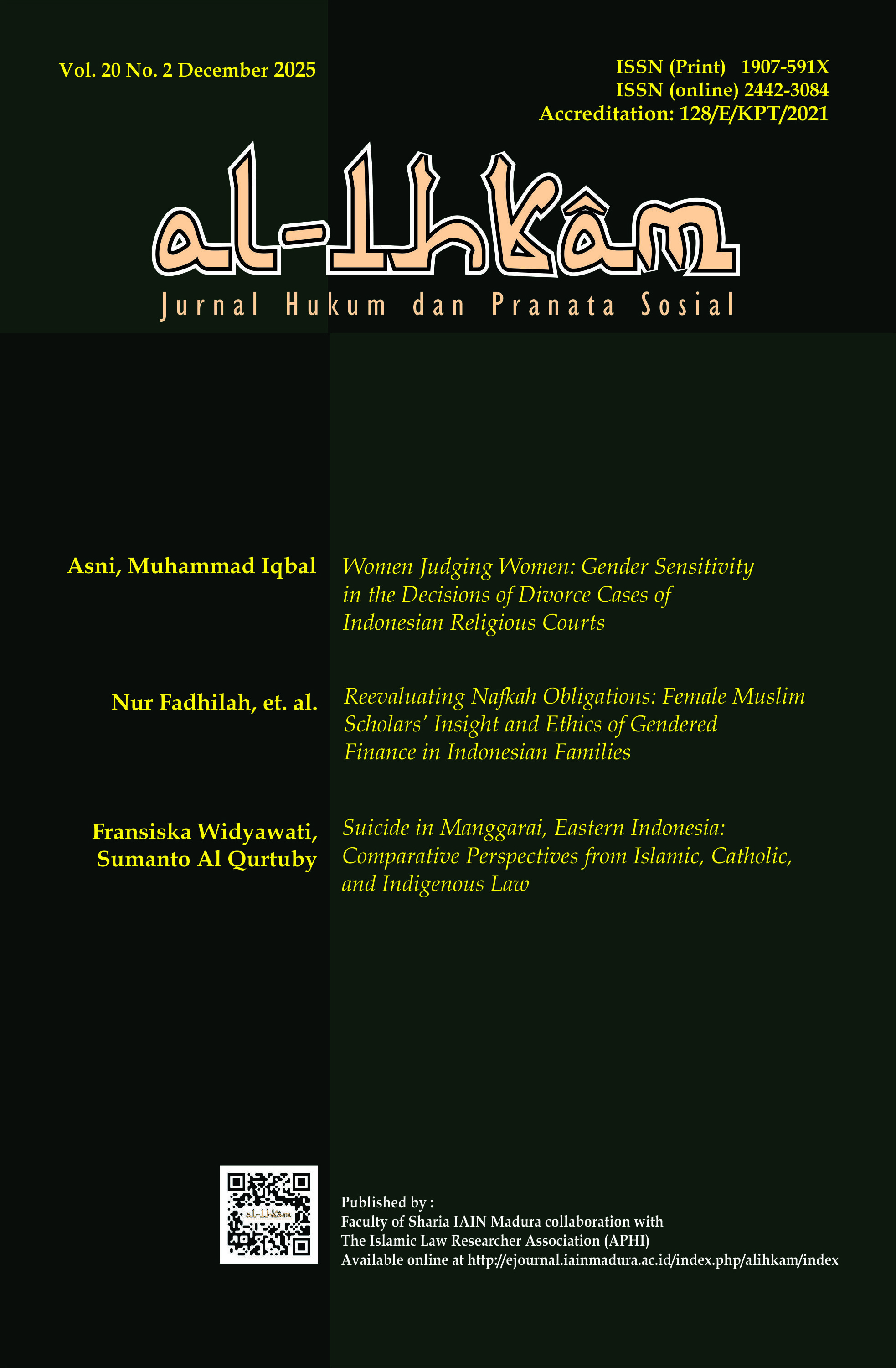
Women Judging Women: Gender Sensitivity in the Decisions of Divorce Cases of Indonesian Religious Courts

 Abstract views: 534
 PDF downloads: 540
Keywords:
Female judges; Gender sensitivity; Religious Courts; Moderate; ProgressiveAbstract
This article examines patterns of gender sensitivity in divorce rulings issued by female judges in Indonesian Religious Courts and analyzes the factors shaping their judicial reasoning. Using an empirical legal research design, the study combines document analysis of selected divorce decisions with in-depth interviews of female judges in several Religious Courts across Sulawesi. Guided by Alimatul Qibtiyah’s framework of gender sensitivity, the findings identify two dominant patterns: moderate and progressive. The moderate pattern is reflected in judicial reasoning that balances religious norms with social realities, emphasizing maṣlaḥah, harm prevention, and the psychological welfare of women and children within existing legal frameworks. The progressive pattern is evident in decisions that explicitly recognize domestic violence, economic neglect, and psychological abuse, and actively enforce women’s post-divorce rights, including nafkah ‘iddah, mut’ah, past maintenance, and child support, even in wife-initiated divorce cases. These patterns are influenced by factors such as gender-based empathy, professional experience, judicial training, and the implementation of Supreme Court regulations on gender-sensitive adjudication. This study highlights the role of female judges in advancing substantive justice in Islamic family law and underscores the importance of strengthening institutional support to ensure consistent protection of women’s rights in Religious Courts.
Downloads
References
Begum, Mohamed Sulthan Ismiya, Indriaty Ismail, Zul’Azmi Yaakob, Ahamed Sarjoon Razick, and Mohamed Mahroof Ali Abdullah. “Gender Equity in Muslim Family Law: Modern and Contemporary ‘Ulamā’s View.” Al-Ahkam 34, no. 2 (2024): 221–56. https://doi.org/10.21580/ahkam.2024.34.2.20773.
Bukido, Rosdalina, L. Sudirman, Suprijati Sarib, Nur Paikah, Anisa Putri Lestari Mokoginta, Misbahul Munir Makka, and Zayed Nawaf Awad Al-Dwairi. “The Resilience of Blind Families in Building a Sakinah Family: Adaptive Strategies and the Role of Islamic Values.” Nurani 25, no. 2 (2025): 399–425. https://doi.org/10.19109/nurani.v25i2.27276.
Burhanuddin, Eneng Nuraeni, Abdy Yuhana, Oyo Sunaryo Mukhlas, and Opik Rozikin. “Reconstructing Gender Justice in Kampung Kuta Ciamis Customary Law: A Patriarchal Culture Review.” Petita: Jurnal Kajian Ilmu Hukum dan Syariah 10, no. 1 (2025): 127–45. https://doi.org/10.22373/petita.v10i1.373.
Fakhyadi, Defel, Muhammad Adib Samsudin, Vito Dasrianto, Muhammad Danil, and Ade Arga Wahyudi. “Reconstructing Gender Relations for Family Resilience in Minangkabau: Integrating Islamic Law and Customary Law.” Al-Ahkam 35, no. 1 (2025): 1–30. https://doi.org/10.21580/ahkam.2025.35.1.22906.
Florence, Dwi. “Perempuan di Balik Palu: Perjuangan Hakim Perempuan dalam Dunia Patriarki.” Dandapala. June 25, 2025. https://dandapala.com/article/detail/perempuan-di-balik-palu-perjuangan-hakim-perempuan-dalam-dunia-patriarki.
Hariri, Achmad. “The Dialectics Feminism Paradigm of the Legal Marriage As a Form of Legal Protection in Women.” Syariah: Jurnal Hukum dan Pemikiran 21, no. 2 (2021): 125–36. https://doi.org/10.18592/sjhp.v21i2.3992.
Holden, Livia. “Women Judges in Pakistan.” International Journal of the Legal Profession 26, no. 1 (2019): 89–104. https://doi.org/10.1080/09695958.2018.1490296.
Kalem, Seda. “Being a Woman Judge in Turkish Judicial Culture.” International Journal of the Legal Profession 27, no. 2 (2020): 119–44. https://doi.org/10.1080/09695958.2019.1667807.
Kobko-Odarii, Viktoriia, Yuliia Leheza, Konstantin Sokolovskiy, Halyna Tatarenko, and Oleksandra Nestertsova-Sobakar. “Reconstructing Gender Equality in Family Law: A Normative and Comparative Analysis of European Family Law Systems in Religious Contexts.” Syariah: Jurnal Hukum dan Pemikiran 25, no. 1 (2025): 195–214. https://doi.org/10.18592/sjhp.v25i1.17694.
Latifiani, Dian, Yusriadi Yusriadi, Agus Sarono, Habib Al Fikry, and Mohammad Nur Cholis. “Reconstruction of E-Court Legal Culture in Civil Law Enforcement.” JILS (Journal of Indonesian Legal Studies) 7, no. 2 (2022): 557–84. https://doi.org/10.15294/jils.v7i2.59993.
McLoughlin, Kcasey. “‘Collegiality Is Not Compromise’: Farewell Justice Crennan, The Consensus Woman.” Australian Feminist Law Journal 42, no. 2 (2016): 241–71. https://doi.org/10.1080/13200968.2016.1254590.
Means, Taneisha N. “Her Honor: Black Women Judges’ Experiences with Disrespect and Recusal Requests in the American Judiciary.” Journal of Women, Politics and Policy 43, no. 3 (2022): 310–27. https://doi.org/10.1080/1554477X.2022.2068120.
Means, Taneisha N. “Her Honor: Black Women Judges’ Experiences with Disrespect and Recusal Requests in the American Judiciary.” Journal of Women, Politics and Policy 43, no. 3 (2022): 310–27. https://doi.org/10.1080/1554477X.2022.2068120.
Mittal, Gita, and Dipika Jain. “Women’s Equal Representation in the Higher Judiciary: A Case for Judicial Diversity in India.” International Journal of Comparative and Applied Criminal Justice 47, no. 2 (2023): 185–99. https://doi.org/10.1080/01924036.2022.2164317.
Mousmouti, Maria. “Gender-Sensitive Law-Making: Concept and Process.” Theory and Practice of Legislation 10, no. 3 (2022): 223–33. https://doi.org/10.1080/20508840.2022.2125704.
Nurlaelawati, Euis, and Arskal Salim. “Gendering the Islamic Judiciary: Female Judges in the Religious Courts of Indonesia.” Al-Jami’ah: Journal of Islamic Studies 51, no. 2 (2014): 247–78. https://doi.org/10.14421/ajis.2013.512.247-278.
Parkinson, Patrick. Family Law and the Indissolubility of Parenthood. Family Law and the Indissolubility of Parenthood. Cambridge: Cambridge University Press, 2011.
Protosavitska, Liudmyla. “Legal Aspects of Gender Equality and Their Legislative Consolidation.” Law. Human. Environment 14, no. 1 (2023): 88–106. https://doi.org/10.31548/law/1.2023.88.
Qibtiyah, Alimatul. “Intersections: The Conceptualisation of Gender Issues Among Gender Activists and Scholars in Indonesian Universities.” Intersections: Gender and Sexuality in Asia and the Pacific, 2012. https://doi.org/10.25911/Y7RR-NZ10.
Rahmaniah, Aniek, Emy Susanti, Dwi Windyastuti Budi Hendrarti, and Ulfi Andrian Sari. “The Movement of Muhammadiyah Women: Religious Values, Culture, and Gender Equality.” Jurnal Ilmiah Peuradeun 13, no. 1 (2025): 669–94. https://doi.org/10.26811/peuradeun.v13i1.1089.
Schultz, Ulrike. “Gender and Potential Impacts on Decision-Making in Arbitration: Experiences from Germany in an International Field.” International Journal of the Legal Profession 29, no. 1 (2022): 53–74. https://doi.org/10.1080/09695958.2021.1953502.
Schultz, Ulrike, and Gisela Shaw. Gender and Judging. New York: Bloomsbury Publishing, 2013.
Thahira, Zia, and Dwini Handayani. “The Impact of Mother’S Gender Preference on Children’S Cognitive Ability in Indonesia.” Jurnal Ilmiah Peuradeun 11, no. 3 (2023): 1027–52. https://doi.org/10.26811/peuradeun.v11i3.1008.
Voeten, Erik. “Gender and Judging: Evidence from the European Court of Human Right.” Journal of European Public Policy 28, no. 9 (2020): 1453–73. https://doi.org/10.1080/13501763.2020.1786146.
Voorhoeve, Maaike. “Gender and Judging in Tunisia and the Intersections of Penalty and Privilege.” Onati Socio-Legal Series 13, no. 3 (2023): 1118–40. https://doi.org/10.35295/OSLS.IISL/0000-0000-0000-1204.
Wei, Shuai. “Gendered Justice in China: Victim–Offender Mediation as the ‘Different Voice’ of Female Judges.” International Journal of Offender Therapy and Comparative Criminology 65, no. 4 (2021): 346–72. https://doi.org/10.1177/0306624X20936202.
Wei, Shuai, and Xin Xin. “Does Gender Play a Role in Divorce Mediation?: Working Pattern of Women Judges in China.” Asian Journal of Women’s Studies 19, no. 3 (2013): 149–71. https://doi.org/10.1080/12259276.2013.11666160.
Wright, Rosalind. “Sybil Campbell, First Woman Judge and Supporter of Higher Education for Women.” Women’s History Review 29, no. 4 (2020): 636–49. https://doi.org/10.1080/09612025.2019.1702785.
Downloads
Published
Issue
Section
License
Copyright (c) 2026 AL-IHKAM: Jurnal Hukum & Pranata Sosial

This work is licensed under a Creative Commons Attribution-ShareAlike 4.0 International License.
In order to be accepted and published by Al-Ihkam: Jurnal Hukum dan Pranata Sosial, author(s) submitting the article manuscript should complete all the review stages. By submitting the manuscript, the author(s) agreed to the following terms:
- The copyright of received articles shall be assigned to Al-Ihkam: Jurnal Hukum dan Pranata Sosial as the publisher of the journal. The intended copyright includes the right to publish articles in various forms (including reprints). Al-Ihkam: Jurnal Hukum dan Pranata Sosial maintain the publishing rights to the published articles.
- Authors are permitted to disseminate published articles by sharing the link/DOI of the article at Al-Ihkam: Jurnal Hukum dan Pranata Sosial. Authors are allowed to use their articles for any legal purposes deemed necessary without written permission from Al-Ihkam: Jurnal Hukum dan Pranata Sosial with an acknowledgment of initial publication to this journal.
- Users/public use of this website will be licensed to CC-BY-SA.
.png)

_1.png)


_page-00011.jpg)