Reevaluating Nafkah Obligations: Female Muslim Scholars’ Insight and Ethics of Gendered Finance in Indonesian Families

 Abstract views: 659
 PDF downloads: 608
Keywords:
Nafkah; Gender roles; MaqÄá¹£id al-usrah; Legal consciousnessAbstract
This study investigates how the Islamic legal obligation of nafkah, or spousal financial support, is reinterpreted in Muslim families in Indonesia through the lens of maqÄá¹£id al-usrah. It aims to explore how gender dynamics, legal consciousness, and economic realities reshape the meaning and practice of nafkah beyond traditional legal prescriptions. Employing a qualitative socio-legal method, the research integrates doctrinal analysis with empirical insights drawn from in-depth interviews with seven female Muslim scholars from pesantren-based and higher education academic communities in East Java. Thematic analysis based on the principles of maqÄá¹£id al-usrah reveals that while formal Islamic law defines nafkah as a unilateral male duty, lived experiences reflect a more collaborative and ethically responsive understanding. Informants demonstrate that financial responsibilities are frequently negotiated based on capability, mutual trust, and emotional stability, embodying values such as justice, compassion, and shared responsibility. The study further highlights how socio-cultural norms and internal religious reasoning influence women’s choices to either uphold or pragmatically reinterpret nafkah obligations. These findings underscore the relevance of maqÄá¹£id-based approaches in bridging doctrinal ideals with everyday realities, offering a pathway for reforming Islamic family law toward greater gender equity and contextual sensitivity.
Downloads
References
Agus Azhar Ma’arif Umpunan Alam, Andi Arsyad, Cikal Agung Pamungkas, et al. “Implementasi Prinsip-Prinsip Ekonomi Islam dalam Pengelolaan Keuangan Keluarga.†Journal of Economics and Business 2, no. 1 (2024): 34–42. https://doi.org/10.61994/econis.v2i1.465.
Ahmad Muhamad Mustain Nasoha, Adi Sulistiyono, Mudhofir, Ashfiya Nur Atqiya, and Ashfiya Nur Atqiya. “Relevance of Religious Court Decisions on Marriage to National Development Policy Directions: A Legal and Social Analysis.†Evolutionary Studies in Imaginative Culture 8, no. 1 (2024): 1340–47. https://doi.org/10.70082/esiculture.vi.1496.
Ali, Jan A. “Understanding Sharia Processes: Women’s Experiences of Family Disputes.†Journal of Law and Religion 38, no. 3 (2023): 485–88. https://doi.org/10.1017/jlr.2023.25.
Alias, Muhammad Nazir, Muhammad Najib Abdullah, Mohd Sham Kamis, Akhmad Jazuli Afandi, and Nursyahidah Alias. “Scientific Approach as the Basis for the Formation of MaqÄá¹£id Asy-syarī’ah Concept and Principles: A Comparative Study.†Malaysian Journal of Syariah and Law 12, no. 2 (2024): 350–63. https://doi.org/10.33102/mjsl.vol12no2.568.
Al-Sharmani, Mulki. “Islamic Feminist Hermeneutics: Between Scholarship and Lived Realities.†Journal of Feminist Studies in Religion 39, no. 2 (2023): 95–97. https://doi.org/10.2979/jfs.2023.a908305.
Athiyyah, Jamaluddin. Nahwa Taf`iil Maqashid Al-Syari'ah. Beirut: Daar Al-Fikr, 2002.
Attia, Gamal Eldin. Towards Realization of the Higher Intents of Islamic Law: Maqashid al-Syariah – A Functional Approach. Thought: International Institute of Islamic Thought, 2007.
Awoleye, Abayomi Folorunso, Bola Lukman Solanke, Joseph Ayodeji Kupoluyi, and Olufemi Mayowa Adetutu. “Exploring the Perception and Socio-Cultural Barriers to Safer Sex Negotiation among Married Women in Northwest Nigeria.†BMC Women’s Health 22, no. 1 (2022): 411. https://doi.org/10.1186/s12905-022-01989-3.
Azmi, Amylia Fuziana, Nor Laila Ahmad, Mohamad Zaharuddin Zakaria, Nik Salida, Suhaila Nik, and Mushaddad Hasbullah. “Unveiling the Significance of Proposing Habah as an Alternative to Nafkah Security for Widows.†Malaysian Journal Syariah and Law 12, no. 2 (2024): 529–34. https://doi.org/10.33102/mjsl.vol12no2.947.
Badan Pusat Statistik. “Jumlah Perceraian Menurut Provinsi Dan Faktor Penyebab Perceraian (Perkara), 2024.†BPS. February 14, 2025. https://www.bps.go.id/id/statistics-table/3/YVdoU1IwVmlTM2h4YzFoV1psWkViRXhqTlZwRFVUMDkjMw==/jumlah-perceraian-menurut-provinsi-dan-faktor-penyebab-perceraian--perkara---2024.html?year=2024.
Bakhshizadeh, Marziyeh. “A Social Psychological Critique on Islamic Feminism.†Religions 14, no. 2 (2023): 202. https://doi.org/10.3390/rel14020202.
Fadhilah, Nur, and Muhammad Nurravi Alamsyah. “Reinterpreting Financial Responsibilities in Islamic Marriage A Maqasid Al-Usrah Perspective.†Al-Syakhsiyyah: Journal of Law and Family Studies 7, no. 1 (2025): 1–26. https://doi.org/10.21154/syakhsiyyah.v7i1.
Fuad, Zainul, Surya Darma, and Muhibbuthabry Muhibbuthabry. “Wither Qanun Jinayat ? The Legal and Social Developments of Islamic Criminal Law in Indonesia.†Cogent Social Sciences 8, no. 1 (2022): 2053269. https://doi.org/10.1080/23311886.2022.2053269.
Garcia Rodriguez, Diego. “Reimagining Home and Responsibility: The Case of Queer Indonesian Muslims.†Sexualities 0, no. 0 (2024): 1–20. https://doi.org/10.1177/13634607241248894.
Güney, Necmeddin. “MaqÄsid Al-Sharī‘a in Islamic Finance: A Critical Analysis of Modern Discourses.†Religions 15, no. 1 (2024): 114. https://doi.org/10.3390/rel15010114.
Hanna, Siti, et al. "Woman and Fatwa: An Analytical Study of MUI’s Fatwa on Women’s Health and Beauty." AHKAM: Jurnal Ilmu Syariah 24.1 (2024): 171-184. https://doi.org/10.15408/ajis.v24i1.37832.
Hasan, Hamka, Asep S. Jahar, Nasaruddin Umar, and Irwan Abdullah. “Polygamy: Uncovering the Effect of Patriarchal Ideology on Gender-Biased Interpretation.†HTS Teologiese Studies / Theological Studies 78, no. 4 (2022): 1-9. https://doi.org/10.4102/hts.v78i4.7970.
Hattab, Muayad, and Mohammad Abualrob. “Under the Veil: Women’s Economic and Marriage Rights in Palestine.†Humanities and Social Sciences Communications 10, no. 1 (2023): 1–11. https://doi.org/10.1057/s41599-023-01591-4.
Huda, Miftahul, Agus Purnomo, Abdul Mun’im, Lutfi Hadi Aminuddin, and Lukman Santoso. “Tradition, Wisdom and Negotiating Marriage and Inheritance Disputes on Javanese Muslim.†Al-Istinbath: Jurnal Hukum Islam 9, no. 1 (2024): 1-25. https://doi.org/10.29240/jhi.v9i1.9887.
Hussin, Mohd Norhusairi Mat, and Muhammad Farid Aizat Fauzi. “Alimony of Children by Deducting of Employees Provident Fund : An Alternative.†Journal of Legal Studies 14, no. 1 (2002): 333–63. https://doi.org/10.32890/uumjls2023.14.1.13.
Iqbal, Roshan. “Nurturing Gender Justice: Qurʾanic Interpretation and Muslim Feminist Thought.†Journal of Feminist Studies in Religion 39, no. 2 (2023): 59–61. https://doi.org/10.2979/jfs.2023.a908296.
Issaka-Toure, Fulera. “Application of Muslim Family Law as a Form of Customary Law in Accra, Ghana.†Islamic Africa 11, no. 2 (2021): 232–51. https://doi.org/10.1163/21540993-01102004.
Issaka-Toure, Fulera, and Ousseina Alidou. “Introduction: Current Perspectives on Islamic Family Law in Africa.†Islamic Africa 11, no. 2 (2021): 153–62. https://doi.org/10.1163/21540993-01101016.
Jauhari, Iman, Zamakhsyari Bin hasballah Thaib, M. Jafar, TM Ali Bahar, M. Jamil, Muhammad Yusuf, and Zaini Dahlan. “The Qur’an and Islamic Legal Perspectives on Child Protection.†Pharos Journal of Theology 104, no. 4 (2023): 1–13. https://doi.org/10.46222/pharosjot.104.417.
Juliansyahzen, Muhammad Iqbal, et al. "Between Sharia, Gender, and Science in the Construction of ‘Iddah: The Response of Banyumas' Ulamas." El-Mashlahah 14.1 (2024): 189-210. https://doi.org/10.23971/el-mashlahah.v14i1.7917.
Khawar, Mariam. “Economic Agency of Women in Islamic Economic Philosophy: Going beyond Economic Man and Islamic Man.†International Journal of Social Economics 51, no. 3 (2024): 364–76. https://doi.org/10.1108/IJSE-05-2023-0366.
Kloos, David, and Nor Ismah. “Siting Islamic Feminism: The Indonesian Congress of Women Islamic Scholars and the Challenge of Challenging Patriarchal Authority.†History and Anthropology 34, no. 5 (2023): 818–43. https://doi.org/10.1080/02757206.2023.2249495.
Mahamid, Fayez, Muayad Hattab, and Denise Berte. “Palestinian Law to Protect Family and Prevent Violence: Challenges with Public Opinion.†BMC Public Health 23, no. 1 (2023): 412. https://doi.org/10.1186/s12889-023-15276-9.
Ma’mun, Sukron, and Ibnu Akbar Maliki. “A Socio-Historical Study of Women’s Rights Advocacy in Islamic Legal Construction.†Journal of Southeast Asian Human Rights 7, no. 1 (2023): 1-17. https://doi.org/10.19184/jseahr.v7i1.39156.
Mohadi, Mawloud. “Normative Islamic Conceptualizations of Families and Kinship Through Maqasid Perspectives: A Comprehensive Literature Study.†Malaysian Journal of Syariah and Law 11, no. 2 (2023): 290–309. https://doi.org/10.33102/mjsl.vol11no2.459.
Mulcahy, Linda, and Rachel Cahillâ€O’Callaghan. “Introduction: Socioâ€legal Methodologies.†Journal of Law and Society 48, no. 1 (2021): 1-25. https://doi.org/10.1111/jols.12336.
Mun'im, Zainul, et al. "Revisioning Official Islam in Indonesia: The Role of Women Ulama Congress in Reproducing Female Authority in Islamic Law." AHKAM: Jurnal Ilmu Syariah 24.1 (2024): 135-152. https://doi.org/10.15408/ajis.v24i1.34744.
Nihayah, Zahrotun, Sururin Sururin, Choirunnisa Choirunnisa, Dinnisa Haura Zhafira Hidayat, Syahirul Alim, and Mohammad Fayruz. “The Effect of Forgiveness and Spouse Social Support on Marital Satisfaction from the Perspective of Islamic Ethics.†Islamic Guidance and Counseling Journal 6, no. 1 (2023): 99–112. https://doi.org/10.25217/igcj.v6i1.3254.
Parnell, Katie J., Kiome A. Pope, Sophie Hart, et al. “‘It’s a Man’s World’: A Gender-Equitable Scoping Review of Gender, Transportation, and Work.†Ergonomics 65, no. 11 (2022): 1537–53. https://doi.org/10.1080/00140139.2022.2070662.
Rachmadhani, Fajar, Mualimin Mochammad Sahid, and Muchammad Ichsan. “The Use of Sadd Al-Dhari’ah on Contemporary Islamic Family Law in Indonesia: Concept and Practice.†Malaysian Journal of Syariah and Law 12, no. 1 (2024): 206–15. https://doi.org/10.33102/mjsl.vol12no1.505.
Rais, Isnawati. “The Impact of COVID-19 Pandemic on Divorce Rates among Indonesian Muslim Societies.†Indonesian Journal of Islam and Muslim Societies 11, no. 2 (2021): 271–97. https://doi.org/10.18326/ijims.v11i2.271-297.
Reda, Nevin. “Gender-Based Research in Qur’anic Studies: Concluding Remarks.†Journal of Feminist Studies in Religion 39, no. 2 (2023): 101–2. https://doi.org/10.2979/jfs.2023.a908307.
Rinaldo, Rachel, Eva F. Nisa, and Nina Nurmila. “Divorce Narratives and Class Inequalities in Indonesia.†Journal of Family Issues 45, no. 5 (2024): 1195–216. https://doi.org/10.1177/0192513X231155657.
Ristawati, Rosa, and Radian Salman. “The Role of The Indonesian Constitutional Court in Preventing Social Conflict in A Diverse Society.†Constitutional Review 9, no. 2 (2023): 332–57. https://doi.org/10.31078/consrev925.
Saiin, Asrizal, et al. "Walking Together: Dynamics of Muslim Wives Dual Role in Rural Areas Pursuing Career and Household Responsibilities." El-Mashlahah 14.1 (2024): 127-148. https://doi.org/10.23971/el-mashlahah.v14i1.7827.
Setiyawan, Deni, et al. "Exploring Abhakalan Culture (Early Marriage) in Madura: A Dialogue of Customary Law, Religion, and The State." Ahkam: Jurnal Ilmu Syariah 24.2 (2024): 345-364. https://doi.org/10.15408/ajis.v24i2.36070.
Shah, Waqar Ali, and Asadullah Lashari. “Regimes of Patriarchy and Faith: Reflections on Challenges in Interviewing Women and Religious Minorities in Pakistan.†Qualitative Research Journal 23, no. 5 (2023): 471–84. https://doi.org/10.1108/QRJ-02-2023-0018.
Showkat, Arshi. “The Principle and Practice of Mahr in Muslim Marriages.†Feminist Theology 31, no. 2 (2022): 197–209. https://doi.org/10.1177/09667350221134992.
Solikin, Nur, and Moh. Wasik. “The Construction of Family Law in the Compilation of Islamic Law in Indonesia: A Review of John Rawls’s Concept of Justice and Jasser Auda’s Maqashid Al-Shari’A.†Ulumuna 27, no. 1 (2023): 315–40. https://doi.org/10.20414/ujis.v27i1.708.
Subchi, Imam, Asep Saepudin Jahar, Faculty of Sharia & Law, UIN Syarif Hidayatullah Jakarta, Indonesia, et al. “Negotiating Religiosity in a Secular Society: A Study of Indonesian Muslim Female Migrant Workers in Hong Kong.†Journal of Population and Social Studies 30 (2021): 147–69. https://doi.org/10.25133/JPSSv302022.010.
Vatuk, Sylvia. “Muslim Daughters and Inheritance in India: Sharīc at , Custom and Practice.†Contemporary South Asia 30, no. 1 (2022): 16–29. https://doi.org/10.1080/09584935.2021.2021854.
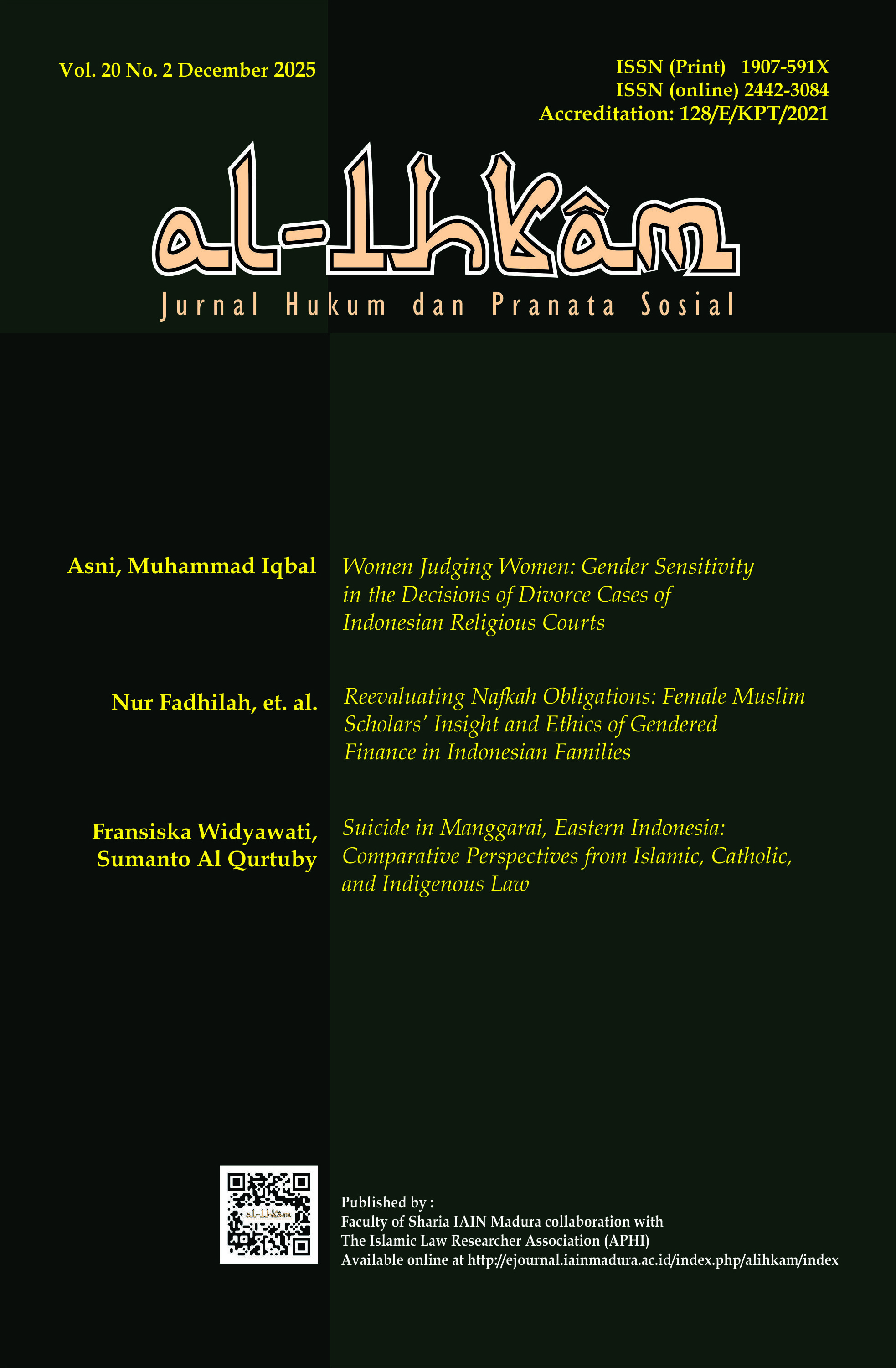
Downloads
Published
Issue
Section
License
In order to be accepted and published by Al-Ihkam: Jurnal Hukum dan Pranata Sosial, author(s) submitting the article manuscript should complete all the review stages. By submitting the manuscript, the author(s) agreed to the following terms:
- The copyright of received articles shall be assigned to Al-Ihkam: Jurnal Hukum dan Pranata Sosial as the publisher of the journal. The intended copyright includes the right to publish articles in various forms (including reprints). Al-Ihkam: Jurnal Hukum dan Pranata Sosial maintain the publishing rights to the published articles.
- Authors are permitted to disseminate published articles by sharing the link/DOI of the article at Al-Ihkam: Jurnal Hukum dan Pranata Sosial. Authors are allowed to use their articles for any legal purposes deemed necessary without written permission from Al-Ihkam: Jurnal Hukum dan Pranata Sosial with an acknowledgment of initial publication to this journal.
- Users/public use of this website will be licensed to CC-BY-SA.
.png)

_1.png)


_page-00011.jpg)