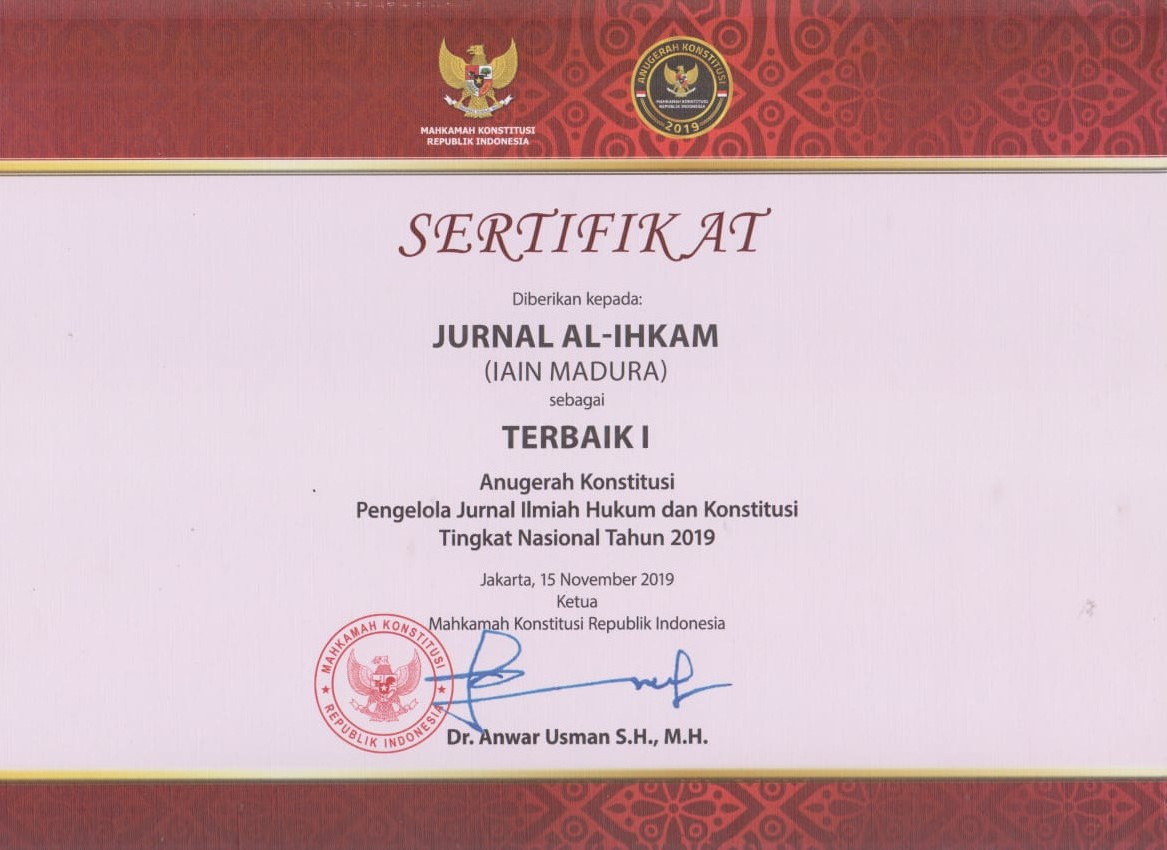
Legal Harmony: Integration of Customary, National, and Islamic Criminal Law in the Toraja Ma’rambu Langi

 Abstract views: 657
 PDF downloads: 293
Keywords:
Ma’rambu langi customary law; legal pluralism; Islamic criminal lawAbstract
This research explores the integration of customary law, national law, and Islamic criminal law through a case study of ma’rambu langi in the Toraja community by firstly examining its effectiveness. Ma’rambu langi is a form of customary sanction imposed for severe moral violations, such as adultery and other breaches of local traditions. This sanction aims not merely to punish, but to restore social harmony through symbolic and public acts of moral responsibility. The offender is required to confess the wrongdoing and seek reconciliation with the community. The research adopts a qualitative method using semi-structured interviews with traditional leaders, community members, and legal practitioners, along with document analysis that includes customary case archives, court decisions, and relevant academic literature. The findings reveal that ma’rambu langi plays a significant role in maintaining social order, preventing the recurrence of offenses, and reinforcing the authority of customary law. Moreover, the study indicates that elements of this customary practice resonate with values in both national and Islamic criminal law, particularly in emphasizing restorative justice and communal integrity. The research contributes to ongoing discussions on legal pluralism in Indonesia, suggesting that harmonizing customary, national, and religious legal systems can enrich the development of a more inclusive, context-sensitive, and sustainable legal framework. It also emphasizes the importance of recognizing local wisdom in addressing moral and social issues while ensuring compatibility with broader legal principles and human rights norms.
Downloads
References
Adi, Rianto. Sosiologi Hukum: Kajian Hukum Secara Sosiologis. Jakarta: Yayasan Pustaka Obor Indonesia, 2012.
Amelinda, Ristia Desmonda, and Gayatri Dyah Suprobowati. “Legal Protection of Women as Victims of Sexual Violence in Madadan Tana Toraja.†Journal of Law, Society, and Islamic Civilization 13, no. 1 (2025): 47–54. https://doi.org/10.20961/jolsic.v13i1.94729.
Armawi, Armaidy, and Desy Susilawati. “Konstruksi Identitas Nasionalisme dalam Pikukuh Masyarakat Adat Baduy.†Paradigma: Jurnal Kajian Budaya 11, no. 2 (2021): 151–66. https://doi.org/10.17510/paradigma.v11i2.530.
Asteria, Donna, Putri Alvernia, Berliana Nur Kholila, Sabarina Isma Husein, and Farha Widya Asrofani. “Forest Conservation by the Indigenous Baduy Community in the Form of Customary Law.†Journal of Cultural Heritage Management and Sustainable Development 14, no. 2 (2024): 175–89. https://doi.org/10.1108/JCHMSD-12-2020-0171.
Bauw, Lily, and Bambang Sugiono. “Pengaturan Hak Masyarakat Hukum Adat di Papua dalam Pemanfaatan Sumber Daya Alam.†Jurnal Konstitusi 1, no. 1 (2009): 1–23. https://doi.org/10.31078/jk2249.
Borean, Melki. “Penerapan Sanksi Pidana Adat Ma’Rambu Langi’ terhadap Pelaku Delik Asusila pada Anak di Tana Toraja.†Universitas Hasanuddin Makassar, 2024.
Bowen, Glenn A. “Document Analysis as a Qualitative Research Method.†Qualitative Research Journal 9, no. 2 (2009): 27–40. https://doi.org/10.3316/QRJ0902027.
Carter, Elizabeth R. “Adultery Provisions in Matrimonial Agreements.†Amirican University Law Review 73 (2023): 679–80. https://digitalcommons.wcl.american.edu/aulr/vol73/iss3/2/.
Davies, John R. Islam, Law, and Equality in Indonesia: An Anthropology of Public Reasoning. New York: Cambridge, 2003.
Haq, Islamul, Hannani, Abdul Syatar, and Musmulyadi Muhammad Majdy Amiruddin. “Unlocking The Potential of ‘Kalosara’: An Extensive Analysis of Adultery Instances Dispute Resolution in the Tolaki Tribe through the Lens of Al-Ishlah Concept.†Al- Risalah: Forum Kajian Hukum dan Sosial Kemasyarakatan 24, no. 1 (2024): 86–100. https://doi.org/10.30631/alrisalah.v24i1.1488.
Haq, Islamul, Muliati, Muhammad Majdy Amiruddin, Nur Misyuari Maddolangeng, and Hamza Abed Al Karim Hammad. “I’adah Al-Nadzr (Reconsideration): A Critical Comparative Study between Indonesian Law and Saudi Arabian Law Perspectives (Fiqh Murafa’at).†Al-Istinbath: Jurnal Hukum Islam 7, no. 2 (2022): 311–28. https://doi.org/10.29240/jhi.v7i2.5248.
Haq, Islamul. “Kriminalitas dalam Pendekatan Aqidah dan Syariat.†Jurnal Hukum Islam 18, no. 1 (2020): 103–20. https://doi.org/10.28918/jhi.v18i1.2663.
———. “Prison in Review of Islamic Criminal Law: Between Human and Deterrent Effects.†Samarah: Jurnal Hukum Keluarga dan Hukum Islam 4, no 1 (2020): 132-50. https://doi.org/10.22373/sjhk.v4i1.6683
Hooker, M. B. Adat Law in Modern Indonesia. Oxford: Oxford University Press, 1978.
Jamshed, Shazia. “Qualitative Research Method-Interviewing and Observation.†Journal of Basic and Clinical Pharmacy 5, no. 4 (2014): 87–88. https://doi.org/10.4103/0976-0105.141942.
Januaris, Fadli, M Khairul Arwani, Adi Jumanda, Ilham Utama Yazid, Yernati Ulfazah, and Rahimatul Fikri. “Combating Corruption in Indonesia Through Islamic Criminal Law and Customary Criminal Law.†Hakamain: Journal of Sharia and Law Studies 2, no. 2 (2024): 221–31. https://doi.org/10.57255/hakamain.v2i2.333.
Kamali, M. H. Shari’ah Law: An Introduction. Oxford: Oneworld Publication, 2008.
Kholiyudani, Ahmad, and Muhammad Hipni. “Tradisi Sangkolan di Desa Karduluk: Perspektif Antropologi terhadap Fiqih Islam.†Jurnal Syari’ah & Hukum 6, no. 2 (2024): 243–67. https://doi.org/10.20885/mawarid.vol6.iss2.art6.
Merry, S. “Anthropology, Law, and Transnational Processes.†Annual Review of Anthropology 21, no. 1 (1992): 357–79. https://doi.org/10.1146/annurev.anthro.21.1.357.
Palmer, Michael, and Ling Zhou. “Legal Pluralism.†In Elgar Encyclopedia of Comparative Law, edited by Jan M. Smits, Jaakko Husa, Catherine Valcke, and Madalena Narciso, 22: 490–501. Herndon: Elgar Online, 2023.
Pimentel, David. “Rule of Law Reform Without Cultural Imperialism? Reinforcing Customary Justice Through Collateral Review in Southern Sudan.†Hague Journal on the Rule of Law 2, no. 1 (2010): 1–28. https://doi.org/10.1017/S1876404510100013.
Prayoga, Reza Amarta, Abdul Hafid, and Entis Sutisna. "The State’s Responsibility in Preserving Local Culture: A Constitutional Law Perspective on the Practice of Akapalumba Jarangk." Volksgeist: Jurnal Ilmu Hukurn dan Konstitusi 8, no. 1 (2025): https://doi.org/10.24090/volksgeist.v8i1.12334.
Pria Suhartana, Lalu Wira, et al. "Risk-Based Mining Investment in the Framework of Fair Legal Certainty." Volksgeist: Jurnal Ilmu Hukurn dan Konstitusi 8, no. 1 (2025): https://doi.org/10.24090/volksgeist.v8i1.12894.
Ramadhani, Evyta Rosiyanti, Ayudya Rizqi Rachmawati, and Roro Hera Kurnikova. "Integrating Islamic Values with the Right to Be Forgotten: A Legal Approach to Addressing Deepfake Pornography in Indonesia." De Jure: Jurnal Hukum dan Syar'iah 17, no. 1 (2025): 112-131. http://dx.doi.org/10.18860/j-fsh.v17i1.28880.
Rofiq, Ahmad, Pujiyono Pujiyono, and Barda Nawawi Arief. “Eksistensi Tindak Pidana Ta’zir dalam Kehidupan Masyarakat Indonesia.†Journal of Judicial Review 23, no. 2 (2021): 241–56. https://doi.org/10.37253/jjr.v23i2.4957.
Sahiman, Afdal. “Penerapan Hukum Adat dalam Penyelesaian Konflik di Desa Embonatana Kecamatan Seko Kabupaten Luwu Utara.†Universitas Islam Negeri Palopo, 2025.
Salman, Radian, et al. "Non-Judicial Activities of the Indonesian Constitutional Court: Do They Foster Judicial Reputation?." Volksgeist Jurnal Ilmu Hukum Dan Konstitusi 8, no. 1 (2025): 231-261. https://doi.org/10.24090/volksgeist.v8i1.12239.
Schrauwers, Albert. “Houses of Worship in Central Sulawesi: Precedence, Hierarchy & Class in the Development of House Ideology.†Anthropological Forum 26, no. 4 (2016): 333–54. https://doi.org/10.1080/00664677.2016.1240659.
Setyowati, Dewi. “Memahami Konsep Restorative Justice Sebagai Upaya Sistem Peradilan Pidana Menggapai Keadilan.†Pandecta Research Law Journal 15, no. 1 (2020): 121–41. https://doi.org/10.15294/pandecta.v15i1.24689.
Shelton, Dinah. “Righting Wrongs: Reparations in the Articles on State Responsibility.†American Journal of International Law 96, no. 4 (2002): 833–56. https://doi.org/10.2307/3070681.
Siboy, Ahmad, and Sholahuddin AlFatih. "The Design of Preventive Control on Local Delegated Legislation: A Case Study of Regional Head Regulations." Volksgeist: Jurnal Ilmu Hukurn dan Konstitusi 8, no. 1 (2025). https://doi.org/10.24090/volksgeist.v8i1.12862.
Sirait, Adi Syahputra, Mhd Syahnan, and Budi Sastra Panjaitan. “Community Service Order Punishment: Alternatives in the Criminal Law System From MaqÄá¹£id Al-Sharī’ah Perspective.†Nurani: Jurnal Kajian Syari’ah dan Masyarakat 24, no. 2 (2024): 273–96. https://doi.org/10.19109/nurani.v24i2.24276.
Sloane, Robert D. “The Expressive Capacity of International Punishment: The Limits of the National Law Analogy and the Potential of International Criminal Law.†In Globalization of Criminal Justice, 315–70. London: Routledge, 2017.
Tonapa, Joni Bane. “Pelaku Pencabulan terhadap Anak Tirinya di Tana Toraja Disanksi Adat Tertinggi Ma’rambu Langi’.†TV One. November 8, 2023. https://www.tvonenews.com/daerah/sulawesi/165323-pelaku-pencabulan-terhadap-anak-tirinya-di-tana-toraja-disanksi-adat-tertinggi-marambu-langi.
Tuerah, Freedy Samuel. “Mengenal Ritual Ma’rambu Langi’, Prosesi Adat di Toraja Saat Ada Yang Melakukan Pelanggaran.†Tribun News. November 7, 2023. https://toraja.tribunnews.com/2023/11/07/mengenal-ritual-marambu-langi-prosesi-adat-di-toraja-saat-ada-yang-melakukan-pelanggaran.
Downloads
Published
Issue
Section
License
In order to be accepted and published by Al-Ihkam: Jurnal Hukum dan Pranata Sosial, author(s) submitting the article manuscript should complete all the review stages. By submitting the manuscript, the author(s) agreed to the following terms:
- The copyright of received articles shall be assigned to Al-Ihkam: Jurnal Hukum dan Pranata Sosial as the publisher of the journal. The intended copyright includes the right to publish articles in various forms (including reprints). Al-Ihkam: Jurnal Hukum dan Pranata Sosial maintain the publishing rights to the published articles.
- Authors are permitted to disseminate published articles by sharing the link/DOI of the article at Al-Ihkam: Jurnal Hukum dan Pranata Sosial. Authors are allowed to use their articles for any legal purposes deemed necessary without written permission from Al-Ihkam: Jurnal Hukum dan Pranata Sosial with an acknowledgment of initial publication to this journal.
- Users/public use of this website will be licensed to CC-BY-SA.
.png)

_1.png)


_page-00011.jpg)