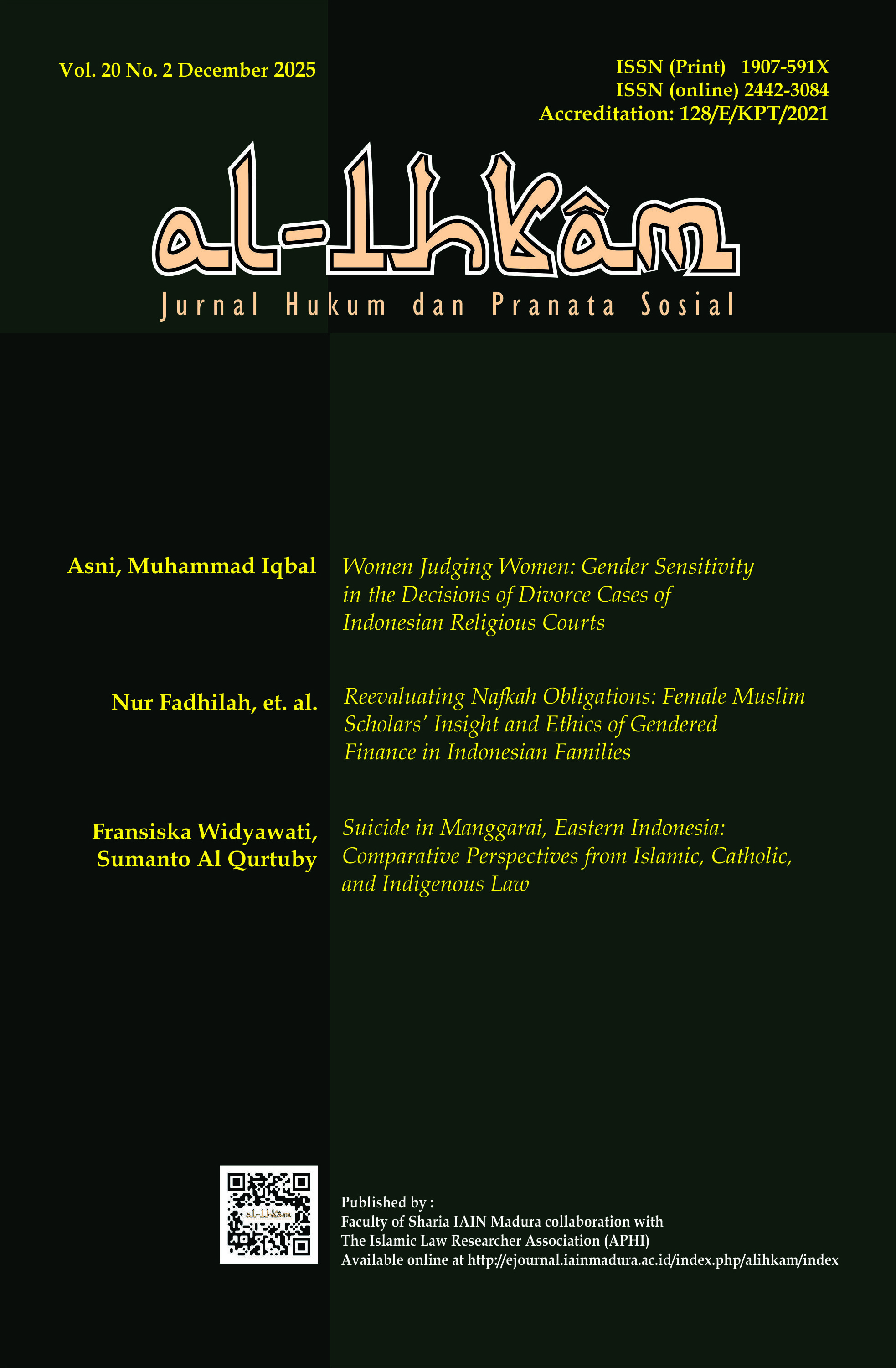
Suicide in Manggarai, Eastern Indonesia: Comparative Perspectives from Islamic, Catholic, and Indigenous Law

 Abstract views: 961
 PDF downloads: 416
Keywords:
Suicide; Islam; Catholic; Local Culture; LawAbstract
Suicide is a complex phenomenon that affects individuals and society, demanding global attention and requiring diverse approaches to be fully understood. This article presents a comparative study of suicide, analyzing both its conceptual and practical aspects within the frameworks of Islamic law, Catholic law, and customary law. For the conceptual analysis, a literature review focusing primarily on Islamic and Catholic law was utilized, while for the practical aspects in religious and customary communities, an ethnographic method was utilized. The research reveals both similarities and differences in how Islamic, Catholic, and local customary laws view suicide. All three perspectives condemn suicide as an act that contradicts life and violates their respective legal and moral codes. Although local cultural practices and the religious traditions in Manggarai—including both Christianity and Islam—generally disapprove of suicide, community responses to it vary. Religious approaches tend to be legalistic, individualistic, and moralistic, whereas Manggarai customary law emphasizes a communal, solution-oriented, and harmonious approach. This study contributes to the understanding of interfaith and intercultural perspectives as essential in addressing social issues, including suicide.
Downloads
References
Abdel-Khalek, Ahmed M. “Neither Altruistic Suicide, nor Terrorism but Martyrdom: A Muslim Perspective.†Archives of Suicide Research 8, no. 1 (2004): 99–113. https://doi.org/10.1080/13811110490243840.
Abdelhadi, Magdi. “The Arrival in Britain of the Islamic Preacher, Yusuf Al-Qaradawi, to Take Part in a Conference Has Sparked a Row Because of His Controversial Views on Suicide Bombings.†News BBC. July 7, 2004. http://news.bbc.co.uk/2/hi/uk_news/3874893.stm.
Adamiak, Stanisław, and Jan Dohnalik. “The Prohibition of Suicide and Its Theological Rationale in Catholic Moral and Canonical Tradition: Origins and Development.†Journal of Religion and Health 62, no. 6 (2023): 3820–33. https://doi.org/10.1007/s10943-023-01900-w.
Allerton, Catherine. “Static Crosses and Working Spirits: Anti-Syncretism and Agricultural Animism in Catholic West Flores.†Anthropological Forum 19, no. 3 (2009): 271–87. https://doi.org/10.1080/00664670903278403.
Andriolo, Karin. “Murder by Suicide: Episodes from Muslim History.†American Anthropologist 104, no. 3 (2002): 736–42. https://doi.org/10.1525/aa.2002.104.3.736.
Arif, Rauf. “Social Movements, YouTube and Political Activism in Authoritarian Countries: A Comparative Analysis of Political Change in Pakistan, Tunisia & Egypt.†University of Iowa, 2014. https://doi.org/10.17077/etd.ej7y9nzm.
Arpangi, et al. "Resolution of Industrial Relations Disputes in Court Rulings and the Fair Fulfillment of Workers' Rights in Indonesia: An Islamic Legal Perspective." JURIS (Jurnal Ilmiah Syariah) 24.1 (2025): 51-62. https://doi.org/10.31958/juris.v24i1.13423.
Avon, Dominique. “Suicide, Islam, and Politics: Reflections on the Events in Tunisia.†Books and Ideas. Oxford, 2011. https://shs.hal.science/halshs-01631228/document.
Badan Pusat Statistik Provinsi Nusa TenggaraTimur. “Banyaknya Desa Menurut Keberadaan Korban Bunuh Diri , 2024.†NTT BPS. January 20, 2025. http://ntt.bps.go.id/id/statistics-table/2/NzMzIzI=/banyaknya-desa-menurut-keberadaan-korban-bunuh-diri.html.
Barry, Robert. “The Development of the Roman Catholic Teachings on Suicide.†Notre Dame Journal of Law, Ethics & Public Policy 9, no. 2 (1995): 449–501. https://scholarship.law.nd.edu/ndjlepp/vol9/iss2/4.
Beauchamp, Tom L. “Suicide in the Age of Reason.†In Suicide and Euthanasia, 35th ed., 183–219. Heidelberg: Springer Nature, 1989. https://doi.org/10.1007/978-94-015-7838-7_6.
Becker, Sascha O, and Ludger Woessmann. “Social Cohesion, Religious Beliefs, and the Effect of Protestantism on Suicide.†The Review of Economics and Statistics 100, no. 3 (2021): 377–91. https://doi.org/10.1162/rest.
Chapple, Alison, Sue Ziebland, and Keith Hawton. “Taboo and the Different Death? Perceptions of Those Bereaved by Suicide or Other Traumatic Death.†Sociology of Health and Illness 37, no. 4 (2015): 610–25. https://doi.org/10.1111/1467-9566.12224.
Colucci, Ermina. “Cultural Meaning(s) of Suicide: A Cross-Cultural Study.†Suicide and Culture: Understanding the Context. Cambridge: Hogrefe Publishing, 2013.
Dale, Stephen Frederic. “Religious Suicide in Islamic Asia: Anticolonial Terrorism in India, Indonesia, and the Philippines.†Journal of Conflict Resolution 32, no. 1 (1988): 37–59. https://doi.org/10.1177/0022002788032001002.
Durkheim, Emile. Suicide: A Study in Sociology. New York: Free Press, 1951.
Fair, C. Christine, Julie Chernov Hwang, and Moiz Abdul Majid. “The Pious or the Doctrinaire? Who Supports Suicide Terrorism in Indonesia?†Asian Security 16, no. 3 (2020): 281–303. https://doi.org/10.1080/14799855.2019.1670641.
Głowala, Justyna. “Martyrdom, Suicide and Absolute Negative Norms.†Studia Philosophiae Christianae UKSW 51, no. 2 (2015): 1–35. https://www.ceeol.com/search/article-detail?id=512825.
Grudecki, Michał, and Mateusz Sajkowski. “Suicide from the Joint Perspective of Canon Law and Polish Law.†Acta Iuris Stetinensis 31, no. 3 (2020): 23–39. https://doi.org/10.18276/ais.2020.31-02.
Guedria-Tekari, Asma, Sonia Missaoui, Wassim Kalai, Naoufel Gaddour, and Lotfi Gaha. “Suicidal Ideation and Suicide Attempts among Tunisian Adolescents: Prevalence and Associated Factors.†Pan African Medical Journal 34, no. 1 (2019): 1–13. https://doi.org/10.11604/pamj.2019.34.105.19920.
Hariyanto, Muhammad Mutawalli Mukhlis, and Daud Rismana. "The Role and Authority of the Deputy Regional Head According to Islamic Principles within the Framework of Regional Government Law." JURIS (Jurnal Ilmiah Syariah) 24.1 (2025): 13-27. https://doi.org/10.31958/juris.v24i1.12678.
Hoel, Nikolas O. “Hues of Martyrdom: Monastic and Lay Asceticism in Two Homilies of Gregory the Great on the Gospels.†The Downside Review 138, no. 1 (2020): 3–18. https://doi.org/10.1177/0012580620910973.
Hooff, Anton J.L. Van. “Voluntary Death in Latin.†In Latin Studies in Honour of JH Brouwers, edited by Litteras. Nijmegen: Nijmegen University, 2001.
Ineichen, Bernard. “The Influence of Religion on the Suicide Rate: Islam and Hinduism Compared.†Mental Health, Religion & Culture 1, no. 1 (May 1, 1998): 31–36. https://doi.org/10.1080/13674679808406495.
Lawrence, Ryan E, Maria A Oquendo, and Barbara Stanley. “Religion and Suicide Risk: A Systematic Review.†Archives of Suicide Research : Official Journal of the International Academy for Suicide Research 20, no. 1 (2016): 1–21. https://doi.org/10.1080/13811118.2015.1004494.
Le, Minh Thi Hong, Huong Thanh Nguyen, Thach Duc Tran, and Jane R.W. Fisher. “Experience of Low Mood and Suicidal Behaviors among Adolescents in Vietnam: Findings from Two National Population-Based Surveys.†Journal of Adolescent Health 51, no. 4 (2012): 339–48. https://doi.org/10.1016/j.jadohealth.2011.12.027.
Lenzi, Matteo, Erminia Colucci, and Harry Minas. “Suicide, Culture, and Society from a Cross-National Perspective.†Cross-Cultural Research 46, no. 1 (2011): 50–71. https://doi.org/10.1177/1069397111424036.
Lester, David. “Suicide and Islam.†Archives of Suicide Research 10, no. 1 (2006): 77–97. https://doi.org/10.1080/13811110500318489.
Lewis, Bernard. The Assassins: A Radical Sect in Islam. New York: Basic Books, 1968.
Lon, Yohanes S, and Fransiska Widyawati. “Food and Local Social Harmony: Pork, Communal Dining, and Muslim-Christian Relations in Flores, Indonesia.†Studia Islamika, 2019. https://doi.org/10.36712/sdi.v26i3.9917.
Middleton, Paul. “What Is Martyrdom?†Mortality 19, no. 2 (2014): 117–33. https://doi.org/10.1080/13576275.2014.894013.
Munir, Muhammad. “Suicide Attacks and Islamic Law.†International Review of the Red Cross 90, no. 869 (2008): 71–89. https://doi.org/10.1017/S1816383108000040.
Nelson, Graham, Ryan Hanna, Alaa Houri, and Bonnie Klimes-Dougan. “Protective Functions of Religious Traditions for Suicide Risk.†Suicidology Onlinee 3, no. 2009 (2012): 59–71. https://api.semanticscholar.org/CorpusID:45055924.
Nöldeke, Theodor. Sketches from Eastern History. London: Adam and Charles Black, 1982.
O’Loughlin, Thomas. “Eucharistic Celebrations: The Chasm between Idea and Action.†New Blackfriars 91, no. 1034 (2010): 423–38. https://doi.org/10.1111/j.1741-2005.2009.01322.x.
Onie, Sandersan, Yuslely Usman, Retno Widyastuti, Merry Lusiana, Tri Juni Angkasawati, Dede Anwar Musadad, Jessica Nilam, et al. “Indonesia’s First Suicide Statistics Profile: An Analysis of Suicide and Attempt Rates, Underreporting, Geographic Distribution, Gender, Method, and Rurality.†The Lancet Regional Health - Southeast Asia 22, no. 1 (2024): 1–10. https://doi.org/10.1016/j.lansea.2024.100368.
Organization, World Health. “Suicide.†WHO News. March 25, 2025. https://www.who.int/news-room/fact-sheets/detail/suicide.
Paus Yohanes Paulus II. Catechism of the Catholic Church. London: Geoffrey Chapman, 1994.
Pouradeli, Shiva, Roya Najafipour, Fatemeh Doost Mohammadi, Fatemeh Hosseini, and Mohsen Rezaeian. “A Review of Suicide in the Mirror of Islamic Hadiths and Traditions.†Journal of Suicide Prevention 3 (2021): 17–26. https://isssp.ir.
Rezaeian, Mohsen. “Suicide among Young Middle Eastern Muslim Females.†Crisis 31, no. 1 (2010): 36–42. https://doi.org/10.1027/0227-5910/a000005.
Ruthven, Malise. Islam: A Very Short Introduction. Oxford: Oxford University Pres, 2012.
Shay, Shaul. The Shahids: Islam and Suicide Attacks. London: Routledge, 2017.
Silverman, Gila S., Aurélien Baroiller, and Susan R. Hemer. “Culture and Grief: Ethnographic Perspectives on Ritual, Relationships and Remembering.†Death Studies 45, no. 1 (2021): 1–8. https://doi.org/10.1080/07481187.2020.1851885.
Sisask, Merike, Airi Värnik, Kairi K[otilde]lves, José M Bertolote, Jafar Bolhari, Neury J Botega, Alexandra Fleischmann, Lakshmi Vijayakumar, and Danuta Wasserman. “Is Religiosity a Protective Factor Against Attempted Suicide: A Cross-Cultural Case-Control Study.†Archives of Suicide Research 14, no. 1 (2010): 44–55. https://doi.org/10.1080/13811110903479052.
Sukti, Surya, Tulus Warsito, Zuly Qodir, and Hasse Jubba. “Political Dynamics of Islamic Law in the Reform Era: A Study of the Response of Muhammadiyah Cadres in Central Kalimantan.†Samarah: Jurnal Hukum Keluarga Dan Hukum Islam 6, no. 2 (2022): 1022–45. https://doi.org/10.22373/sjhk.v6i2.12415.
Torgler, Benno, and Christoph Schaltegger. “Suicide and Religion: New Evidence on the Differences between Protestantism and Catholicism.†Journal for the Scientific Study of Religion 53, no. 2 (2014): 316–40. https://doi.org/10.1111/jssr.12117.
Welan, Yeremia AJ, BY Kebingin, Fransiskus Yance Sengga, and I Budiono. “The Meaning of the Eucharist in Everyday Life.†Journal of Asian Empirical Theology 2023, no. 3 (2023): 152–58. http://jaemth.org/index.php/JAEmTh.
Widyawati, Fransiska, and Yohanes S. Lon. “The Catholic Church and the Covid-19 Pandemic Case Study of Bishop Ordination in Ruteng, Flores, Indonesia.†Journal of Law, Religion and State 8, no. 2–3 (2021): 298–308. https://doi.org/10.1163/22124810-2020011.
Downloads
Published
Issue
Section
License
In order to be accepted and published by Al-Ihkam: Jurnal Hukum dan Pranata Sosial, author(s) submitting the article manuscript should complete all the review stages. By submitting the manuscript, the author(s) agreed to the following terms:
- The copyright of received articles shall be assigned to Al-Ihkam: Jurnal Hukum dan Pranata Sosial as the publisher of the journal. The intended copyright includes the right to publish articles in various forms (including reprints). Al-Ihkam: Jurnal Hukum dan Pranata Sosial maintain the publishing rights to the published articles.
- Authors are permitted to disseminate published articles by sharing the link/DOI of the article at Al-Ihkam: Jurnal Hukum dan Pranata Sosial. Authors are allowed to use their articles for any legal purposes deemed necessary without written permission from Al-Ihkam: Jurnal Hukum dan Pranata Sosial with an acknowledgment of initial publication to this journal.
- Users/public use of this website will be licensed to CC-BY-SA.
.png)

_1.png)


_page-00011.jpg)