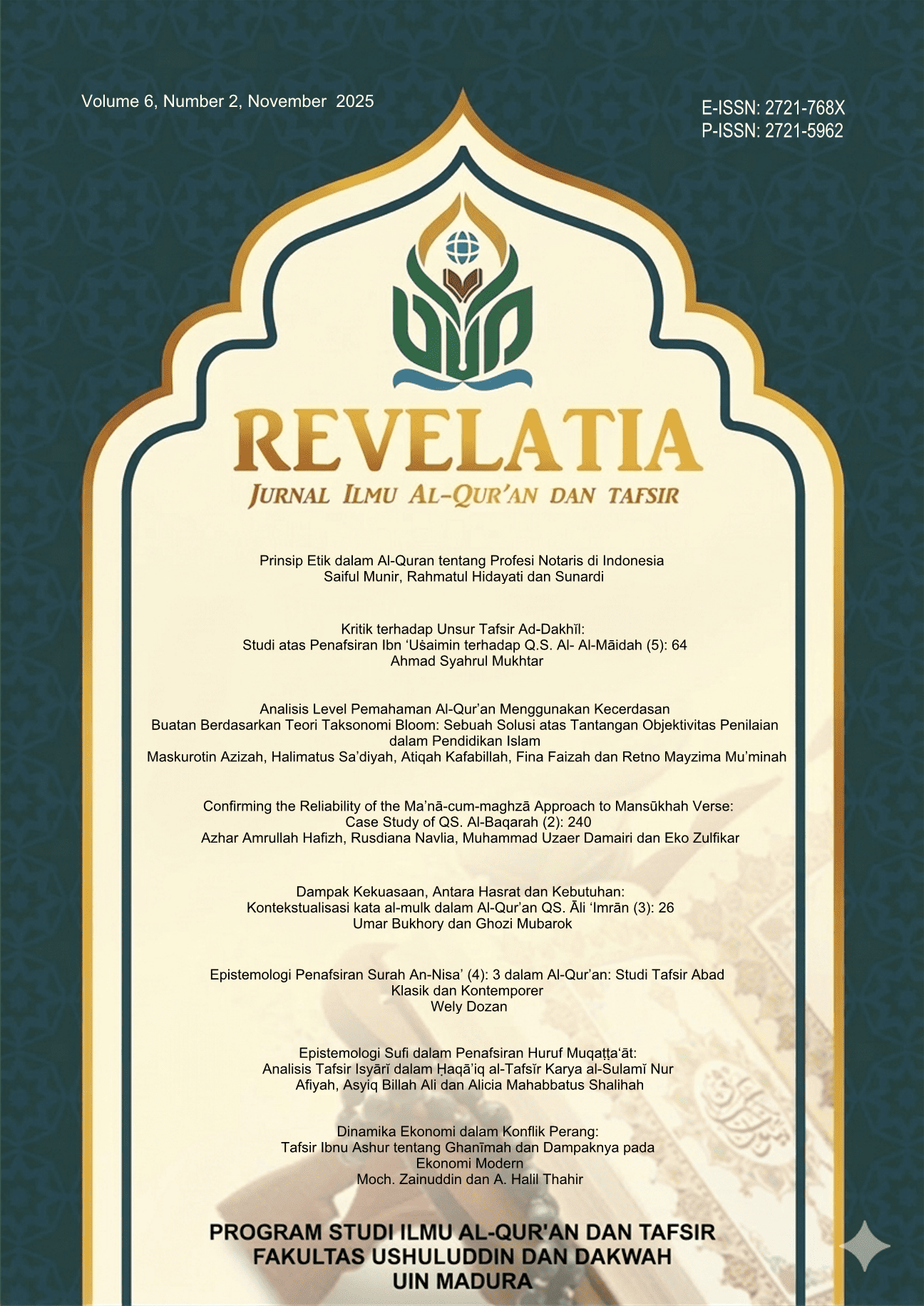
Dinamika Ekonomi dalam Konflik Perang:
Tafsir Ibnu Ashur tentang Ghanīmah dan Dampaknya pada Ekonomi Modern

 Abstract views: 157
 PDF downloads: 127
Keywords:
Ghanīmah, Ibnu Ashur, Wealth Redistribution, Post-Conflict RecoveryAbstract
This article explores the dynamics of ghanīmah, the wealth gained by Muslim armies from their enemies during warfare and its modern-day context, through the interpretive lens of Ibnu Ashur. It further explores how principles derived from ghanīmah can inform contemporary economic policy, address issues of inequality and foster social solidarity after conflict. By linking historical interpretations of ghanīmah to modern economic challenges, this study offers valuable insights into the potential of Islamic economic principles to contribute to a fairer global economy. This research is qualitative in nature with a descriptive-analytical approach, with the methodology used being library research, with primary sources being Ibnu Ashur's Tafsir al-Taḥrīr wa al-Tanwīr, and secondary sources including books, journals, scientific articles, and other relevant documents. Ghanīmah goes beyond mere material acquisition, serving as a mechanism for wealth redistribution aimed at restoring social and economic balance in the post-conflict context. Ibnu Ashur's analysis emphasizes the importance of justice and social responsibility, especially in protecting vulnerable groups such as orphans, the poor, and relatives of the Prophet Muhammad.
Downloads
References
Al-Mawardi, Abu al-Hasan. Al-AḥkÄm Al-Sulá¹Äniyyah. Beirut: DÄr al-Kutub al-‘Ilmiyyah, 1985.
Al-Tabari, Muhammad ibn Jarir. JÄmi‘ Al-BayÄn ‘an Ta’WÄ«l Ä€y Al-Qur’Ān. Vol. 10. Beirut: DÄr al-Fikr, 1995.
Arafah, Muh. “Sistem Keuangan Islam: Sebuah Telaah Teoritis.†Al-Kharaj Journal of Islamic Economic and Business 1, no. 1 (2019). https://doi.org/10.24256/kharaj.v1i1.801.
Auda, J. “MaqÄá¹£id Al-Sharī‘ah as Philosophy of Islamic Law: A Systems Approach.†The International Institute of Islamic Thought, 2008.
Auda, Jasser. Maqasid Al-Shariah as Philosophy of Islamic Law. London: IIIT, 2008.
Badi, Ahmad. “Paradigma Universal Dan Sistem Dunia Islam.†Tribakti Jurnal Pemikiran Keislaman 28, no. 1 (2017): 69–93. https://doi.org/10.33367/tribakti.v28i1.415.
Damiri, Muhammad U. “Konsep Iman Dalam Tafsir Al-TaḥrÄ«r Wa Al-TanwÄ«r Dan Tafsir Al-MÄ«zÄn.†Al-Manar Jurnal Kajian Alquran Dan Hadis 7, no. 2 (2021): 91–106. https://doi.org/10.35719/amn.v7i2.17.
Dianah, Fairuz, Mohammad H Sucipto, Abdul Djalal, and Mohammad Kurjum. “Altruisme Sebagai Benteng Pertahanan Keluarga Di Era 4.0 (Penafsiran Qs. Al-Hasyr Ayat 9 Perspektif Tafsir Al-Tanwir Wa Al-Tahrir Dan Al-Mizan Fi Al-Tafsir).†Kontemplasi Jurnal Ilmu-Ilmu Ushuluddin 8, no. 1 (2020): 229–63. https://doi.org/10.21274/kontem.2020.8.1.229-263.
Fajrina, Alifah N, Farhan R Putra, and Annisa S Sisillia. “Optimalisasi Pengelolaan Zakat: Implementasi Dan Implikasinya Dalam Perekonomian.†Journal of Islamic Economics and Finance Studies 1, no. 1 (2020): 100. https://doi.org/10.47700/jiefes.v1i1.1918.
Fardian, Muhammad I. “Karakteristik Demografi Dan Sosial-Ekonomi Penerima Manfaat Bantuan Pangan Rastra Dan BPNT Di Indonesia.†Jurnal Menara Ekonomi Penelitian Dan Kajian Ilmiah Bidang Ekonomi 8, no. 2 (2022): 136–51. https://doi.org/10.31869/me.v8i2.3397.
Fatchurrahman, M. “Relevansi Sistem Akuntansi Zakat Pada Pengembangan Berkelanjutan Lembaga Amil Zakat Di Indonesia.†Journal of Accounting and Finance 3, no. 1 (2024). https://doi.org/10.31942/jafin.v3i1.10853.
Haerunnisa, Haerunnisa. “Analisis Strukturalisme Terhadap Peran Katalisator Instrumen Keuangan Syariah Dalam Mendorong Pembangunan Berkelanjutan Dan Tanggung Jawab Sosial.†Al- Aqdu Journal of Islamic Economics Law 3, no. 2 (2023): 124. https://doi.org/10.30984/ajiel.v3i2.2853.
Haikal, Mohammad. “Peran Zakat Dalam Pengentasan Kemiskinan Masyarakat Di Aceh.†At-Tasyri Jurnal Ilmiah Prodi Muamalah 15, no. 2 (2023): 245–58. https://doi.org/10.47498/tasyri.v15i2.2362.
Hamidah, Siti N. “Implementasi Prinsip Konsumsi Pangan Islami (Studi Kasus Perbandingan Mahasiswa Ekonomi Syariah Dan Ekonomi Konvensional Di Bogor).†Karimahtauhid 3, no. 2 (2024): 1597–1607. https://doi.org/10.30997/karimahtauhid.v3i2.11871.
Harahap, M G. “Pengaruh Pendidikan Dan Literasi Keuangan Terhadap Perilaku Pengelolaan Keuangan Dalam Perspektif Ekonomi Syariah Di Kalangan Mahasiswa.†Cendekia 1, no. 3 (2024): 90–96. https://doi.org/10.62335/0c06wd63.
Hidayat, Muhammad S. “Pemahaman Umat Muslim Tentang Distribusi Kekayaan Dalam Ekonomi Islam: Studi Fenomenologi Tentang Pemerataan Ekonomi.†Gose 1, no. 2 (2023): 72–86. https://doi.org/10.52029/gose.v1i2.130.
Hocini, Mohamed A. “(خصائص المنهج القرآني ÙÙŠ بناء الإنسان والØضارة عند ابن عاشور من خلال التØرير والتنوير: (دراسة موضوعية the Characteristics of the Qur’anic Approach in Human and Civilization Building According to Ibn Achour in His Book Al-Tahrir Wa Tanwir: Thematic Study.†Ris 6, no. 2 (2019): 63–74. https://doi.org/10.22452/ris.vol6no2.5.
Hourani, Albert. Arabic Thought in the Liberal Age 1798–1939. Cambridge: Cambridge University Press, 1983.
ibn al-Hajjaj, Muslim. á¹¢aḥīḥ Muslim. KitÄb Al-JihÄd Wa Al-Siyar, BÄb TaḥrÄ«m Al-GhulÅ«l. Beirut: DÄr IḥyÄ’ al-TurÄth al-‘ArabÄ«, n.d.
Ibn Ashur, Muhammad al-Tahir. al-Taḥrīr wa al-Tanwīr. Vol. 1–30. Tunis: Dar al-Tunisiyyah li al-Nashr, 1984.
———. MaqÄá¹£id Al-Sharī‘ah Al-IslÄmiyyah. Tunis: al-DÄr al-TÅ«nisiyyah li al-Nashr, 1978.
K, Muh. Arif Rezki Ananda. “Akuntabilitas Dalam Birokrasi : Konsep Dan Implementasinya,†2023. https://doi.org/10.31219/osf.io/sbupa.
Kapojos, Peter, Joubert B Maramis, David P E Saerang, Lucky O H Dotulong, and Djurwati Soepeno. “Penerapan Sebuah Prinsip Dalam Laporan Keuangan Pemerintah : ‘Substansi Mengungguli Bentuk Formal’ Atau ‘Bentuk Formal Mengungguli Substansi’ ?†Jurnal Emba Jurnal Riset Ekonomi Manajemen Bisnis Dan Akuntansi 10, no. 2 (2022). https://doi.org/10.35794/emba.v10i2.41385.
Khamid, Abdul. “Islam Dan Migrasi Manusia Tafsir Al-Isra’ Ibnu Ashur : 70 Dan Yasin : 41.†Injas 1, no. 2 (2024): 144–71. https://doi.org/10.21111/injas.v1i2.11219.
Kharomen, Agus I. “Rekonstruksi Metode Penafsiran Ayat Mutasyâbih Lafẓî (Ayat Beredaksi Mirip) Berbasis Teori Munâsabah Al-Âyât.†Syariati 9, no. 2 (2023): 143–66. https://doi.org/10.32699/syariati.v9i2.5266.
Kuran, Timur. “The Economic Impact of Islamic Institutions.†Journal of Economic Perspectives 18, no. 3 (2004): 71–90.
Makki, Muhammad, and Waseem Iftikhar. “Transformation in Political Economy of Post-Conflict North Waziristan, Pakistan.†Journal of Asian and African Studies 57, no. 3 (2021): 497–513. https://doi.org/10.1177/00219096211021866.
Markavia, None R N, Fidzri N Febriani, and Fitri N Latifah. “Instrumen Kebijakan Fiskal Dalam Perspektif Ekonomi Islam.†Jihbiz Jurnal Ekonomi Keuangan Dan Perbankan Syariah 6, no. 2 (2022): 81–91. https://doi.org/10.33379/jihbiz.v6i2.1123.
Matveev, I. “Parallel Economies in Syria: A New Interpretation of the Notion.†Vostok Afro-Aziatskie Obshchestva Istoriia I Sovremennost, no. 1 (2023): 106. https://doi.org/10.31857/s086919080023782-7.
Meagher, Kristen, B Attal, and Preeti Patel. “Exploring the Role of Gender and Women in the Political Economy of Health in Armed Conflict: A Narrative Review.†Globalization and Health 17, no. 1 (2021). https://doi.org/10.1186/s12992-021-00738-9.
Muhamad, Muhamad, Hamdani Anwar, Iik A Mansurnoor, Ahmad M Rohim, Muchamad Yusron, and Dewi Khairani. “The Social Morphology of the City in the Qur’anic Perspective,†2022. https://doi.org/10.4108/eai.20-10-2021.2316332.
Mujib, Abdul. Metodologi Penelitian Untuk Studi Islam. Yogyakarta: UII Press, 2003.
Mustofa, Ahmad, and Nurus Syarifah. “The Meaning of Al-Hurriyyah in QS. Al-Baqarah [2]: 256 and QS. Al-Kahfi [18]: 29: A Maqâṣid Approach of Ibn Ashur.†Jurnal Ushuluddin 29, no. 1 (2021): 31. https://doi.org/10.24014/jush.v29i1.10661.
Mutmainah, Naeli, Hisam Ahyani, and Haris M Putra. “Tinjauan Hukum Ekonomi Syariah Tentang Pengembangan Kawasan Industri Pariwisata Halal Di Jawa Barat.†Al-Mawarid Jurnal Syariah Dan Hukum (Jsyh) 4, no. 1 (2022): 15–42. https://doi.org/10.20885/mawarid.vol4.iss1.art2.
Mutmainna, None, and Titik Sumarti. “Hubungan Tingkat Penerapan Prinsip Pengembangan Masyarakat Dengan Keberhasilan Program CSR Pt Pertamina.†Sodality Jurnal Sosiologi Pedesaan 2, no. 3 (2015). https://doi.org/10.22500/sodality.v2i3.9424.
Nawawi, Ruston. “Hukuman Pidana Mati Bagi Pelaku Tindak Pidana Pembunuhan Berencana Dalam Tafsir Ibn ’Asyur, Al-Tahrir Wa Al-Tanwir.†Al-Manar Jurnal Kajian Alquran Dan Hadis 9, no. 2 (2023): 145–57. https://doi.org/10.35719/amn.v9i2.32.
Ni’ami, Mohammad F, and Bustamin Bustamin. “MaqÄá¹£id Al-Syarī’ah Dalam Tinjauan Pemikiran Ibnu Ashur Dan Jasser Auda.†Juris (Jurnal Ilmiah Syariah) 20, no. 1 (2021): 91. https://doi.org/10.31958/juris.v20i1.3257.
Nurhayati, Nurhayati. “Artikel Ekonomi Syariah (Mekanisme Pasar Syariah Pada Hukum Kepemilikan Dalam Islam),†2021. https://doi.org/10.31219/osf.io/59zce.
Prastyo, Angga Teguh. Metode Penelitian Kualitatif Dalam Manajemen Pendidikan Islam. Malang: Literasi Nusantara, 2020.
Prayoga, Taufik I. “Potensi Sistem Hukum Ekonomi Syariah Dalam Pencegahan Korupsi Wujudkan Integritas Sektor Ekonomi.†Al- Aqdu Journal of Islamic Economics Law 3, no. 2 (2023): 135. https://doi.org/10.30984/ajiel.v3i2.2850.
Purnamawati, Ida Ayu Putu Santi. “Implementasi Konsep Ekonomi Sirkular Melalui Produksi Eco-Enzim Dalam Pengelolaan Sampah Sisa Makanan Di Desa Mambal.†Akuntansi Dan Humaniora Jurnal Pengabdian Masyarakat 3, no. 1 (2024): 11–18. https://doi.org/10.38142/ahjpm.v3i1.993.
Putriyani, Siti N U, and Ira N Qalbah. “Menyingkap Polemik Historisitas Tafsir Corak Lughawi.†Jurnal Iman Dan Spiritualitas 3, no. 1 (2023): 43–50. https://doi.org/10.15575/jis.v3i1.21802.
Qolbi, M Y S. “Kajian Q.S Al-Fajr Dalam Karya Ibnu Ashur Analisis Kriteria Penggunaan Kata Isti’arah Atau Shigat Selain Isti’arah.†Mustafid 2, no. 2 (2023): 14–30. https://doi.org/10.30984/mustafid.v2i2.583.
Rahman, Fazlur. Islam and Modernity: Transformation of an Intellectual Tradition. Chicago: University of Chicago Press, 1982.
Rahmatullah. “Studi Literatur : Peran Modal Sosial Dalam Pemberdayaan Masyarakat.†Jurnal Arajang 6, no. 1 (2023): 49–58. https://doi.org/10.31605/arajang.v6i1.2804.
Ratnasari, Aireni. “Teori Ekonomi Al-Ghazali Dan Adam Smith: Analisis Komparatif Terhadap Mekanisme Pasar.†IQTISHOD: Jurnal Pemikiran Dan Hukum Ekonomi Syariah 3, no. 2 (2024): 186–95. https://doi.org/10.69768/ji.v3i2.63.
RI, Kementerian Agama. Al-Qur’an Dan Terjemahnya. Jakarta: Lajnah Pentashihan Mushaf Al-Qur’an, 2019.
Rizqulloh, Ahmad Z. “Sumber Pendapatan Non Zakat Negara Dalam Islam Dan Perbandingannya Dengan Zaman Kontemporer Di Indonesia.†Iesbir 2, no. 2 (2023). https://doi.org/10.59580/iesbir.v2i2.6010.
Salma, None Shofya Humaira Siti, and Ayi Y Rusyana. “Kebijakan Ekonomi Khalifah Umar Bin Abdul Aziz Dan Relevansinya Terhadap Zakat Di Indonesia.†Jurnal Riset Ekonomi Syariah, 2023, 7–14. https://doi.org/10.29313/jres.v3i1.1705.
Sari, Pita. “MaʾnÄ AlfÄz SÅ«rah Luqman: DirÄsah TahlÄ«liyyah DilÄliyyah.†Jurnal Al-Maqayis 7, no. 2 (2021): 1. https://doi.org/10.18592/jams.v7i2.5038.
Sri. “Researching Waqf Forest Studies.†International Journal of Waqf 1, no. 1 (2021). https://doi.org/10.58968/ijf.v1i1.75.
Suardi, Didi. “Makna Kesejahteraan Dalam Sudut Pandang Ekonomi Islam.†Islamic Banking Jurnal Pemikiran Dan Pengembangan Perbankan Syariah 6, no. 2 (2021): 321–34. https://doi.org/10.36908/isbank.v6i2.180.
Sugiyono. Metodologi Penelitian Kualitatif. Bandung: Alfabeta, 2013.
Syariah, Komite Nasional Ekonomi dan Keuangan. Ekonomi Pembangunan Islam. Jakarta: KNEKS, 2021.
———. Sejarah Pemikiran Ekonomi Islam. Jakarta: KNEKS, 2021.
Syarigawir, Syarigawir. “Sistem Distribusi Kekayaan Negara Dalam Perspektif Islam.†Jurnal Adz-Dzahab Jurnal Ekonomi Dan Bisnis Islam 8, no. 1 (2023): 130–40. https://doi.org/10.47435/adz-dzahab.v8i1.1849.
Syukur, Musthafa. “Distribusi Perspektif Etika Ekonomi Islam.†Profit Jurnal Kajian Ekonomi Dan Perbankan Syariah 2, no. 2 (2018): 33–51. https://doi.org/10.33650/profit.v2i2.559.
Ulfa, Mufida U M. “Membaca Ulang Permasalahan Muḥallil Dalam Al-Baqarah [2]: 230, Sebuah Analisis Tafsir Maqasidi Al-Taḥrir Wa Al-Tanwir.†Alkauniyah 4, no. 1 (2023): 31–47. https://doi.org/10.56874/alkauniyah.v4i1.1296.
Umar, Wahyudi. “Pembagian Harta Bersama Dalam Perspektif Hukum Islam: Implementasi Moral Justice Dan Social Justice.†Jurnal Al-Ahkam Jurnal Hukum Pidana Islam 5, no. 1 (2023): 11–17. https://doi.org/10.47435/al-ahkam.v5i1.1724.
Wahid, Dr. A. “دلالة المÙهوم وأثرها ÙÙŠ تÙسير التØرير والتنوير للطاهر بن عاشور.†Al-Nasr, 2023, 1–16. https://doi.org/10.53762/alnasr.02.03.a01.
Watt, W Montgomery. Muhammad at Mecca. Oxford: Oxford University Press, 1953.
Wennmann, Achim. “The Political Economy of Violent Conflict Within States,†2019. https://doi.org/10.1093/acrefore/9780190846626.013.370.
Yudha, Muhammad A. “Uncovering the Human and Divine Aspect of Ridha in the Qur’an Through the Lens of Tafsir Al-Taḥrīr Wa Al-Tanwīr.†Jurnal Studi Ilmu-Ilmu Al-Qur an Dan Hadis 24, no. 1 (2023): 119–36. https://doi.org/10.14421/qh.v24i1.4291.
Yudistia, Nova S, Elva R Roem, and Ernita Arif. “Analisis Terhadap Pengelolaan Media Sosial KPP Pratama Padang Satu Untuk Meningkatkan Literasi Perpajakan Masyarakat Melalui Instagram.†Mukadimah Jurnal Pendidikan Sejarah Dan Ilmu-Ilmu Sosial 7, no. 1 (2023): 74–82. https://doi.org/10.30743/mkd.v7i1.6533.
Zeng, Hao. “The Economic Consequences of Political Factors: Energy, Finance, and Policies.†Advances in Economics Management and Political Sciences 22, no. 1 (2023): 388–96. https://doi.org/10.54254/2754-1169/22/20230335.
Downloads
Published
Issue
Section
License
The journal operates an Open Access policy under a Creative Commons Non-Commercial Share-Alike license. All articles published Open Access will be immediately and permanently free for everyone to read and download.
• Creative Commons Attribution-NonCommercial (CC-BY-NC)

Revelatia: Jurnal Ilmu al-Qur`an and Tafsir by http://ejournal.iainmadura.ac.id/index.php/revelatia is licensed under a Creative Commons Attribution-NonCommercial 4.0 International License.
Based on a work at http://ejournal.iainmadura.ac.id.