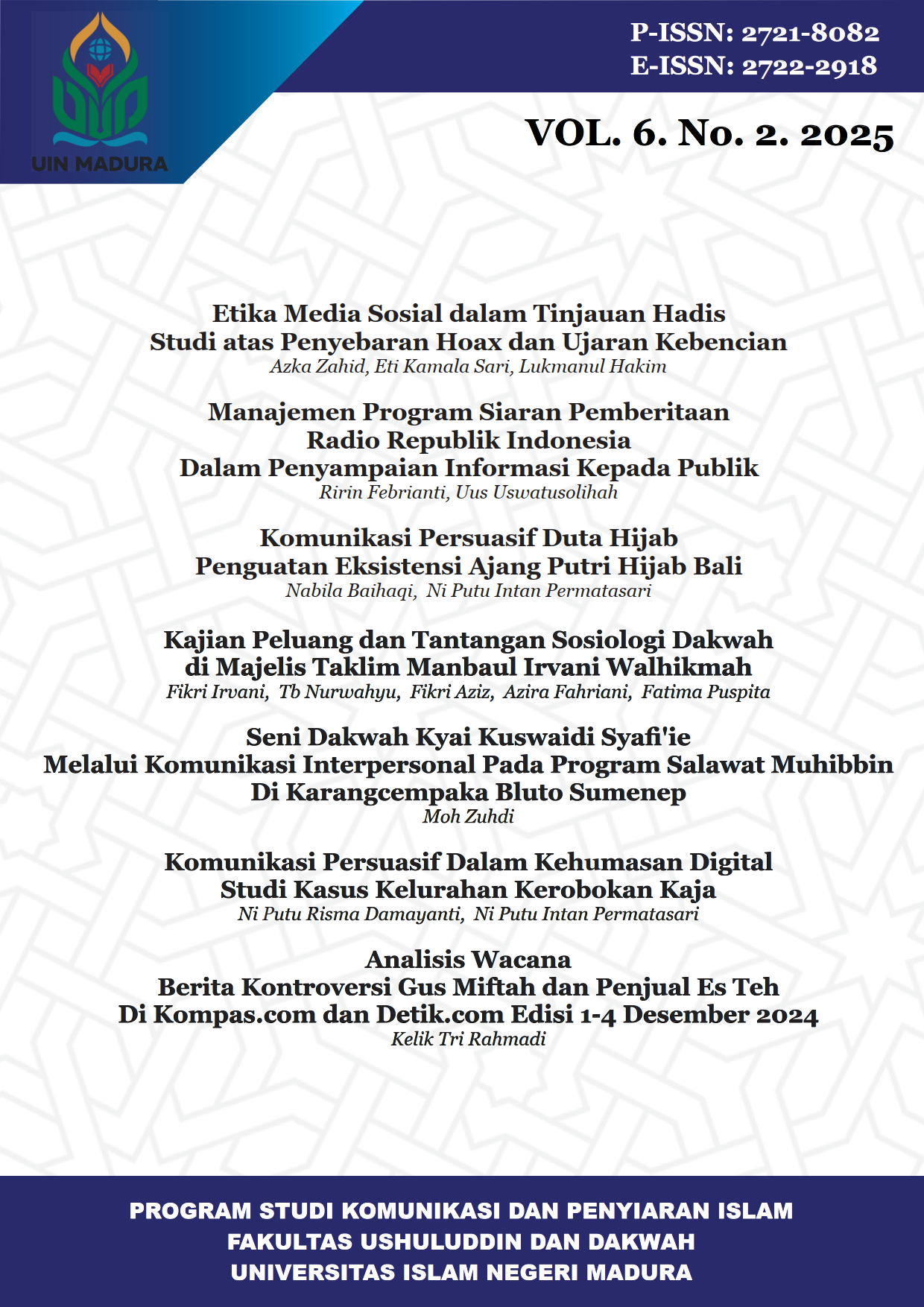
Komunikasi Persuasif dalam Kehumasan Digital
Studi Kasus Kelurahan Kerobokan Kaja

 Abstract views: 463
 PDF downloads: 484
Keywords:
Digital Public Relations, Persuasive Communication, Village BrandingAbstract
This study examines how Kelurahan Kerobokan Kaja builds its public image and connection with citizens through digital communication. Although social media is used to share public information, current practices remain predominantly one-way. The study aims to explain how persuasive communication is applied in the kelurahan’s digital public relations and how it contributes to shaping the local government’s image. A qualitative approach was employed through in-depth interviews, observation, and analysis of Instagram content. Thematic coding was used to identify forms of persuasion, message patterns, and government–public interaction dynamics. The findings show that informational content dominates, while persuasive elements and digital interaction remain limited. Message delivery relies heavily on peripheral cues such as visuals, but verbal messages rarely include dialogic invitations. Internal factors also constrain content variety and communication responsiveness. These conditions result in a digital image that is informative but not yet participatory or fully persuasive. The novelty of this study lies in its comprehensive mapping of how persuasion operates at the village administrative level through an in-depth analysis of local government digital PR practices. The study recommends strengthening the public relations role, diversifying content, and improving mechanisms for responsive digital dialogue.
Downloads
References
Andriani, R., dkk, “Peran Digital Marketing dalam Meningkatkan UMKM di Kelurahan Wonorejo Kota Surabaya.†Jurnal Pengabdian Kepada Masyarakat Nusantara 5, no. 4 (2024): 4498–4503. https://doi.org/10.55338/jpkmn.v5i4.2499.
Ardiansyah, R. D. (2024). Strategi Komunikasi Humas Setda Pemerintah Provinsi Jawa Tengah Melalui Penggunaan Media Sosial Instagram@ Humas. Jateng Dalam Publikasi Kinerja Pimpinan Daerah Pemerintah Provinsi Jawa Tengah (Doctoral Dissertation, Universitas Islam Sultan Agung Semarang).
Bueno, Diego Vinicio Orellana, and Pablo Javier Pérez Jara. “Marketing Applications in the Public Sector: A Systematic Review.†Journal of Business and Entrepreneurial Studies 8, no. 1 (2024): 26-40. https://doi.org/10.37956/jbes.v8i1.
Dominic, D., & Gisip, I. A. (2021). Effect Of Social Media Usage In Government Agencies’ Communication Effort. International Journal of Academic Research in Business and Social Sciences, 11(3), 1452-1467.
Grunig, J., & Hunt, T. (1984). Managing public relations.
Kana, B., Fattah, S., Musdah, E., & Alauddin Umar, A. “Study Open Government Maturity pada Social Media Pemerintah.†Jurnal Transformative 9, no. 2 (2023): 2023–2146. https://doi.org/10.21776/ub.transformative.2023.009.02.2.
Kurniawan, Agus Rahmat Dwi Saputro Rachman. “Strategic Public Relations for Strengthening Public Trust in Government.†Journal of Public Communication and Governance 12, no. 1 (2025): 45–59. https://doi.org/10.31002/jpcg.v12i1.4559.
Kusuma, A. S., Solichin, M. N., & Yuliana, M. E. (2024). Perancangan Aplikasi Duta Bangsa E-Kantin Sebagai Media Komunikasi Digital Berbasis Android. IDEALIS: InDonEsiA journaL Information System, 7(2), 128-135.
Mannayong, J., & Faisal, M. (2024). Transformasi digital dan partisipasi masyarakat: mewujudkan keterlibatan publik yang lebih aktif. Jurnal Administrasi Publik, 20(1), 53-75.
Pandiangan, C. U. A., & Ratnasari, E. “Humas Pemerintah dan Transparansi Informasi untuk Membangun Kepercayaan Publik.†Perspektif Komunikasi 7, no. 2 (2023): 155–168. https://doi.org/10.24853/pk.7.2.155-168.
Permatasari, A. N., Soelistiyowati, E., Suastami, I. G. A. P. P., & Johan, R. A. “Digital Public Relations: Trend and Required Skills.†Jurnal ASPIKOM 6, no. 2 (2021): 373–386. https://doi.org/10.24329/aspikom.v6i2.836.
Petty, R. E., & Cacioppo, J. T. (1986). Message elaboration versus peripheral cues. In Communication and persuasion: Central and peripheral routes to attitude change (pp. 141-172). New York, NY: Springer New York.
Putri, V. C. C., & Sonni, A. F. (2025). AI-Driven Personal Branding for Female Entrepreneurs: The Indonesian Hijabi Startup Ecosystem. Journalism and Media, 6(3), 131.
Sakir, S., Walinegoro, B. G., & Putri, S. A. G. “Pengembangan Potensi Kalurahan Banyurejo sebagai Desa Wisata Melalui Strategi Branding Media Sosial.†Jurnal Abdi Masyarakat Indonesia 2, no. 1 (2022): 341–348. https://doi.org/10.54082/jamsi.238.
Sofie, T., & Rachmawati, R. “The Role of Government in the Implementation of Smart Branding in Blora Regency.†Jurnal Bina Praja 16, no. 2 (2024): 261–278. https://doi.org/10.21787/jbp.16.2024.261.
Usman, E., & Pramezwary, A. (2023). Kolaborasi Mitra Co-branding Dalam Meningkatkan Brand Equity Wonderful Indonesia. Masyarakat Pariwisata: Journal of Community Services in Tourism, 1-7.
Wahyuni, P. D., Utami, S. W., & Tanjung, J. (2024). The impact of ESG disclosure on firm value relevance: moderating effect of competitive advantage. European Journal of Accounting, Auditing and Finance Research, 12(8), 19-33.
Wulandari, M. P., Wachid, I. B., Dahlia, S., Bahesa, S. B. P., & Arista, K. G. W. S. W. “Digital Public Relations in Indonesia in the Age of AI and Big Data: Theoretical and Practical Insights from a Five-Dimensional Framework.†Jurnal Komunikasi: Malaysian Journal of Communication 41, no. 2 (2025): 405–427. https://doi.org/10.17576/JKMJC-2025-4102-23.
Zahrah, F. “City Branding Dimensions, Strategies, and Obstacles: A Literature Review.†Jurnal Bina Praja 15, no. 1 (2023): 101–109. https://doi.org/10.21787/jbp.15.2023.101-109.
Zhai, Y., Yang, K., Chen, L., Lin, H., Yu, M., & Jin, R. (2023). Digital entrepreneurship: global maps and trends of research. Journal of Business & Industrial Marketing, 38(3), 637-655.