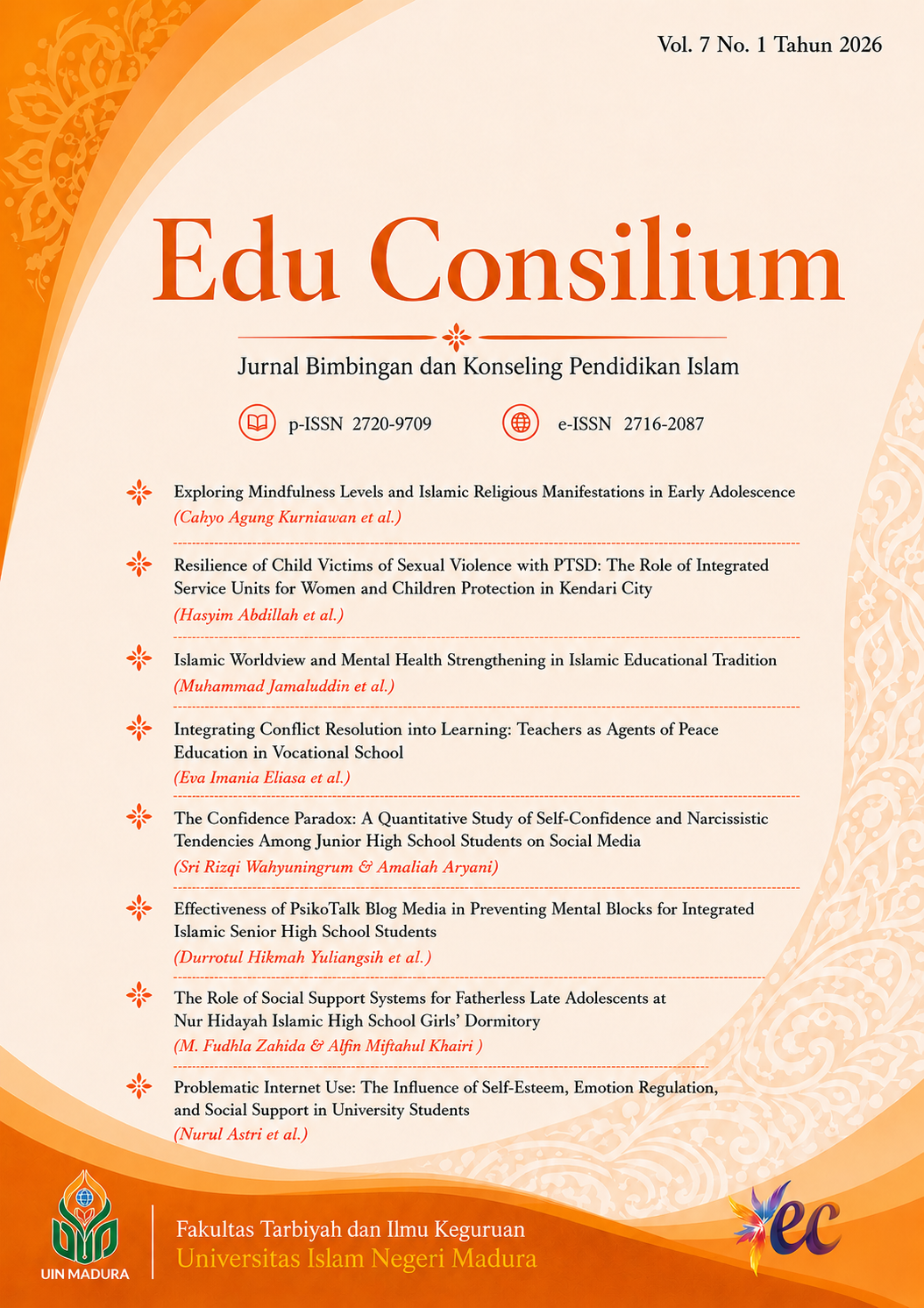
The Role of Social Support Systems for Fatherless Late Adolescents at Nur Hidayah Islamic High School Girls’ Dormitory

 Abstract views: 413
 PDF downloads: 590
Keywords:
fatherlessness, adolescent girls, descrptive, social supportAbstract
Fatherlessness significantly impacts the emotional, social, and psychological development of adolescents. This study explores the subjective experiences of adolescent girls living in dormitories who grew up without the presence or involvement of a father figure. Employing a qualitative descriptive approach, the research involved three participants selected through purposive sampling, with data collected via in-depth interviews, observation, and documentation. Data analysis followed the Miles and Huberman interactive model, consisting of data reduction, data display, and conclusion drawing. The results indicate that fatherlessness affects five key dimensions of involvement defined by Hart: economic provider, friend and playmate, caregiver, protector, and advocate. While the absence of a father leads to emotional emptiness, reduced security, and economic instability, participants demonstrated resilience by adapting through social support from mothers, peers, teachers, and dormitory supervisors. These figures served as alternative substitutes providing essential emotional warmth, guidance, and protection. Ultimately, this study emphasizes the necessity of a supportive boarding school environment and the vital role of educators and counselors in providing empathetic, spiritually-based assistance to adolescents navigating fatherlessness.
Downloads
References
Alisa, T. P., & Lestari, M. (2025). SMP Fatherless And Social Support on Juvenile Delinquency Among Junior High School Students. 8(8), 5602–5611. https://doi.org/10.56338/jks.v8i8.8416
Amato. (2010). : Linked references are available on JSTOR for this article Research on Divorce : Continuing Trends and New Developments. 72(3), 650–666. https://doi.org/10.1111/j.l741-3737.2010.00723.x
Ashari, Y. (2017). Fatherless in indonesia and its impact on children ’ s psychological development. 15(September), 16–17.
Astuti, M., Mutyati, M., Handayani, P., Rahmawati, R., Nor`aini, N., & Puspita, D. (2023). Peran Orang Tua Dalam Perkembangan Psikologi Anak. Jurnal Visionary : Penelitian Dan Pengembangan Dibidang Administrasi Pendidikan, 11(2), 120. https://doi.org/10.33394/vis.v11i2.9186
Berlian, T. C.; Chitam, M. N. (2023). The impact of fatherless on students’ learning achievement in primary school X Boyolali City. The Impact of College on Students, 1(1), 15–23. https://doi.org/10.4324/9780429339059
Bowlby, J. (1998). A SECURE BASE Parent-Child Attachment and Healthy Human Development.
Cahyani, A., Mandang, J. H., & Kaumbur, G. E. (2023). Subjective Well-Being Wanita Dewasa Awal Yang Mengalami Fatherless Di Manado. Psikopedia, 4(4), 207–212. https://doi.org/10.53682/pj.v4i4.7598
Creswell, John W.; Creswell, J. D. (2018). Research design: Qualitative, quantitative, and mixed methods approaches (5th ed.). Sage Publications. https://doi.org/10.4324/9780429469237-3
Culpin, I., Heuvelman, H., Rai, D., Pearson, R. M., Joinson, C., Heron, J., Evans, J., & Kwong, A. S. F. (2022a). Father absence and trajectories of offspring mental health across adolescence and young adulthood : Findings from a UK-birth cohort. Journal of Affective Disorders, 314(July), 150–159. https://doi.org/10.1016/j.jad.2022.07.016
Culpin, I., Heuvelman, H., Rai, D., Pearson, R. M., Joinson, C., Heron, J., Evans, J., & Kwong, A. S. F. (2022b). Father absence and trajectories of offspring mental health across adolescence and young adulthood: Findings from a UK-birth cohort. Journal of Affective Disorders, 314(January), 150–159. https://doi.org/10.1016/j.jad.2022.07.016
Culpin, I., Heuvelman, H., Rai, D., Pearson, R. M., Joinson, C., Heron, J., Evans, J., & Kwong, A. S. F. (2022c). Father absence and trajectories of offspring mental health across adolescence and young adulthood: Findings from a UK-birth cohort. Journal of Affective Disorders, 314(June), 150–159. https://doi.org/10.1016/j.jad.2022.07.016
Delgado, E., Serna, C., & Mart, I. (2022). Parental Attachment and Peer Relationships in Adolescence : A Systematic Review. https://doi.org/https://doi.org/10.3390/ijerph19031064
Fajarrini, A., & Umam, A. (2023). Dampak Fatherless Terhadap Karakter Anak Dalam Pendidikan Islam. Pendidikan Islam Anak Usia Dini, 3(1), 20–28.
Fiqrunnisa, A., Yuliadi, I., & Saniatuzzulfa, R. (2023). Hubungan Persepsi Keterlibatan Ayah Dalam Pengasuhan Dengan Pemilihan Pasangan Pada Perempuan Dewasa Awal Fatherless. Psyche: Jurnal Psikologi, 5(2), 152–167. https://doi.org/10.36269/psyche.v5i2.1396
Fitroh, S. (2014). Dampak Fatherless terhadap Prestasi Belajar Anak. Jurnal PG-PAUD Trunojoyo : Jurnal Pendidikan Dan Pembelajaran Anak Usia Dini, 1(2), 83–91. https://doi.org/https://doi.org/10.21107/pgpaudtrunojoyo.v1i2.3551
Hidayah, N., Ramli, A., & Tassia, F. (2023). Fatherless Effects On Individual Development; An Analysis Of Psychological Point Of View And Islamic Perspective. INNOVATIVE: Journal Of Social Science Research, 3, 754–766. https://j-innovative.org/index.php/Innovative/article/view/381
Imroatun, I., Nirmala, I., Juhri, J., & Muqdamien, B. (2024). Kajian Literatur Pengasuhan Anak Usia Dini Dalam Islam. As-Sibyan: Jurnal Pendidikan Anak Usia Dini, 5(1), 57–66. https://doi.org/10.32678/assibyan.v5i1.10562
Iskandar, A. S., Prasetyo, eli(s), & Mulya, H. C. (2023). Dinamika Self-Esteem pada pria emerging adulthood. Jurnal Experientia, 11(2), 173–197.
Miles, Matthew B.; Huberman, A. Michael; Saldaña, J. (2014). Qualitative data analysis: A methods sourcebook (T. R. Rohidi (ed.); 3rd ed.). UI-Press.
Nindhita, V., & Arisetya Pringgadani, E. (2023). Fenomena Fatherless dari Sudut Pandang Wellbeing Remaja (Sebuah Studi Fenomenologi). Cakrawala - Jurnal Humaniora, 23(2), 46–51. https://doi.org/10.31294/jc.v23i2.16983
Nurmalasari, F., Fitrayani, N., Paramitha, W. D., & Azzahra, F. (2024). Dampak Ketiadaan Peran Ayah (Fatherless) terhadap Pencapaian Akademik Remaja: Kajian Sistematik. Jurnal Psikologi, 1(4), 14. https://doi.org/10.47134/pjp.v1i4.2567
Putri Fajriyanti, A., & Saputri, D. (2024). The Indonesian Journal of Social Studies Fenomena Fatherless di Indonesia. Ijss, 7(1), 94–99. https://journal.unesa.ac.id/index.php/jpips/index
Rachmatika, P., & Rokib, M. (2025). Dampak Fatherless pada Tokoh Anak dalam Film Indonesia Dampak Fatherless Pada Tokoh Anak Dalam Film Indonesia: Studi Kasus Ketika Berhenti Di Sini, Lovely Man, Dan Bolehkah Sekali Saja Ku Menangis? Sapala, 12, 103–124.
Rahmasari, D. (2024). Strategi Coping Remaja Akhir yang Mengalami Fatherless dalam Hidupnya Coping Strategies Late Adolescents Who Experience Fatherless in Their. 11(01), 632–643.
Rajab, M. A., Toban, R. C., Yuliandini, A., & Ramadani, N. F. (2025). Relationship between Father Involvement in Parenting and Adolescent Mental Health. Genius Journal, 7(1), 136–147. https://doi.org/https://www.researchgate.net/deref/https%3A%2F%2Fdoi.org%2F10.56359%2Fgj.v7i1.900?_tp=eyJjb250ZXh0Ijp7ImZpcnN0UGFnZSI6InB1YmxpY2F0aW9uIiwicGFnZSI6InB1YmxpY2F0aW9uIn19
Ratnasari, S., & Suleeman, J. (2017). Perbedaan Regulasi Emosi Perempuan dan Laki-Laki di Perguruan Tinggi. Jurnal Psikologi Sosial, 15(1), 35–46. https://doi.org/10.7454/jps.2017.4
Santrock, J. W. (2007). Adolescene, eleventh edition (11th ed., p. 343). Penerbit Erlangga.
Santrock, J. W. (2012). Life-span development: Perkembangan masa hidup (13th ed.). Erlangga.
Sefanya, N., & Kurniawati, M. (2024). Korelasi Ketiadaan Peran Ayah dengan Regulasi Emosi pada Remaja Perempuan. Khatulistiwa: Jurnal Pendidikan Dan Sosial Humaniora, 4(4). https://doi.org/https://doi.org/10.55606/khatulistiwa.v4i4.9612
Selian, S. N., Psikologi, F., Muhammadiyah, U., & Aceh, B. (2025). Jurnal Ilmu Kesehatan dan Psikologi. 2(2), 67–74. https://doi.org/10.70115/harapan.v2i2.345
Simatupang, M. (2025). Layanan Konseling Individu Bagi Anak Fatherless di Panti Asuhan Darul Hikmah. 1(6), 2955–2964.
Sri luluk, Agus Ari Afandi, Eva Zuli Oktavia, M. N. (2025). Peran Ayah Dalam Pendampingan Remaja Di Kabupaten Bojonegoro. Jurnal Ilmiah Kesehatan, 6(1), 20–23. https://ejournal2.rajekwesi.ac.id/index.php/Kesehatan/article/view/8
Sugiyono. (2013). Metodologi Penelitian Kuantitatif, Kualitatif dan R & D.
Tata Arbiyana, S. K. (2024). Dinamika Fatherless terhadap Pengembangan Diri Remaja. 17(3), 287–294. https://doi.org/10.35134/jpsy165.v17i3.437
Utami, N. D., Rakhmat, C., & Zulkarnaen, R. H. (2023). The Impact of Fatherless in the Ability to Control Self-Emotions in Children. Jurnal Pendidikan Amartha, 2(2), 96–111. https://doi.org/10.57235/jpa.v2i2.638
Wibiharto, B. M. Y., Setiadi, R., & Widyaningsih, Y. (2021). Relationship Pattern of Fatherless Impacts to Internet Addiction, Suicidal Tendencies and Learning Difficulties for Students at SMAN ABC Jakarta. Society, 9(1), 264–276. https://doi.org/10.33019/society.v9i1.275
Zulfa, V., & Ana, N. (2025). The Effect of Adolescent Boys ’ Attachment to Fathers on Social and Emotional Development. 2(2), 56–68. https://doi.org/https://doi.org/10.63203/jitss.v2i2.132
Downloads
Published
How to Cite
Issue
Section
License
The journal operates an Open Access policy under a Creative Commons Non-Commercial 4.0 International license. Authors who publish with this journal agree to the following terms:
- Authors retain copyright and grant the journal right of first publication with the work simultaneously licensed under a
 Commons Attribution-NonCommercial 4.0 International License
that allows others to share — copy and redistribute the material in any medium or format, and adapt — remix, transform, and build upon the material.
- Authors are able to enter into separate, additional contractual arrangements for the non-exclusive distribution of the journal's published version of the work (e.g., post it to an institutional repository or publish it in a book), with an acknowledgement of its initial publication in this journal.
- Authors are permitted and encouraged to post their work online (e.g., in institutional repositories or on their website) prior to and during the submission process, as it can lead to productive exchanges, as well as earlier and greater citation of published work (see The Effect of Open Access).