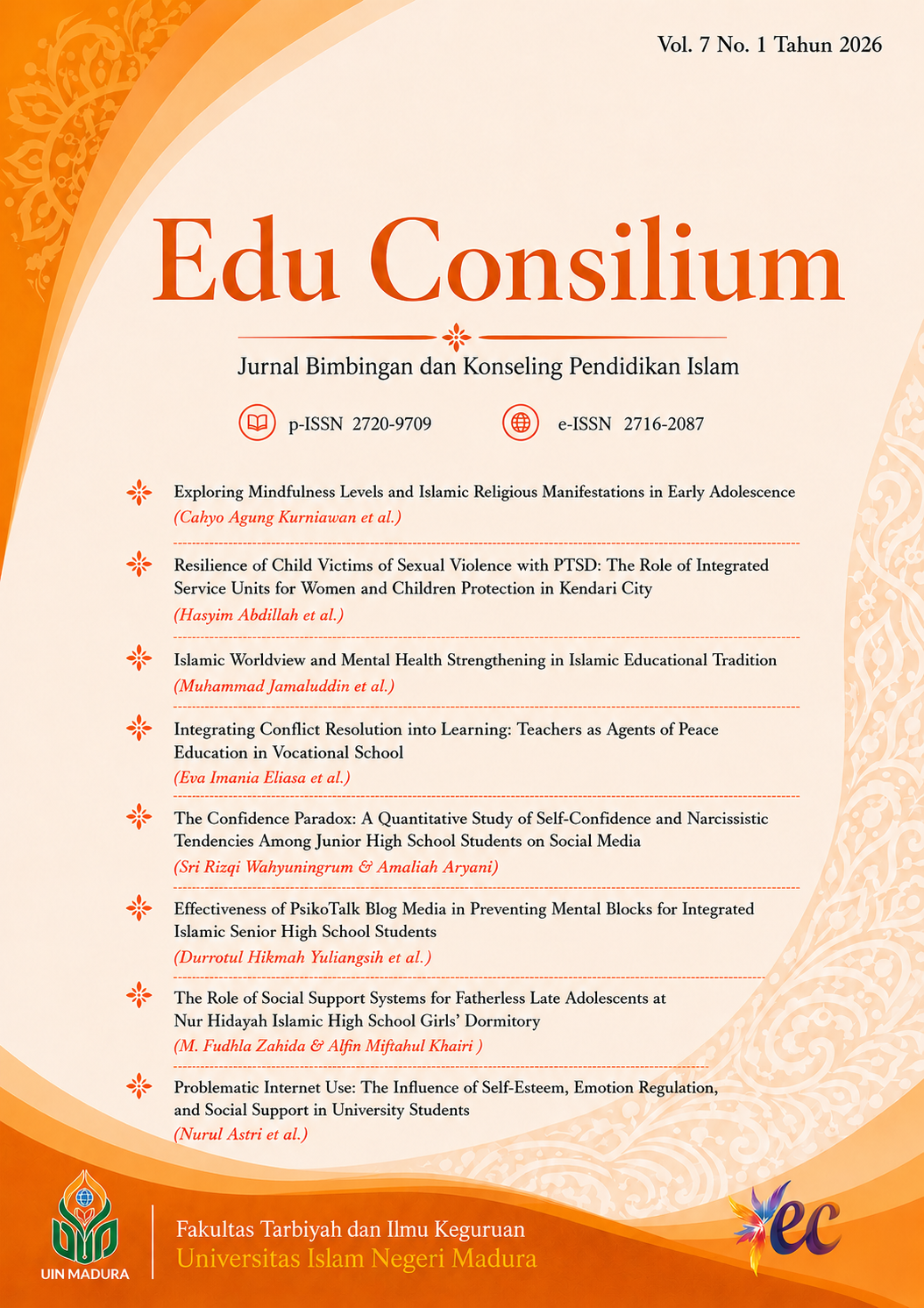
The Confidence Paradox: A Quantitative Study of Self-Confidence and Narcissistic Tendencies Among Junior High School Students on Social Media

 Abstract views: 240
 PDF downloads: 326
Keywords:
Kepercayaan Diri, Narsistik Digital, Regresi LinierAbstract
Self-confidence and narcissistic tendencies have a fairly complex relationship. Individuals with narcissistic traits often appear very confident, but in fact, they have a strong drive for admiration and social recognition. The phenomenon of increasing adolescent activity on social media, which often shows narcissistic behavior, such as showing off and seeking validation from others, is similar to what happened to students at SMPN 2 Pamekasan. This study used a comparative causal quantitative approach with simple linear regression. The instruments used were a questionnaire scale of self-confidence (X) and digital narcissistic tendencies (Y). The results showed a positive and significant influence of self-confidence on narcissistic tendencies on social media, with a significance value of 0,000 <0,05, and a magnitude of 20.%. This means that the higher a student's self-confidence, the higher the narcissistic tendencies shown on social media. This study concludes that self-confidence plays a role in shaping students' narcissistic tendencies in social media. Therefore, it is important for schools, guidance counselors, and parents to guide students to have healthy and moderate self-confidence without using it as a basis for seeking excessive validation in cyberspace.
Downloads
References
Adawiyah, D. P. R. (2020). Pengaruh Penggunaan Aplikasi TikTok Terhadap Kepercayaan Diri Remaja di Kabupaten Sampang. Jurnal Komunikasi, 14(2), 135–148. https://doi.org/10.21107/ilkom.v14i2.7504
Alamin, Z., & Missouri, R. (2023). Penggunaan Media Sosial Sebagai Sarana Pendukung Pembelajaran Agama Islam di Era Digital. Tajdid: Jurnal Pemikiran Keislaman Dan Kemanusiaan, 7(1), 84–91. https://doi.org/10.52266/tadjid.v7i1.1769
Aurilio, F. L., Isolawati, I., Nurshafa, J. N., & Khairina, N. (2023). Analisis Dampak Perilaku Narsistik pada Kesehatan Mental Remaja. Flourishing Journal, 3(11), 478–485. https://doi.org/10.17977/um070v3i112023p478-485
Lauster. (n.d.). Skala Kepercayaan Diri Lauster. Scribd. Retrieved January 8, 2026, from https://id.scribd.com/document/476833677/Self-Confidence
Liang, S. (2021). Kecenderungan Perilaku Narsistik Dengan Intensitas Penggunaan Media Sosial Instagram. EXPERIENTIA : Jurnal Psikologi Indonesia, 9(1), 32–41. https://doi.org/10.33508/exp.v9i1.2881
Muliani, N. (2021). Pencegahan Kecenderungan Narsistik Melalui Kontrol Diri. Jurnal Al-Irsyad: Jurnal Bimbingan Konseling Islam, 3(2), 311–324. https://doi.org/10.24952/bki.v3i2.4668
Pratama, M., & Novita, E. (2022). Hubungan Antara Kepercayaan Diri (Self Confidence) Dengan Penyesuaian Sosial (Social Adjustment) Pada Remaja Kelas X Di SMA Swasta Nurul Amaliyah Tanjung Morawa. Tabularasa: Jurnal Ilmiah Magister Psikologi, 4(2), 121–128. https://doi.org/10.31289/tabularasa.v4i2.1346
Putri, A. P., & Wahyuningrum, S. R. (2021). Efektivitas Bimbingan Kelompok untuk Meningkatkan Keterampilan Komunikasi Siswa SMK dengan Teknik Assertive Training. Edu Consilium : Jurnal Bimbingan Dan Konseling Pendidikan Islam, 2(1), Article 1. https://doi.org/10.19105/ec.v2i1.4268
Raharjo, A. P., Amalia, A. H., Aulia, S. Z., Prabaningtyas, F. D., Evitananda, S., Zhafirah, A. A., & Putri, I. N. E. H. (2024). Effectiveness of Community-Based Psychosocial Crisis Intervention in Elderly and Future Research Directions: Scoping Review. Buletin Psikologi, 32(1), 56–67. https://doi.org/10.22146/buletinpsikologi.94751
Rahmayanti, K., Hamdi, N., Awwaliyah, A., Putri, J. R., & Iqlima, A. (2024). Pentingnya Memahami Diri Sendiri (Self-Understanding) dalam Pengembangan Diri. Jurnal Pengabdian Kepada Masyarakat Bidang Kesehatan, 6(2), 130–133.
Rennita, S. (2023). Hubungan Antara Kepercayaan Diri dan Kecenderungan Narsistik Pada Remaja Pengguna Instagram [UIN Raden Intan Lampung]. https://repository.radenintan.ac.id/29851/
Ronningstam, E. (2011). Narcissistic personality disorder in DSM-V--in support of retaining a significant diagnosis. Journal of Personality Disorders, 25(2), 248–259. https://doi.org/10.1521/pedi.2011.25.2.248
Sabiq, Z. (2016). Kecerdasan Emosional, Spiritual dan Perilaku Prososial Santri Sabilul Ihsan Pamekasan Madura. KABILAH : Journal of Social Community, 1(1), 121–138.
Sakinah, U., Zatrahadi, M. F., & Darmawati, D. (2019). Fenomena Narsistik di Media Sosial Sebagai Bentuk Pengakuan Diri. Al-Ittizaan: Jurnal Bimbingan Konseling Islam, 2(1), 34–43. https://doi.org/10.24014/0.8710544
Santoso, S., & Nurwiyati, E. (2023). Menghadapi Gangguan Kepribadian Narsistik Sebagai Epidemi Modern: Berobat Atau Bertobat? Jurnal Gamaliel : Teologi Praktika, 5(2), 79–94. https://doi.org/10.38052/gamaliel.v5i2.185
Sungkar, Y., & Partini, P. (2016). Sense Of Humor Sebagai Langkah Meningkatkan Kepercayaan Diri Guru PPL dalam Proses Belajar Mengajar. Indigenous: Jurnal Ilmiah Psikologi, 13(1). https://doi.org/10.23917/indigenous.v13i1.2327
Twenge, J. M., & Campbell, W. K. (2010). The Narcissism Epidemic: Living in the Age of Entitlement. Simon and Schuster.
Ulfah, A. K., Razali, R., Rahman, H., Ghofur, A., Bukhory, U., Wahyuningrum, S. R., Yusup, M., Inderawati, R., & Muqoddam, F. (2022). Ragam Analisis Data Penelitian (Sastra, Riset dan Pengembangan). IAIN Madura Press.
Wahyuningrum, S. R. (2020). Statistika Pendidikan (Konsep Data dan Peluang). Jakad Media Publishing. https://books.google.co.id/books?hl=en&lr=&id=41HWDwAAQBAJ&oi=fnd&pg=PP1&dq=info:FNeOnq_Btg8J:scholar.google.com&ots=_VOQkRdFBi&sig=iEnr5QYZKh9a3k-iOwgtoNkQWZw&redir_esc=y#v=onepage&q&f=false
Wahyuningrum, S. R., & Fransiska, M. (2023). Pengaruh Efikasi Diri dan Kemandirian terhadap Pilihan Karier Siswa. Edu Consilium : Jurnal Bimbingan dan Konseling Pendidikan Islam, 4(1), Article 1. https://doi.org/10.19105/ec.v4i1.7713
Downloads
Published
How to Cite
Issue
Section
License
The journal operates an Open Access policy under a Creative Commons Non-Commercial 4.0 International license. Authors who publish with this journal agree to the following terms:
- Authors retain copyright and grant the journal right of first publication with the work simultaneously licensed under a
 Commons Attribution-NonCommercial 4.0 International License
that allows others to share — copy and redistribute the material in any medium or format, and adapt — remix, transform, and build upon the material.
- Authors are able to enter into separate, additional contractual arrangements for the non-exclusive distribution of the journal's published version of the work (e.g., post it to an institutional repository or publish it in a book), with an acknowledgement of its initial publication in this journal.
- Authors are permitted and encouraged to post their work online (e.g., in institutional repositories or on their website) prior to and during the submission process, as it can lead to productive exchanges, as well as earlier and greater citation of published work (see The Effect of Open Access).