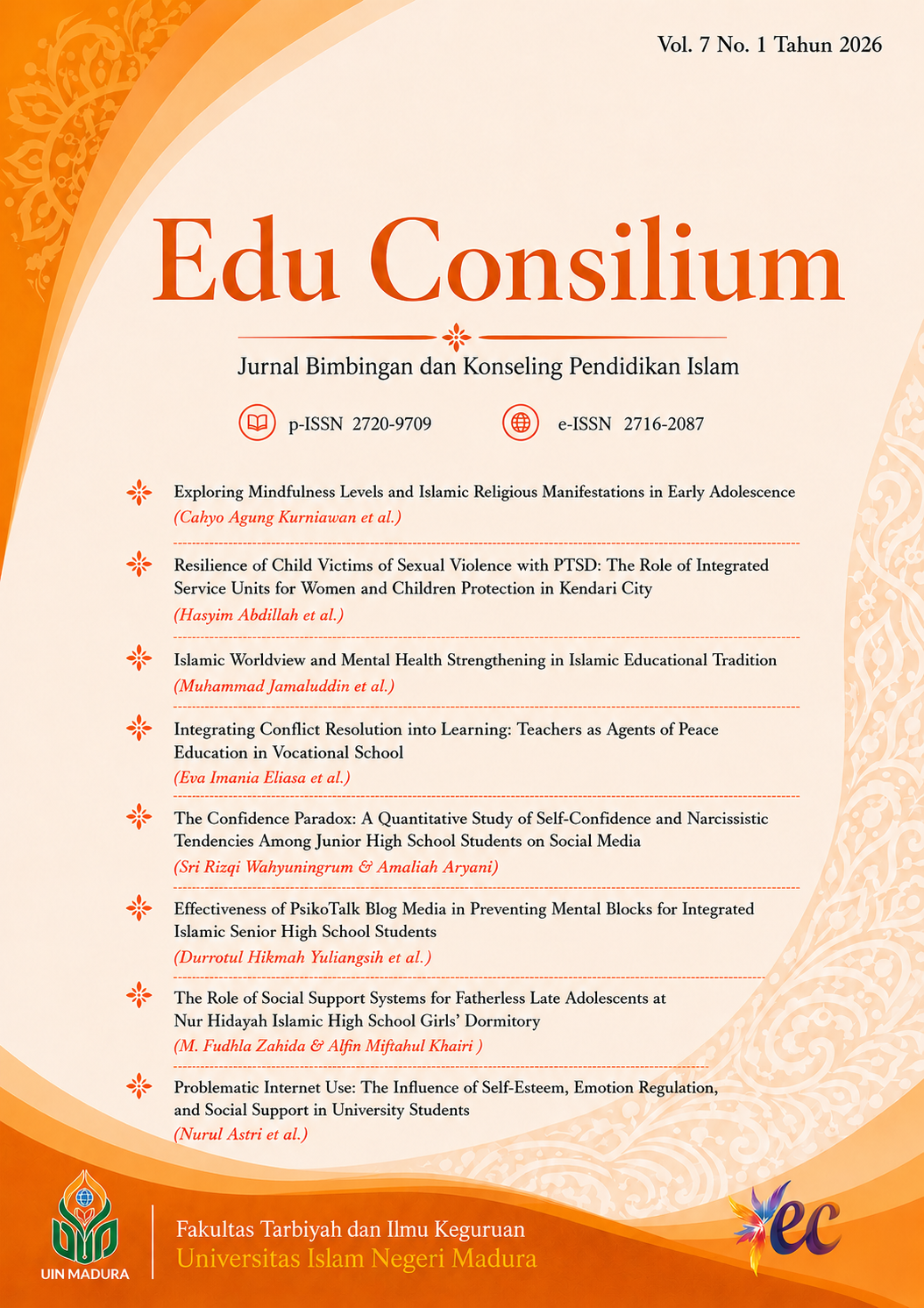
Effectiveness of PsikoTalk Blog Media in Preventing Mental Blocks for Islamic Senior High School Students

 Abstract views: 202
 PDF downloads: 207
Keywords:
Digital Literacy, mental block, psikoTalk blogAbstract
This study aims to examine the effectiveness of the PsikoTalk blog in preventing mental blocks among students at Assalaam Integrated Islamic Senior High School, Pekalongan. The scope of this study includes the process of implementing blog media as an educational tool that emphasizes students’ psychological and reflective aspects in the context of boarding education. The study used a quantitative approach with a one-group pretest-posttest design. The research subjects were 25 students selected purposively. Data collection was carried out using a mental block scale questionnaire, and the data were analyzed using a Wilcoxon Signed Rank Test in SPSS. The analysis results showed a significant difference between the pretest and posttest scores (p < 0.05) with an effect size value of 0.797 which is categorized as a large effect. These findings indicate that using the PsikoTalk blog effectively reduces mental blocks among students and increases motivation and readiness to learn. Thus, the PsikoTalk blog serves as a digital learning innovation that not only strengthens cognitive skills but also supports students’ mental health. The results of this study are expected to serve as a reference for educators in developing technology-based learning media to strengthen students’ character and psychological well-being.
Downloads
References
Aini, K., Mariatun, I. L., & Sholeh, Y. (2023). Pengembangan Media Pembelajaran Berbasis Blog untuk Meningkatkan Motivasi Belajar X SMAN 1 Tanjung Bumi. Jurnal Pendidikan Ekonomi (JURKAMI), 8(2), 423–432. https://doi.org/10.31932/jpe.v8i2.2543
Arizona, Andika Ari Saputra, Fattah Hanurawan, Nur Hidayah, Muslihati, Mei Sarri, & Nurkumalasari. (2025). The Effect of Zikir Therapy to Reduce Social Anxiety of Students in Islamic Boarding School. Edu Consilium : Jurnal Bimbingan Dan Konseling Pendidikan Islam, 6(2), 1–11. https://doi.org/10.19105/ec.v6i2.18416
Astinah, Nurul Fajriani, Nasriani, & Dupriani. (2025). School Counselor Self-Advocacy: The Role of Local Cultural Values of Sipakatau, Sipakalebbi, and Sipakainge. Edu Consilium : Jurnal Bimbingan Dan Konseling Pendidikan Islam, 6(2), 12–25. https://doi.org/10.19105/ec.v6i2.19650
Campillo-Ferrer, J. M., Miralles-MartÃnez, P., & Sánchez-Ibáñez, R. (2021). The effectiveness of using edublogs as an instructional and motivating tool in the context of higher education. Humanities and Social Sciences Communications, 8(1). https://doi.org/10.1057/s41599-021-00859-x
Fadilah, N., Akmal, A., & Ariffin, K. (2020). Developing Students’ Communicative Writing Skills through Blogging. International Journal of Modern Languages And Applied Linguistics, 4(3). https://doi.org/10.24191/ijmal.v4i3.9107
Istiqomah, A. (2023). Analisis Perilaku Mental Block Siswa Di SMKN 2 Kota Madiun. Seminar Nasional Sosial Sains, Pendidikan, Humaniora (Senassdra), 2(1), 173–178.
Lestari, W., & Sari, S. P. (2025). Penerapan Media Video untuk Meningkatkan Kemampuan Kognitif Siswa di Sanggar Bimbingan kepong, Kuala Lumpur Malaysia. Jurnal Pendidikan Dan Pembelajaran Indonesia (JPPI), 5(2), 1096–1106. https://doi.org/10.53299/jppi.v5i2.1447
Lie, N., Suherman, H., Utomo, B., Partono, P., & Kabri, K. (2025). Mindfulness dan Kecerdasan Emosional sebagai Prediktor Self-Efficacy Siswa SMA: Pendekatan Psikologis dan Pendidikan. Jurnal Ilmiah Religiosity Entity Humanity (JIREH), 7(1), 384–396. https://doi.org/10.37364/jireh.v7i1.353
Millatina, N., Aziz, R., & Zuhriyah, I. A. (2025). Adversity Quotient, Religious Spirituality, and Career Adaptability: An Empirical Study on Masters Students of Islamic Religious Education. Edu Consilium : Jurnal Bimbingan Dan Konseling Pendidikan Islam, 6(2), 23–36. https://doi.org/10.19105/ec.v6i2.19831
Mutmainah, K., & Jamaluddin, M. (2020). Implementasi Konseling Ratioal Emotif Behavior Therapy Untuk Mengubah Mindset Negatif Siswa. Edu Consilium: Jurnal Bimbingan dan Konseling Pendidikan Islam, 1(2), 69–81. https://doi.org/10.19105/ec.v1i2.3779
Nalyarti, C. (2025). Perbedaan Tingkat Stres Antara Siswa Sekolah Asrama dan Siswa Sekolah Biasa di Pondok Pesantren Darul Muttaqin Sariek Sarumpun Batu Taba dan di SMAN 1 Rambatan. Universitas Islam Negeri Mahmud Yunus Batusangkar.
Nasir, M. (2025). Strategi Penggunaan Media Digital untuk Kesehatan Mental Pelajar di SMA Al-Khairiyah Cilegon. 02(03), 236–246.
Pardede, R. M., & Aktar, S. (2022). Efektifitas Program Pendidikan Boarding School Terhadap Pembentukan Karakter siswa (Studi di SMA Swasta Advent Pematangsiantar). EduTech: Jurnal Ilmu Pendidikan Dan Ilmu Sosial, 8(1), 71–76. https://doi.org/10.30596/edutech.v8i1.9609
Rahman, S., Munawar, W., & Berman, E. T. (2016). Pemanfaatan Media Pembelajaran Berbasis Website Pada Proses Pembelajaran Produktif Di Smk. Journal of Mechanical Engineering Education, 1(1), 137. https://doi.org/10.17509/jmee.v1i1.3746
Ryan, R. M., & Deci, E. L. (2024). Self-determination theory (A. C. Michalos, Ed.). Springer International Publishing.
Badan Pusat Statistik. (2024). Statistik pendidikan, volume 13. Badan Pusat Statistik. https://doi.org/10.22146/mgi.34838
Wibowo, B. R., Sudana, D., & Wirza, Y. (2020). Pemanfaatan Webinar Sebagai Media dalam Pembelajaran Kemampuan Berbicara untuk Pembelajar Dewasa di Indonesia. Jurnal Penelitian Pendidikan, 20(3), 417–431. https://doi.org/10.17509/jpp.v20i3.30219
Xing, J., Leng, L., & Ho, R. T. H. (2021). Boarding school attendance and mental health among Chinese adolescents: The potential role of alienation from parents. Children and Youth Services Review, 127. https://doi.org/10.1016/j.childyouth.2021.106074
Yani, S., & Siwi, M. (2020). Analisis Penggunaan Media Sosial Dan Sumber Belajar Digital Dalam Pembelajaran Bagi Siswa Digital Native Di SMAN 2 Painan. Jurnal Pendidikan Ekonomi, 13(1), 1–7. https://doi.org/10.17977/um014v13i12020p001
Downloads
Published
How to Cite
Issue
Section
License
The journal operates an Open Access policy under a Creative Commons Non-Commercial 4.0 International license. Authors who publish with this journal agree to the following terms:
- Authors retain copyright and grant the journal right of first publication with the work simultaneously licensed under a
 Commons Attribution-NonCommercial 4.0 International License
that allows others to share — copy and redistribute the material in any medium or format, and adapt — remix, transform, and build upon the material.
- Authors are able to enter into separate, additional contractual arrangements for the non-exclusive distribution of the journal's published version of the work (e.g., post it to an institutional repository or publish it in a book), with an acknowledgement of its initial publication in this journal.
- Authors are permitted and encouraged to post their work online (e.g., in institutional repositories or on their website) prior to and during the submission process, as it can lead to productive exchanges, as well as earlier and greater citation of published work (see The Effect of Open Access).